
David of Thessalonica
Our Venerable Father David the Dendrite, the Wonderworker of Thessalonica
Venerable · Wonderworker · b. c. 450, in Upper Mesopotamia — d. c. 540, at sea off Emvolos on the return from Constantinople
Commemorated 26 June — Repose on the voyage home from the imperial embassy, 16 September — Return of the relics from Italy to Thessalonica, 1978
David the Dendrite is the most beloved of the ascetics of Thessalonica and one of the best documented of the tree-dwelling hermits of the Christian East. A Mesopotamian by birth who came west as a young monk to the monastery of the holy martyrs Theodore and Mercurius outside the city walls, he refused to be made abbot and instead climbed into an almond tree beside the church, where he lived exposed to sun, frost and rain for three years until an angel bade him come down. From the cell he then occupied he healed, exorcised, counselled and prophesied for decades. In extreme old age he was sent as the city's ambassador to the emperor Justinian at Constantinople to plead that Thessalonica not be stripped of the prefecture of Illyricum; there he carried live coals and incense in his bare hands before the emperor and the senate without being burned, and won his city's cause. He died on the voyage home, about 540, within sight of the Thessalonian shore, having accomplished exactly the "one last work of love" the angel had foretold.

Origins and early life
David was born about the year 450 in Upper Mesopotamia, in the eastern reaches of the Syriac-speaking world where the extreme forms of solitary ascesis — the stylites, the grazers, the dendrites — had their homeland. Nothing is preserved of his family. As a young man he travelled west in the company of a monk named Adolas, and about 465–470 the two came to Thessalonica, the second city of the empire and the seat of the imperial prefecture of Illyricum.
There he was received into the monastery of the holy martyrs Theodore and Mercurius, known locally as the monastery of the Koukouliatoi — "of the cowl-wearers," from the distinctive hood worn by its monks, which the iconography of David preserves. The monastery stood just outside the northern wall of the city, in the quarter that later took his own name. David gave himself to obedience, fasting, and the recitation of the Psalter with such constancy that the fathers marked him out at once.
Ascetic struggle: the almond tree
When the abbot of the monastery died the brethren chose David unanimously to succeed him. He would not take the office. Instead — and this is the act that made him famous throughout the East — he climbed into an almond tree that grew to the right of the monastery church, and settled himself among its branches. There he remained for three years, without shelter of any kind, praying day and night, keeping a rule of fasting, and enduring what the sources describe simply as the winter's bitter cold and the summer's burning heat, with the rains and the winds of the Thermaic Gulf in between.
The choice was not eccentricity but a recognised form of the ascetic life. The dendrites (from δένδρον, "tree") stood beside the stylites as one of the accepted extreme disciplines of the fifth and sixth centuries: as the pillar lifted the ascetic out of the world without removing him from the sight of the city, so did the tree. David's tree stood inside a working monastery on a busy road, and his ascesis was therefore public, a sermon preached by endurance.
At the end of three years an angel of the Lord appeared to him and told him that his prayer had been heard, that he was to come down and to live henceforth in a cell, and that before his death God would give him one further work of love to accomplish. David descended and, in the presence of the Archbishop Dorotheos of Thessalonica, was enclosed in a cell built for him a short distance beyond the city wall.
Wonderworking and spiritual fatherhood
In his cell David became what the tree had prepared him to be. The sources — and the tradition after them — credit him with the healing of the sick, the expulsion of demons, and above all with the gift of counsel: clergy, monastics, the city's officials and its ordinary people came to the little window of his enclosure for a word. He is remembered as gentle where the extreme ascetics were often severe, and as a man who never used his reputation to rebuke or to dominate. He lived so long in this seclusion that when at last he was made to leave it he had not seen the open sunlight for many years; his hair had grown to his waist and his beard, in the traditional description, to his feet.
Among the wonders attributed to him the best remembered is the one that belongs to his embassy, below; but the narrative of his life also credits him with the healing of a boy tormented by an unclean spirit and with foreknowledge of the day and manner of his own repose.
The embassy to Justinian
The "further work of love" came near the end of his life. In the sixth century the civil prefecture of Illyricum had its seat at Thessalonica; the emperor Justinian I, born in the Balkan interior, resolved to raise his birthplace into a new city, Justiniana Prima, and to move the prefecture — and with it the ecclesiastical primacy of the province — there. For Thessalonica this meant demotion in rank, in revenue, and in the protection of the imperial administration.
Archbishop Dorotheos had died; his successor, Aristeides, judged that no ordinary delegation would move the emperor, and pressed David to go himself to Constantinople. David, by now a very old man, consented, foretelling that this was the last thing required of him and that he would not enter the imperial City a second time. He set out with two disciples, Theodore and Demetrios.
His arrival in the capital caused a sensation; the Empress Theodora received him with great reverence, and word of the tree-dweller of Thessalonica ran through the City before the emperor would see him. When at last he was brought into the presence of Justinian and the senate, David asked for a censer, and taking live coals and incense into his bare hands, censed the emperor and the whole assembly, praying and blessing — the tradition says for something near an hour — and his hands were not burned. The emperor rose from his throne. Whatever the political calculation may separately have been, the sources agree in the outcome: Justinian granted the petition of Thessalonica, and the city kept the prefecture.
Repose
David took ship for home. He had foretold that he would not see his own monastery again, and so it fell out: the ship had reached Thermes, at the place called Emvolos on the Thermaic Gulf — the sources reckon it some 126 stadia from his cell — when he gave up his spirit, about the year 540. His body was carried the rest of the way, met by the archbishop and by the whole city in procession, and buried at his monastery of Saints Theodore and Mercurius in a plain wooden coffin, as he had asked.
Relics and translations
The grave at once became a place of pilgrimage, and the tradition preserves a striking account of its inviolability: about 685–690 an abbot named Demetrios attempted to open the tomb, and a plague fell upon the monastery, which was understood as the saint's refusal; a later archbishop, Sergius, dared to take from the relics no more than some hairs of the beard.
In the disaster of the Latin occupation that followed the Fourth Crusade the relics were carried out of Thessalonica to Italy, and came to rest at Pavia; in 1967 they were moved to Milan. On 16 September 1978 — the date now kept as a second commemoration — they were returned to Thessalonica by Metropolitan Panteleimon, received at the basilica of Saint Demetrios, and afterwards enshrined in the katholikon of the monastery of Saint Theodora in the city, where they remain.
Veneration and later cultus
David is one of the patrons of Thessalonica, second in the city's affection only to Saint Demetrios himself. The quarter around his monastery long bore his name, and the small late-fifth-century church of the Latomou monastery — famous for its mosaic of the vision of Ezekiel, the young beardless Christ in the mandorla — has been popularly known for centuries as Hosios David, after him, though the church is not the monastery in which he lived. His name-day is a civic occasion in Thessalonica, and his relics draw pilgrims from across northern Greece.
The synaxarion distich for the day plays on his name against the Prophet-King's: the new David slew the Goliath of the carnal passions, and on the twenty-sixth passed through the gates of life.
Feast and commemoration
June 26 (church date; Old Calendar civil July 9), kept universally — Greek, Slavonic, Antiochian and Romanian calendars agree on the day — as the repose of the venerable David. The commemoration falls in the days after the Nativity of the Forerunner (June 24) and immediately before the leave-taking of the Apostles' Fast at the feast of Saints Peter and Paul (June 29); in years in which the fast is being kept, the day is an ordinary fasting day of it. September 16, the return of the relics from Italy in 1978, is kept as a second commemoration at Thessalonica and in the Greek local usage, and is not general.
In Thessalonica the day is celebrated with a vigil at the monastery of Saint Theodora, where the relics lie, and the saint is invoked as a protector of the city.
Hymns
Troparion — Tone 8 (common of a venerable father)
In thee, O Father, was that which is according to the image preserved unfailing; for taking up the Cross thou didst follow after Christ, and by thy deeds thou didst teach us to overlook the flesh, since it passeth away, but to care for the soul, a thing immortal. Wherefore, O venerable David, thy spirit rejoiceth together with the angels.
Original translation from the Greek
Kontakion — Tone 2 (common of a venerable father)
Having wounded thy flesh by abstinence and enlightened thy soul by unsleeping prayer, thou wast shown forth, O father David, a dwelling-place of the Spirit; wherefore, standing now before the Master of all, entreat Him to grant remission of sins unto us who honour thy memory.
Original translation from the Greek
Synaxarion
With the David of old thou art joined, O new David, for thou didst lay low the Goliath of the passions. On the twenty-sixth, David passed through the gates of life.
Iconography
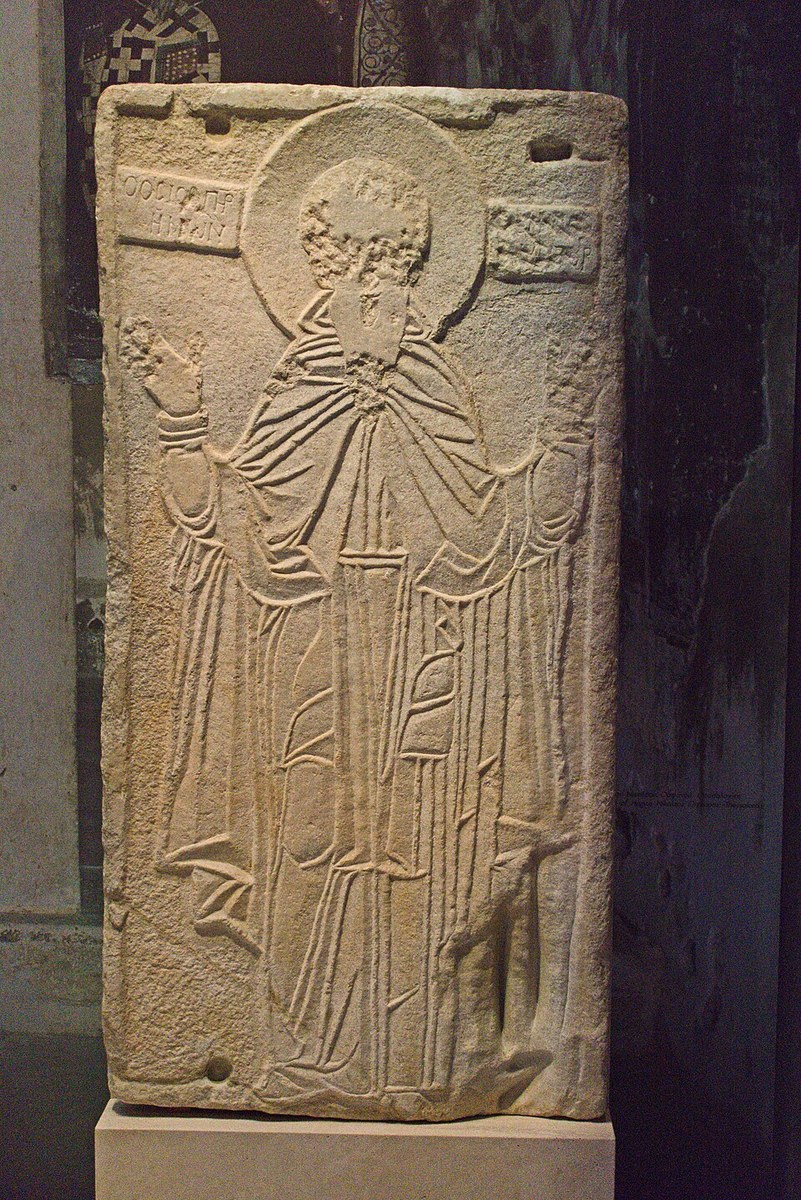
David is painted as an old man of great age, with a long white beard falling to his breast or lower, in the monastic schema and often in the pointed cowl (koukoulion) that gave his monastery its by-name of the Koukouliatoi. His two constant attributes are the tree and the hands: he is very often shown seated or standing among the branches of the almond tree, half-figure emerging from the foliage in the manner in which stylites are shown emerging from their pillars; and where the tree is absent, his hands are raised open in prayer — the hands that carried fire unburnt. Full-length images give him the extended right hand of blessing or supplication and a scroll. The scene of the censing before Justinian, the saint holding live coals in his palms before the enthroned emperor and the senate, appears in later Thessalonian cycles and on modern wall-paintings in the city.
The stored image is the marble relief icon of Hosios David in the Museum of Byzantine Culture at Thessalonica, a Byzantine carving of the 13th–14th century: the saint stands frontally in the monastic habit with both hands raised, the inscription Ο ΟΣΙΟΣ Π(ΑΤΗ)Ρ ΗΜΩΝ … ΔΑΒΙΔ cut in the panel to either side of the nimbus, and stylised foliage carved at his shoulders on both sides — the almond tree reduced to a heraldic sign of the dendrite's life. Because this is a photograph of a sculpted, three-dimensional object taken at an angle, and not a flat reproduction of a two-dimensional work, the photographer's own copyright in the image subsists; the file is stored here under his Creative Commons licence (CC BY-SA 4.0, Ymblanter) rather than on the public-domain-reproduction basis used for painted panels.
Disputed questions
- The date of repose. The tradition and the calendars give 540; the internal evidence of the Life (the death of Archbishop Dorotheos, the reign of Justinian from 527, the Justiniana Prima project of 535) allows a range of roughly 535–541, and scholarly treatments generally state it so. This entry keeps c. 540 as the received date and records the range.
- The church called Hosios David. The Latomou church in the Ano Poli of Thessalonica is universally called Hosios David, and visitors routinely take it for David's own monastery. It is not: the monastery of Saints Theodore and Mercurius (the Koukouliatoi) stood elsewhere, outside the wall, and the popular name of the Latomou church is a later transfer.
- The historicity of the embassy. That Justinian founded Justiniana Prima and that its archbishop was given jurisdiction over Illyricum in 535 (Novel XI) is documented imperial history; that the civil prefecture nevertheless remained at Thessalonica is likewise the case. The Life attributes the outcome to David's intervention. The two statements are compatible and the tradition is old, but the causal claim rests on the hagiography alone.
- Not to be confused with David of Hermopolis (the converted robber-chief of Egypt, September 6), with David and Tarichan of Georgia, or with the Prophet-King David; nor with the Athonite New Martyr David of Saint Anne's Skete, who is commemorated on this same day and who was likewise put to death at Thessalonica, but more than twelve centuries later.