
Demetrius of Priluki
Our Venerable Father Demetrius, Abbot and Wonderworker of Priluki
Venerable · Wonderworker · b. early 14th century, at Pereyaslavl-Zalessky — d. 11 February 1392, at Priluki near Vologda
Commemorated 11 February — Repose of the Abbot at the Priluki monastery
Demetrius of Priluki (†1392) was a monastic founder of the Russian North and a friend and contemporary of Saint Sergius of Radonezh. Born to a merchant family of Pereyaslavl-Zalessky, he took the monastic tonsure young, founded the Nicholas monastery on the Lake of Pereyaslavl, and was drawn into the circle of Saint Sergius, whose reform of communal (cenobitic) monasticism he embraced and carried northward. Seeking deeper solitude, he journeyed to the region of Vologda and there, about 1371, established the Saviour Monastery at Priluki (Spaso- Prilutsky) on a bend of the river — one of the first cenobitic houses of the northern forests and a mother-house of that region's monastic settlement. Renowned for his ascetic severity, his hidden almsgiving, and his gift of foresight, he reposed on 11 February 1392; his incorrupt relics remained the treasure of the Priluki monastery, and he is venerated as one of the great wonderworkers of the Russian North. Dionisius painted his celebrated vita icon about 1503.
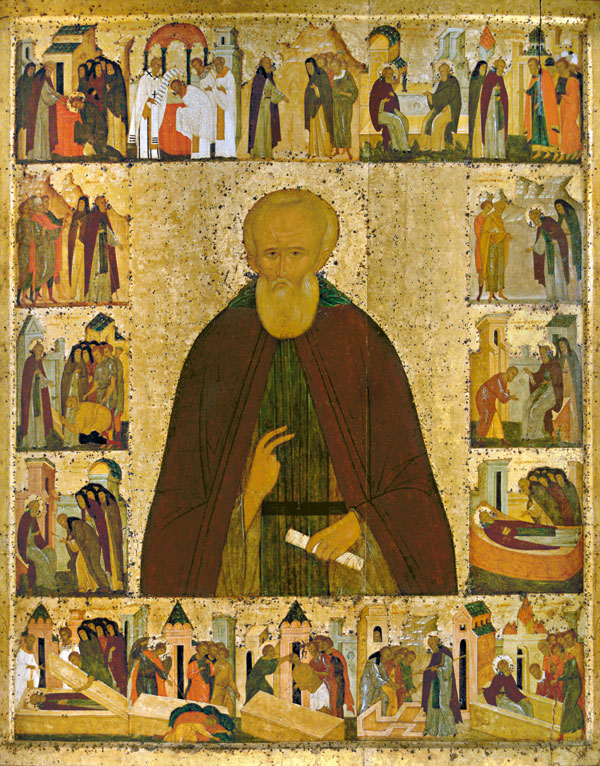

Origins and monastic beginnings at Pereyaslavl
Demetrius was born in the earlier fourteenth century at Pereyaslavl-Zalessky, into a family of wealthy merchants; but the world's prosperity did not hold him, and while still young he renounced his inheritance, received the monastic tonsure in one of the town's monasteries, and gave himself to the ascetic life. Ordained in time to the priesthood, he founded on the shore of the Lake of Pereyaslavl a monastery dedicated to Saint Nicholas, gathering brethren about him and ordering their life. His holiness drew the notice of the townsfolk and the honour of the grand-princely house — the tradition makes him a godfather to the children of Grand Prince Dmitry Donskoy — but honour was a burden to him, and he longed for a hidden life.
Saint Sergius, and the turn to the North
In these years Demetrius came into the orbit of Saint Sergius of Radonezh, the renewer of Russian monasticism, whom he visited and revered, and whose restoration of the cenobitic (communal) rule — the sharing of all things in common under an abbot, in place of the older separate life of the hermits — he made his own. Filled with the desire for solitude that Sergius's example kindled in a whole generation, Demetrius left the Pereyaslavl region and travelled north, into the forested and still-heathen lands beyond the Volga, seeking a place apart.
The foundation of the Priluki monastery
After trials in the northern wilds — where at one settlement the peasants, fearing that a monastery would swallow their lands, turned him away — Demetrius came to the neighbourhood of Vologda, and there, at a bend (luka) of the river a little below the city, the place called Priluki, he was welcomed by the people and given ground for a monastery. About the year 1371 he founded the Saviour Monastery of Priluki (Spaso-Prilutsky), building a wooden church of the Saviour's Origin (the Procession of the Cross) and establishing the cenobitic rule he had learned from Sergius. It became one of the earliest communal monasteries of the Russian North and a centre from which the monastic and Christian settlement of the Vologda land spread. Demetrius governed it as a father, famed for feeding the hungry from the monastery's stores in years of dearth, for the heavy asceticism he hid beneath a serene face, and for the gift of spiritual sight by which he knew things distant and to come — the death of Dmitry Donskoy, the tradition says, he announced to his brethren at the hour it befell.
Repose and relics
Demetrius reposed at his monastery on 11 February 1392, full of years, and was buried in the church he had raised. His relics, found incorrupt, remained enshrined at the Spaso-Prilutsky Monastery near Vologda, which flourished as one of the great houses of the North; there his tomb, his heavy iron chains (vериги) and his abbatial staff were kept and venerated, and many healings were recorded at his shrine. He is honoured as a wonderworker and a patron of Vologda, and his glorification passed early into the calendars of the Russian Church.
Feast and commemoration
Demetrius of Priluki is commemorated on February 11 (church date; Old Calendar civil February 24), the day of his repose, kept in the Russian calendars and by the Orthodox Church in America, which style him "the venerable Demetrius, abbot and wonderworker of Priluki (Vologda)." His veneration is a Russian one, proper to the North and to the Russian Church at large. The tradition also keeps a commemoration of the founding and of the monastery's deliverances at Priluki, but February 11 is his principal feast.
Iconography
Demetrius is shown in the type of the venerable abbot: an aged monk with a long grey beard, in the mantle, analavos, and koukoulion of the great schema, holding a scroll or blessing, sometimes bearing the model of his monastery or his abbatial staff. His most famous representation is the vita icon (житийная икона) in which the central standing figure of the saint is surrounded by a border of scenes from his life and miracles — the founding of the Priluki monastery, his acts of charity and foresight, his repose, and the wonders at his tomb.
The stored image is precisely that vita icon by Dionisius (c. 1503; Vologda Museum-Reserve), among the masterpieces of the Moscow school: the tall, attenuated figure of Demetrius in the schema, surrounded by the small scenes of his life (source, public domain, pd-old-work).