
Sergius of Radonezh
Our Venerable and God-bearing Father Sergius, Abbot of Radonezh and Wonderworker of All Russia
Venerable · Wonderworker · b. May 3, 1314 — d. September 25, 1392
Commemorated 5 July — Uncovering of the relics, 1422, 25 September — Repose, 1392
Sergius of Radonezh (1314–1392) is the greatest monastic saint of Russia and one of the most beloved figures of all Orthodoxy. Born Bartholomew near Rostov, he withdrew as a young man to the forested hill of Makovets, where his hermitage dedicated to the Holy Trinity grew into the Trinity Lavra, the spiritual heart of the Russian Church to this day. Restorer of the common life, teacher of a whole generation of monastic founders who filled the northern forests — the "Northern Thebaid" — counsellor of princes and peacemaker of a fractured land, he is remembered above all as a man of the Holy Trinity, in whose honour Andrei Rublev painted his famous icon. He reposed on September 25, 1392; his relics were uncovered in 1422.
.jpg)
Origins and early life
The saint was born in the lands of Rostov the Great, at the family estate near the city, and was named Bartholomew at baptism. His parents, the boyar Cyril and his wife Maria, were people of standing but of declining fortune, pious and charitable; the Russian Church venerates them as saints in their own right (January 18 and September 28 in the Russian calendar, as schema-monastics of Khotkovo). The Life written by his disciple Epiphanius the Wise sets his birth on May 3, 1314 — a date the tradition has kept, though modern scholarship inclines to 1319 or 1322 (see Disputed questions) — and surrounds it with signs: while his mother stood at the Liturgy before his birth, the child is said to have cried out three times from the womb — at the reading of the Gospel, at the Cherubic Hymn, and at "Holy things unto the holy" — which the hagiographer reads as a first mark of the future servant of the Trinity; and as an infant he refused his mother's milk on Wednesdays and Fridays.
The famous story of his boyhood concerns his schooling. Bartholomew was set to letters with his brothers Stephen and Peter and could not learn; he was slow where they were quick, was rebuked by his teachers and grieved over by his parents, and prayed with tears for understanding. One day, sent to find the family's strayed horses, he came upon a monk-elder — "a presbyter of angelic appearance" — praying under an oak in a field. The boy asked the elder to pray that he might learn his letters; the elder prayed, gave him a piece of holy bread (prosphora) to eat, told him that henceforth he would know his letters better than his brothers, and, brought home to the family table, had the boy read the Psalter aloud — which he did, suddenly and well. Departing, the elder foretold that the child would be great before God and men, a dwelling-place of the Holy Trinity. The scene, painted memorably by Nesterov in the nineteenth century, remains among the most familiar images of Russian sacred story.
In the 1320s or 1330s the family was ruined in the troubles of Rostov: the principality passed under the heavy hand of Moscow, and Cyril, impoverished by exactions, Tatar tribute and famine, resettled with his household in the small town of Radonezh, in the Moscow lands, from which the saint takes his name. Bartholomew longed from youth for the monastic life, but at his parents' request remained to care for them in their old age — his brothers having married — until they took the monastic habit in their last years at the Protection monastery of Khotkovo and reposed in peace. Bartholomew gave his share of the inheritance to his younger brother Peter and was free.
Ministry and ascetic struggle
About 1337 (the conventional date of the monastery's founding) Bartholomew persuaded his elder brother Stephen, by then a widower and monk of Khotkovo, to seek the wilderness with him. Some ten versts from Radonezh they chose the low forested hill called Makovets, above the little river Konchura, cut a cell and a small church with their own hands, and dedicated the church to the Holy Trinity — a dedication then unusual, which the Life makes the keynote of the saint's whole purpose. Stephen could not bear the severity and solitude of the place and departed for the Theophany monastery in Moscow; Bartholomew remained alone. Only then, about the age of twenty-three, was he tonsured, by a certain abbot Mitrofan whom he called to Makovets, receiving the name Sergius from the martyr of the day (October 7, Sergius and Bacchus).
For perhaps two years or more Sergius lived utterly alone in the forest, in labour, fasting and unceasing prayer, assailed — the Life records — by fears, apparitions and demonic assaults which he overcame by prayer. The wild creatures of the forest tamed to him; most famously, a bear took to visiting his cell, and the saint shared his last piece of bread with it, sometimes giving the beast the whole of it and going hungry himself — the bear became in later iconography and popular memory the emblem of his wilderness years.
His holiness could not stay hidden. Monks began to gather one by one, each building his own cell, until there were twelve; Sergius laboured for them all — he built cells, carried water, ground and baked the bread, cooked, made shoes and clothing — while refusing all precedence. Pressed by the brethren to become their abbot and priest, he long refused, yielding at last to the word of the bishop; he was ordained and made abbot by Athanasius, bishop of Volhynia (acting for the absent metropolitan), about 1354. His abbacy changed nothing in his labour: he remained the first at work and the poorest in dress, his patched cassock proverbial, so that visitors seeking the famous abbot could not tell him from the least of the brethren — the Life tells of a peasant who refused to believe that the shabby monk digging in the garden was Sergius, until a prince arriving with his retinue prostrated before the saint.
At first the community lived by the old skete custom, each monk providing for himself. At a decisive moment — the Life connects it with a letter and gifts from Philotheus, Patriarch of Constantinople, commending the common life, and with the blessing of Metropolitan Alexis of Moscow — Sergius introduced the full cenobitic rule: common table, common property, common obedience, the pattern of the Studite and Athonite houses. It was the restoration to northern Russia of a discipline that had lapsed since the Mongol ruin of Kiev, and it became the model for the whole monastic revival that flowed from him. The reform brought murmuring; when a party in the brotherhood, headed for a time by his own brother Stephen, resented his rule, Sergius — rather than contend — quietly left his monastery and founded a new hermitage on the river Kirzhach. Only the entreaty of Metropolitan Alexis, and the grief of the brethren, brought him back; the Kirzhach community remained as a daughter house under his disciple Roman.
Honours he refused to the end. When Metropolitan Alexis, near death (†1378), wished to consecrate Sergius as his successor in the see of Moscow and All Russia — investing him, as a first step, with the golden pectoral cross of the metropolitan — Sergius declined absolutely, saying that from his youth he had never worn gold and desired to remain in poverty; no persuasion moved him, and Alexis, fearing the saint would flee to the wilderness altogether, let him be. The refusal of the highest office of the Russian Church, from a man whose authority in it was already without rival, sealed his reputation for holiness in his own lifetime.
That authority the princes of Russia constantly enlisted. Sergius walked — always on foot — on missions of peace: to Rostov, to Ryazan (where his quiet words turned the fierce prince Oleg from war with Moscow, 1385), to Nizhny Novgorod; he stood godfather to the sons of Grand Prince Dimitri Ivanovich of Moscow, and his name appears among the witnesses of the grand prince's testament. Most famously, the tradition places before the battle of Kulikovo (September 8, 1380) — the first great Russian victory over the Horde — a visit of Dimitri (called thereafter "Donskoy") to the Trinity monastery, where Sergius blessed him for the battle, foretold his victory at heavy cost, and gave him two monks of boyar origin, Alexander Peresvet and Andrew (Rodion) Oslyabya, the first of whom fell in single combat opening the battle. During the fighting, the Life relates, Sergius stood with his brethren in prayer, naming the fallen at the very hour of their deaths. The historical standing of the blessing narrative is debated (see Disputed questions); its place in Russian memory is beyond debate.
Beneath all this outward history the Life insists on the inner one: Sergius as a contemplative, a man of the vision of God. His dedication of his church and community to the Holy Trinity was understood by his biographer and his tradition as a programme — in the much-quoted later formulation, "that by gazing upon the Holy Trinity the fear of the hateful discord of this world might be overcome." In an age of partition, civil strife and the Tatar yoke, the Trinity — perfect unity of distinct persons in love — was preached from Makovets not in treatises but in a community's life. It is this theology that Andrei Rublev's icon of the Trinity, painted for the saint's monastery "in praise of Sergius," was created to express.
Repose
Six months before his end, Sergius, foreknowing his death, gathered the brethren and handed the governance of the monastery to his disciple Nikon; he then gave himself to complete silence. Falling ill in September, he called the community, gave his last instruction — to keep the faith unsullied, to preserve oneness of mind, purity of soul and body, unfeigned love, humility and hospitality — communicated of the Holy Mysteries, and reposed on September 25, 1392. He had asked to be buried in the common cemetery with the brethren, but Metropolitan Cyprian blessed his burial in the church he had founded. He was about seventy-eight years old by the traditional reckoning, and had lived on Makovets some fifty-five years.
Relics and translations
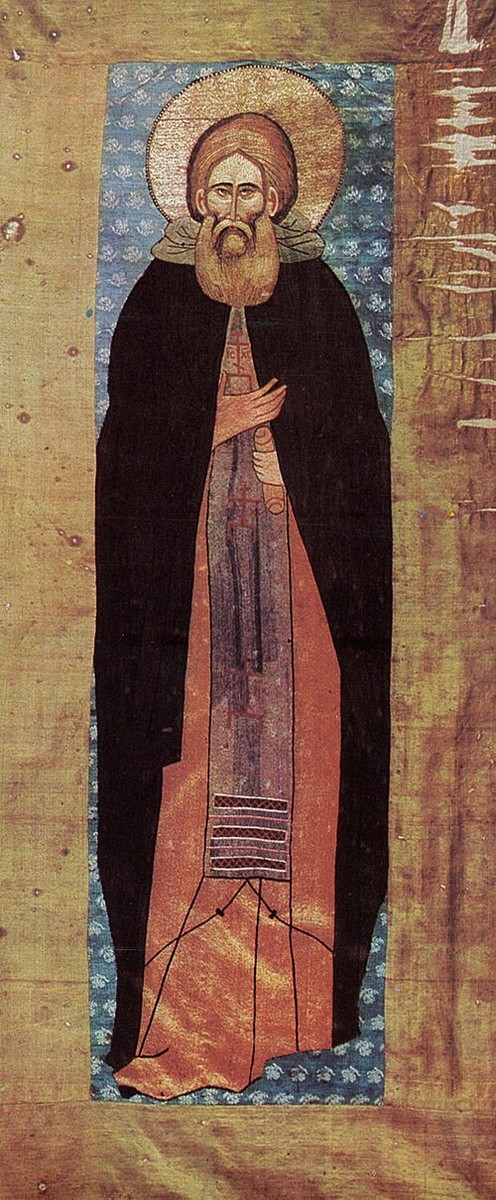
Thirty years after his repose, during the rebuilding of the monastery — burned in the Tatar raid of Edigei in 1408 and restored by abbot Nikon — the saint appeared in a vision to a devout layman, asking why his body was left "covered by water." When on July 5, 1422, in the presence of Prince George of Zvenigorod (the saint's godson), the grave was opened for the foundations of the new stone Trinity cathedral, the relics were found whole, untouched — the Life says — by the water that stood about the coffin. They were placed first in the wooden church and then, on the completion of the white-stone Trinity cathedral (1423–1424), in a shrine within it, where they remain. It was for the iconostasis of this cathedral that Nikon called Andrei Rublev, whose Trinity was set beside the royal doors above the saint's shrine; and for the shrine itself Moscow workshops of the 1420s embroidered the celebrated pall (pokrov) bearing the saint's image — the near-contemporary "portrait" of Sergius stored with this entry.
The relics have left the Lavra only under compulsion. In 1919–1920 the Soviet authorities publicly opened the shrine and closed the monastery, holding the relics as a museum exhibit; in 1946, with the monastery's reopening, they were returned to the Church, and they rest today in the Trinity cathedral, where a continuous molieben is served at the shrine through the day.
Veneration and later cultus
Veneration of Sergius began at his grave and never ceased. His feast was kept at the Trinity monastery from the uncovering of 1422 at the latest; by the mid-fifteenth century (before 1448/49) he was honoured throughout the Russian metropolia — with Anthony and Theodosius of the Kiev Caves, one of the first saints of all-Russian veneration — and the Russian tradition came to style him "igumen of the Russian land" and, with Nicholas the Wonderworker, the most universally loved of its saints.
His monastery became what Kiev's Caves had been: the mother house of Russian monasticism. From his own disciples and their disciples came, by the traditional count, some seventy monasteries within a century — Kirill of Belozersk and Therapont on the White Lake, Sabbas of Storozhevsk at Zvenigorod, Methodius of Peshnosha, Abraham of Galich, Sylvester and Paul of the Obnora, Sergius of Nurma, Andronicus of Moscow (whose monastery holds Rublev's grave), Athanasius of Vysotsk, and many more — the movement that carried the common life into the far northern forests, the region hagiography calls the "Northern Thebaid," and with it the colonisation and Christianisation of the Russian north.
The Trinity monastery itself, fortified in stone in the sixteenth century, withstood the sixteen-month Polish-Lithuanian siege of 1608–1610 in the Time of Troubles — a defence the Russian tradition ascribes to the saint's protection — and sheltered the young Peter I in 1689. In 1744 it received the title of Lavra. Closed in 1920, it was returned to the Church in 1946 and has been ever since the best-known monastery of Russia, seat of the Moscow Theological Academy and frequent seat of Church councils; the town around it, Sergiev Posad, bears the saint's name. His veneration long ago crossed jurisdictional bounds: he entered the Greek synaxaria and the calendars of the whole Orthodox world, and churches are dedicated to him from the Balkans to America.
Miracles and traditions
The Life records the gifts of a wonderworker attested in the saint's own lifetime. At his prayer a spring of water broke from the earth near the monastery when the brethren murmured at carrying water from afar — the "Sergius well" — and its water healed the sick. A local peasant carried his dead son to the saint's cell in winter; Sergius prayed, and the boy revived — the saint, in his humility, forbidding the father to speak of a miracle, saying the child had only been numbed by the cold. Healings, the reading of hearts, and foreknowledge are reported throughout the later chapters of the Life.
Three visions frame his tradition. In one, Sergius, praying at night for his brotherhood, heard a voice saying "Look — behold the multitude of thy disciples," and saw a great flock of beautiful birds filling the monastery and all around it: so, the voice said, would his children multiply. In the Liturgy, his disciples testified to seeing an angel serving with him, and divine fire moving upon the altar and entering the chalice at the moment of communion. And near the end of his life the Mother of God herself, with the apostles Peter and John, appeared to him in his cell — the first recorded appearance of the Theotokos to a Russian saint — promising her unfailing care for his monastery; the appearance is commemorated in the Russian calendar (August 24) and in a distinct iconographic type.
Hymnographic and literary legacy
The primary source for the saint is the Life by his disciple Epiphanius the Wise, begun within a generation of the repose (c. 1417–1418) and counted among the masterpieces of medieval Russian literature for its "word-weaving" style; it was revised and expanded several times in the fifteenth century by Pachomius the Serb (Pachomius Logothetes), who also composed the service for the uncovering of the relics. The received services for September 25 and July 5, with two canons for the repose, an akathist of later composition, and a rich body of troparia and kontakia, belong to the Slavic Menaia; the magnification sung at the vigil calls him "instructor of monks and converser with angels." In another medium altogether stands Rublev's Trinity (painted for the Trinity cathedral, by the two attested traditions either c. 1411 or with the cathedral's decoration of 1425–1427): the Russian tradition itself records that it was made "in praise of the holy father Sergius," and it remains the most profound commentary on his theology.
Feast and commemoration
September 25 (church date; Old Calendar civil October 8), the day of his repose in 1392, is the principal feast, kept in the Russian tradition with an all-night vigil and ranking among the great commemorations of the Russian year; July 5 (Old Calendar civil July 18) commemorates the uncovering of the relics in 1422. The Russian books also honour him in the Synaxis of the Radonezh saints (July 6) and the Synaxis of Moscow saints, and on August 24 the appearance of the Theotokos to him. The commemoration is of Russian origin but his veneration is now genuinely universal: the feast stands in the calendars of the Moscow Patriarchate, the OCA and the whole Slavic tradition, and the saint is listed in the Greek synaxaria for September 25 ("Sergius the Wonderworker, abbot of Radonezh"), though the Greek Menaion of the day appoints its proper service to Euphrosyne of Alexandria, with whom he shares the day. On the New Calendar his repose falls in the season after the leavetaking of the Cross; Old Calendar jurisdictions keep it on civil October 8.
Hymns
Troparion — Tone 4
From thy youth thou didst receive Christ in thy soul, O venerable one, and above all things didst long to withdraw from the turmoil of the world. Manfully didst thou settle in the wilderness, and there didst raise up children of obedience, the fruits of humility. Wherefore, having become a dwelling-place of the Trinity, thou didst enlighten with thy miracles all who come to thee with faith, granting healings abundantly to all. O our father Sergius, pray to Christ God that our souls may be saved.
Original translation from the Slavonic
Kontakion — Tone 8
Wounded with the love of Christ, O venerable one, and following Him with a desire that turned not back, thou didst hate every fleshly pleasure and didst shine forth upon thy fatherland like the sun; wherefore Christ has enriched thee with the gift of miracles. Remember us who honour thy most radiant memory, that we may cry to thee: Rejoice, O Sergius, wise in God.
Original translation from the Slavonic
Magnification
We call thee blessed, O venerable father Sergius, and we honour thy holy memory, instructor of monks and converser with angels.
Original translation from the Slavonic
Appointed readings
Epistle — Galatians 5:22–6:2
22But the fruit of the Spirit is love, joy, peace, longsuffering, gentleness, goodness, faith, 23Meekness, temperance: against such there is no law. 24And they that are Christ’s have crucified the flesh with the affections and lusts. 25If we live in the Spirit, let us also walk in the Spirit. 26Let us not be desirous of vain glory, provoking one another, envying one another. 1Brethren, if a man be overtaken in a fault, ye which are spiritual, restore such an one in the spirit of meekness; considering thyself, lest thou also be tempted. 2Bear ye one another’s burdens, and so fulfil the law of Christ.
Gospel — Luke 6:17–23
17And he came down with them, and stood in the plain, and the company of his disciples, and a great multitude of people out of all Judæa and Jerusalem, and from the sea coast of Tyre and Sidon, which came to hear him, and to be healed of their diseases; 18And they that were vexed with unclean spirits: and they were healed. 19And the whole multitude sought to touch him: for there went virtue out of him, and healed them all. 20And he lifted up his eyes on his disciples, and said, Blessed be ye poor: for yours is the kingdom of God. 21Blessed are ye that hunger now: for ye shall be filled. Blessed are ye that weep now: for ye shall laugh. 22Blessed are ye, when men shall hate you, and when they shall separate you from their company, and shall reproach you, and cast out your name as evil, for the Son of man’s sake. 23Rejoice ye in that day, and leap for joy: for, behold, your reward is great in heaven: for in the like manner did their fathers unto the prophets.
Iconography
Sergius is painted as a Russian monastic elder in the mantle and schema, with a rounded, moderately full dark-to-greying beard, his right hand blessing, his left holding a scroll; the type was fixed within a generation of his death and is remarkably stable. The earliest and most authoritative image is the embroidered pall (pokrov) of 1422–1424, made in a Moscow workshop for the shrine at the uncovering of the relics and preserved in the Sergiev Posad museum — held by many scholars to preserve genuine portrait features; it is the image stored with this entry. Vita icons with border scenes (the elder and the child Bartholomew, the bear, the visions, Kulikovo) multiply from the late fifteenth century; the appearance of the Theotokos to Sergius became a distinct iconographic subject; and the saint stands in countless deesis rows, menaion panels and "Radonezh saints" compositions. Modern painting outside the canon — Nesterov's Vision of the Youth Bartholomew above all — testifies to the same national memory.
Disputed questions
- Year of birth. Epiphanius's chronology is inconsistent; the traditional church date is May 3, 1314, while critical scholarship (following the Life's own statement that the saint died at seventy-eight, and other indications) has argued for 1319 or 1322. The church books keep 1314, and so does this entry's frontmatter.
- The blessing before Kulikovo. The meeting of Dimitri Donskoy and Sergius before the battle of 1380, with the blessing and the gift of the monks Peresvet and Oslyabya, appears in the expanded Life and in the literary monuments of the Kulikovo cycle (the "Zadonshchina" and the "Skazanie of the Mamai battle"), which reached their received form decades after the events. The earliest short chronicle accounts of the battle do not mention it, and some historians have argued that a genuine visit of Dimitri to Sergius belongs rather to 1378 and the battle of the Vozha, later transferred to the greater victory; the surviving letter of Sergius to Dimitri urging courage is likewise dated by some to another occasion. Other scholars defend the substance of the tradition. The Church's memory — hymnography, iconography, and the national tradition — keeps the blessing with the battle of Kulikovo; the entry records both the tradition and the debate without resolving them.
- Date of the monastery's founding and of the abbacy. The conventional dates (settlement on Makovets c. 1337; ordination and abbacy c. 1354) are reconstructions from the Life's relative chronology and shift with the birth-year adopted.
- Not to be confused with his disciple Sergius of Nurma (†1412, October 7), with Sergius of Valaam (June 28), or with the martyr Sergius of the pair Sergius and Bacchus (October 7), from whom he received his monastic name.