
Dimitry of Rostov
Our Father among the Saints Demetrius (Dimitri) Tuptalo, Metropolitan of Rostov
Bishop · Wonderworker · b. December 1651, Makarovo, near Kiev — d. 1709
Commemorated 21 September — Uncovering of the relics (1752), 28 October — Repose (1709)
Dimitry of Rostov (1651–1709), in the world Daniel Tuptalo, was Metropolitan of Rostov and the greatest churchman-scholar of the Russian Church in the age of Peter the Great. For some twenty years he laboured over the Chetii-Minei, the great Lives of the Saints for the whole year, which became the standard hagiographic reading of the Russian world for two centuries; he was besides a famed preacher and a gentle, unworldly pastor who died owning little but his books and manuscripts. Glorified in 1757 — the first canonisation of the Synodal period — he is commemorated on October 28, the day of his repose, and on September 21, the uncovering of his incorrupt relics.

Origins and formation
He was born in December 1651 at Makarovo, not far from Kiev, and given the name Daniel. His family soon moved to Kiev, where in 1662 the gifted boy was sent to the Kiev-Mohyla college; there he mastered Greek and Latin and the whole course of the classical learning of the day. On July 9, 1668 he was tonsured a monk with the name Demetrius, after the Great-Martyr Demetrius of Thessalonica, at the Kirillov monastery of Kiev, where he began to preach and to write. On May 23, 1675 the Archbishop of Chernigov, Lazar (Baranovich), ordained him hieromonk, and for several years he lived and preached through the monasteries and churches of Ukraine, Lithuania and Belarus.
The Lives of the Saints
In 1684, while igumen of the Maximov (later Baturin St Nicholas) monastery, he was summoned to the Kiev Caves Lavra, whose superior, Archimandrite Barlaam (Yasinsky), knowing his learning and literary gift, entrusted to him the great work of compiling the Menaion — the Lives of the Saints for the whole year. To this labour the rest of his life was given: gathering, sifting and harmonising a vast body of Greek and Slavonic sources and setting them out in a flowing language worthy of the subject and open to every reader. The work, issued in four great volumes over some twenty years, is the Chetii-Minei of Demetrius of Rostov, which for two centuries was the Lives of the Saints of the whole Russian and Slavic Orthodox world. During these years he governed, in succession, several monasteries.
Metropolitan of Rostov
His labours brought him to the notice of Patriarch Adrian, and in 1701, by decree of Tsar Peter I, Archimandrite Demetrius was called to Moscow and on March 23 consecrated Metropolitan of Tobolsk in Siberia. But because his scholarly work could not be carried on at such a distance, and because of his frail health, he was soon reassigned nearer the centre, and on March 1, 1702 took up the see of Rostov-Yaroslavl. As metropolitan he founded a school, preached unwearyingly, and laboured for the unity of the Church against the Old-Believer schism, writing on the disputed questions. He remained to the end a monk of few possessions: when he died at Rostov on October 28, 1709, it was found that he had left almost nothing but his books and manuscripts.
Glorification
His relics were found incorrupt and uncovered on September 21, 1752, and he was solemnly glorified on April 22, 1757 — the first formal canonisation of the Russian Church in the Synodal period. From his sermons and writings, the tradition says, generations of Russian theologians drew nourishment; the Church holds him up as a model of the learned, ascetic and non-acquisitive hierarch.
Feast and commemoration
October 28 (church date; Old Calendar civil November 10), the day of his repose, is his principal feast; the uncovering of his relics is kept on September 21. He is venerated in the Russian Church and the Orthodox Church in America; the entry records his jurisdictions honestly. He is also numbered among the synaxis of the saints of Rostov and Yaroslavl.
Hymns
Troparion — Tone 8
O zealot of Orthodoxy and uprooter of schism, healer of Russia and new intercessor before God, by thy writings thou hast brought the foolish to their right mind, O spiritual harp, blessed Demetrius: entreat Christ God that our souls may be saved.
Original translation from the Slavonic
Kontakion — Tone 4
Let us bless the golden-worded teacher Demetrius, the star of Russia that rose from Kiev and, passing through Novgorod-Seversky, came to Rostov, and illumined all this land with his teachings and his miracles; for he wrote all things for all, unto their instruction, that he might win them all, as did Paul, for Christ, and save our souls by right belief.
Original translation from the Slavonic
Iconography
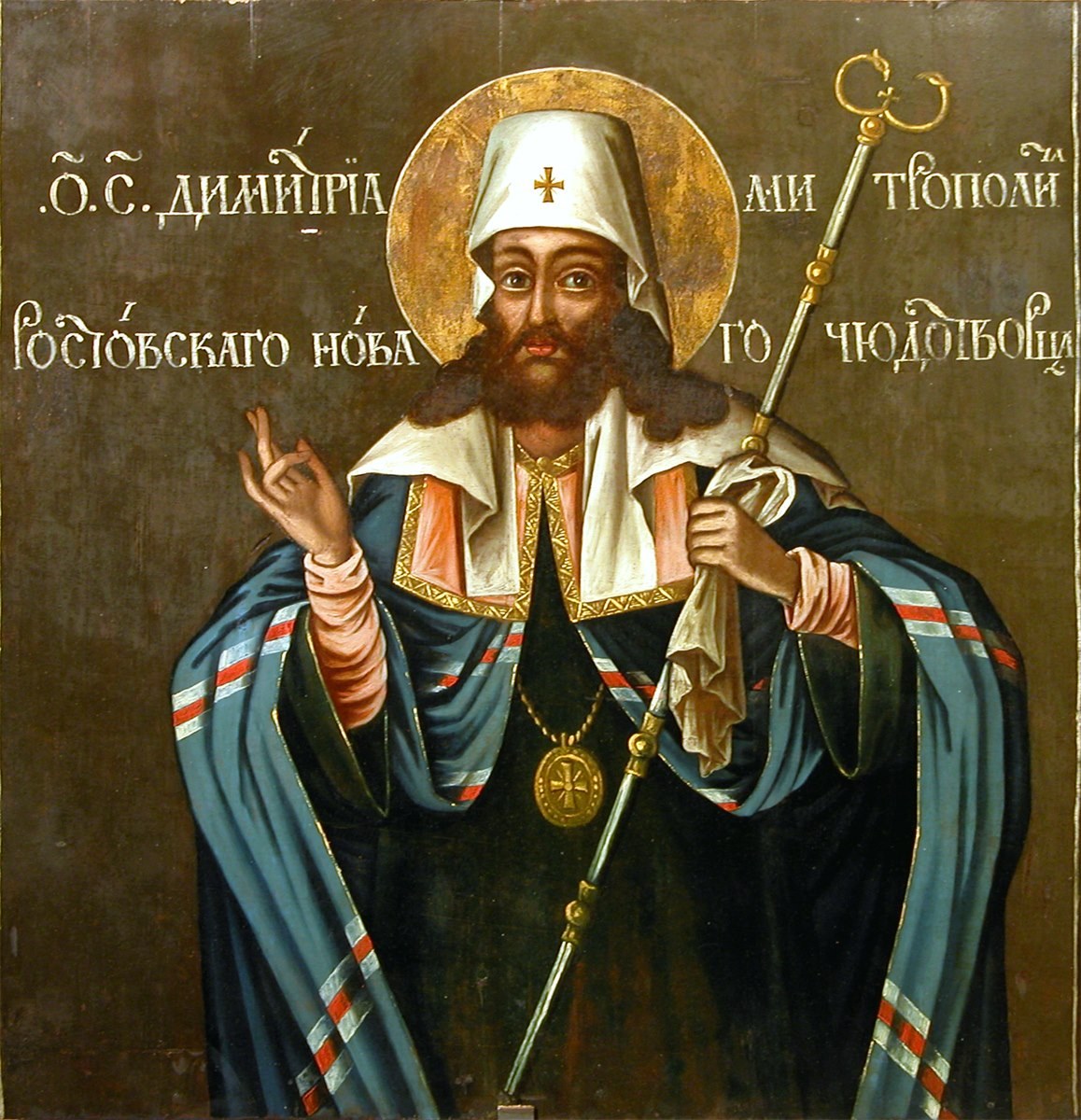
Dimitry is depicted as a hierarch of the Petrine age: in the metropolitan's mitre, sakkos and omophorion, blessing with one hand and holding the Gospel or a scroll — sometimes shown with his books, in token of the great Menaion. His face is that of the historical portraits, refined and ascetic. The stored image is a Russian icon of the late eighteenth century, inscribed "the Holy Hierarch Demetrius, Metropolitan of Rostov."