
Dionysius of Olympus
Our Venerable Father Dionysius of Mount Olympus
Venerable · b. c. 1490s, at Slatina (Drakotrypa) in Thessaly — d. 23 January 1541, on Mount Olympus
Commemorated 23 January — Repose on Mount Olympus
Dionysius of Olympus (c. 1490s – 1541) was a Greek ascetic and monastic founder of the Ottoman period, remembered as a light of the enslaved Greek Church. Born in Thessaly and formed as a monk at Meteora, he made his way to Mount Athos, where he lived as a hesychast and was chosen abbot of the Monastery of Philotheou; driven from the Holy Mountain by the jealousy his reforms aroused, he settled at last on the northern slopes of Mount Olympus, in the gorge of the Enipeas, where he raised the Monastery of the Holy Trinity and gathered a brotherhood devoted to silence, manual labour, and the care and teaching of the poor mountain people. A tireless spiritual father, preacher, and worker of wonders among a subjugated flock, he reposed on Olympus on January 23, 1541.

Origins and monastic beginnings
Dionysius was born in the last decade or so of the fifteenth century in the village of Slatina — later called Drakotrypa — in the region of Thessaly, of pious Christian parents. Orphaned young, he supported himself for a time as a teacher and copyist, but the desire for the monastic life drew him early to the great rock-monasteries of Meteora, where he received the tonsure under an elder named Savvas at the Monastery of the Transfiguration. He had not long been in the habit when, hearing the praises of the hesychast life of the monks of Athos, he left Meteora — against the wish of his elder, who would have kept him — and went to the Holy Mountain.
Athos and the abbacy of Philotheou
On Mount Athos Dionysius lived the ascetic and contemplative life with such ardour that his gifts could not stay hidden. He was ordained priest, dwelt for a time in stillness, and was in due course elected abbot of the Monastery of Philotheou, which under his rule he restored in discipline and in fabric, introducing the coenobitic (common) life in place of the idiorrhythmic laxity into which many of the houses had fallen. His very success bred opposition: the reforms and the influx of Greek monks he drew stirred resentment among some of the brethren — the sources speak of a faction, in part on national lines — and Dionysius, unwilling to be a cause of strife, withdrew from Athos.
Mount Olympus and the Monastery of the Holy Trinity
After wanderings that took him through the monasteries of the region, and a period of solitude, Dionysius came at last to Mount Olympus — the great mountain on the border of Thessaly and Macedonia — and settled in the wild gorge of the Enipeas, in a cave he called the Cave of Golgotha. There, about 1541 (the dedicatory tradition gives 1542–1543), he rebuilt on the ruins of an older Byzantine foundation the Monastery of the Holy Trinity (Agia Triada), which became a centre of Orthodox life and learning for the Christians of the mountain country under the Turkish yoke. The pattern of life he set his brotherhood was threefold: stillness and prayer, manual labour and building, and active mercy and teaching toward the poor and often half-instructed villagers of the region, whom he catechised, confessed, reconciled, and defended. He is remembered as a fearless pastor of an oppressed people — feeding the hungry, settling feuds, standing between his flock and the Ottoman power — and as a wonderworker whose prayers were credited with healings and providential deliverances.
Repose
Dionysius reposed in peace on January 23, 1541, on the mountain he had made a garden of monastic life, while praying for his brethren. His monastery on Olympus kept his memory and his relics, and his cult spread through Thessaly, Macedonia, and the Athonite world; the Monastery of Philotheou, which he had once governed, honours him among its own. A proper Greek office celebrates him, and he is numbered among the notable new ascetics of the Turkish period, a link between the hesychast tradition of Athos and the enslaved Greek countryside it went out to serve.
Feast and commemoration
Dionysius is kept on January 23 (church date; Old Calendar civil February 5), the day of his repose, chiefly in the Greek Church and on Athos, and universally among the Athonite fathers. His memory is especially kept at the Monastery of the Holy Trinity on Olympus and at Philotheou on Athos.
Hymns
Troparion — Tone 8
In thee, O Father, that which is according to the image was preserved unimpaired; for taking up the Cross thou didst follow Christ, and by thy deeds thou didst teach us to despise the flesh, for it passeth away, but to care for the soul, a thing immortal. Therefore doth thy spirit, O venerable Dionysius, rejoice together with the Angels.
Original translation from the Greek
Iconography
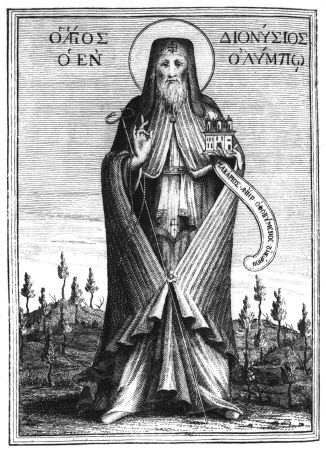
Dionysius is depicted as a monastic elder in the schema — long grey beard, monastic koukoulion or bare head, holding a scroll or a cross — often with Mount Olympus and his monastery in the background, and sometimes with a scroll bearing a counsel to his monks. The stored image is a 1781 Greek engraving of the saint of Olympus (source, public domain, pd-old-work).