
Friday 23 January 2026
Hieromartyr Clement and Martyr Agathangel
Friday of the 33rd week after Pentecost
Saints commemorated
-
Saint of the day
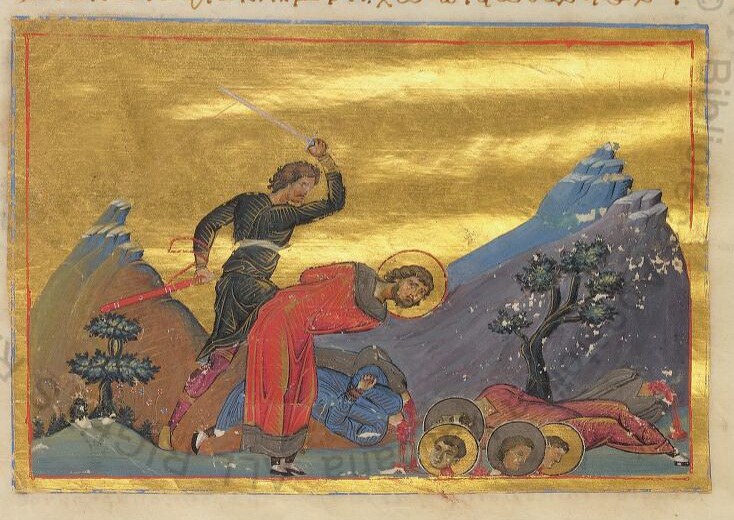
Hieromartyr Clement and Martyr Agathangel
Agathangelus (†c. 312) was the young companion and fellow-martyr of Clement of Ancyra. A native of Rome, he was moved by the constancy of the imprisoned bishop of Ancyra — some accounts make him one of a company of Roman confessors, spared when his companions were put to the sword — and attached himself to Clement to share his chains and his death. From that point the two are inseparable in the tradition: taken, tortured, and at last beheaded together at Ancyra, on the day the Church keeps them both, January 23. His name, "good messenger" (agath-angelos), is dwelt on by the hymnographers, who set the youthful disciple beside the aged hierarch as his "fellow-contestant."
-
Antiochian commemoration
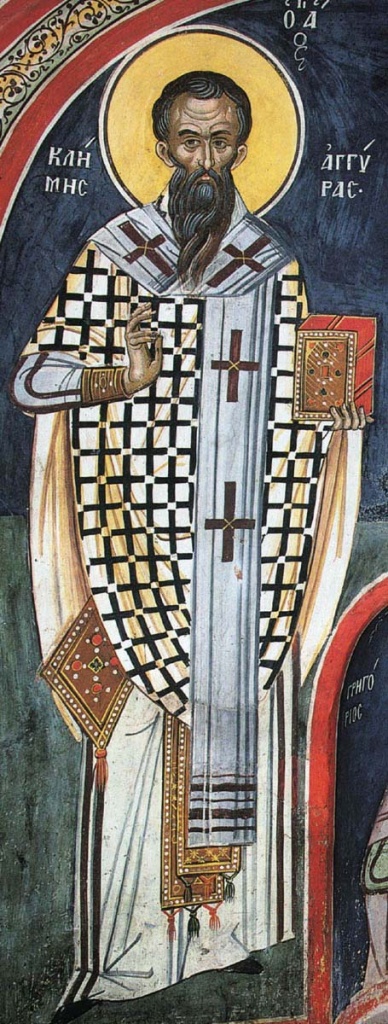
Clement of Ancyra
Clement of Ancyra (c. 258 – c. 312) was bishop of Ancyra in Galatia and one of the most enduring of all the martyrs of the synaxarion: the tradition holds that his passion lasted some twenty-eight years, dragged through a succession of emperors, governors, and cities from the persecution of Diocletian to its very last flickerings under Maximinus. Orphaned young and raised by a Christian woman named Sophia, he was made bishop of his city at twenty; when the persecution broke out he was seized and sent from tribunal to tribunal — Ancyra, Rome, Nicomedia, Amisus, Tarsus — enduring torture after torture without yielding, and by his constancy converting many, including his fellow-martyr Agathangelus, a young Roman who joined himself to the bishop to suffer with him. After nearly three decades of chains and torments the two were at last beheaded at Ancyra, on a day the Church keeps as January 23. For the length and severity of his contest the Greek Church calls him polyathlos, "of many struggles."
-
Dionysius of Olympus
Dionysius of Olympus (c. 1490s – 1541) was a Greek ascetic and monastic founder of the Ottoman period, remembered as a light of the enslaved Greek Church. Born in Thessaly and formed as a monk at Meteora, he made his way to Mount Athos, where he lived as a hesychast and was chosen abbot of the Monastery of Philotheou; driven from the Holy Mountain by the jealousy his reforms aroused, he settled at last on the northern slopes of Mount Olympus, in the gorge of the Enipeas, where he raised the Monastery of the Holy Trinity and gathered a brotherhood devoted to silence, manual labour, and the care and teaching of the poor mountain people. A tireless spiritual father, preacher, and worker of wonders among a subjugated flock, he reposed on Olympus on January 23, 1541.
-
Gennadius of Kostroma
Gennadius of Kostroma and Liubimograd (early sixteenth century – 1565) was a Russian monastic founder, a disciple of Cornelius of Komel and, through him, an heir of the great northern tradition of forest-dwelling ascetics. Born at Mogilev in a wealthy family under the name Gregory, he abandoned home and riches as a youth, was tonsured by Cornelius in the Vologda forest, and after sharing his master's flight into the deeper wilderness founded, on the shore of Lake Sura in the Kostroma country, the Monastery of the Transfiguration (afterwards called the Gennadiev Monastery). Famed for his labours, his charity, and a gift of spiritual counsel and foresight, he reposed on January 23, 1565, and was glorified when his relics were uncovered incorrupt in 1646.
-
Mausimas the Syrian
Mausimas the Syrian (late fourth century) was a village priest and ascetic of the country near Cyrrhus in Syria, remembered in the History of the Monks of Syria of Theodoret of Cyrrhus. A Syriac-speaking man of the simplest life, he gave himself wholly to hospitality and the relief of the poor, keeping his door open to every stranger; and the tradition preserves the memory of two vessels in his house — one of grain and one of oil — that, like the widow's cruse of Zarephath, never ran dry so long as he gave from them to the needy. He is commemorated on January 23.
-
Paulinus of Nola
Paulinus of Nola (c. 354 – 431) was a Gallo-Roman nobleman — senator, consul, and governor — who renounced one of the greatest fortunes in the Western Empire to become a monk, a Christian poet, and at last bishop of Nola in Campania, where he served for decades at the shrine of the martyr Felix. With his wife Therasia he gave away his estates to the poor and to the ransoming of captives; a cherished tradition, told by Gregory the Great, has him at the end of his resources offering his own person into slavery in Africa to redeem a widow's only son — the deed that earned him the title "the Merciful." A friend and correspondent of Ambrose, Augustine, Jerome, and Martin of Tours, and one of the finest Latin Christian poets, he reposed at Nola in 431. The West keeps him on June 22; the Byzantine calendar commemorates him on January 23.
-
Salaman the Silent
Salaman the Silent (died c. 400) was a hermit of the Euphrates country in Syria, one of the ascetics whose lives Theodoret of Cyrrhus recorded, and the very type of the hesychast — the monk of total silence. Born at the village of Capersana on the western bank of the river, he shut himself into a small windowless and doorless cell, walled up from all company, and there passed his years without speaking to any man, opening his wall but once a year to take in a year's supply of food. So complete was his stillness that when the bishop of the region broke in and ordained him by force, and again when the villagers of the two banks carried off his very cell from one side of the Euphrates to the other, Salaman answered nothing at all, neither resisting nor consenting, but kept his silence to the end. He is commemorated on January 23.
British Isles and Ireland
- St. Colman of Lismore (c.702)
- Holy Martyr Maimbod (c.880)
Troparia & kontakia
Kontakion — Tone 4
Thou didst become a precious branch of the Vine that is Christ, O all-praised Clement, shown forth as a martyr of many struggles; and together with thy fellow-contestants thou didst cry aloud: O Christ, the radiant gladness of the Martyrs.
Troparion — Tone 4
A vine-branch of holiness and a stem of contest, a most sacred flower and a God-given fruit, thou didst blossom most sweetly for the faithful, O all-hallowed one. But as a fellow-contestant of the Martyrs and a sharer of the throne of the Hierarchs, intercede with Christ our God that our souls may be saved.
Troparion — Tone 8
In thee, O Father, that which is according to the image was preserved unimpaired; for taking up the Cross thou didst follow Christ, and by thy deeds thou didst teach us to despise the flesh, for it passeth away, but to care for the soul, a thing immortal. Therefore doth thy spirit, O venerable Dionysius, rejoice together with the Angels.
Troparion — Tone 8
In thee, O Father, that which is according to the image was preserved unimpaired; for taking up the Cross thou didst follow Christ, and by thy deeds thou didst teach us to despise the flesh, for it passeth away, but to care for the soul, a thing immortal. Therefore doth thy spirit, O venerable Gennadius, rejoice together with the Angels.
Troparion — Tone 8
In thee, O Father, that which is according to the image was preserved unimpaired; for taking up the Cross thou didst follow Christ, and by thy deeds thou didst teach us to despise the flesh, for it passeth away, but to care for the soul, a thing immortal. Therefore doth thy spirit, O venerable Mausimas, rejoice together with the Angels.
Troparion — Tone 4
A rule of faith and an image of meekness, a teacher of temperance, the truth of things revealed thee to thy flock; therefore hast thou gained by humility the things on high, and by poverty the things that are rich. O Father and Hierarch Paulinus, intercede with Christ our God that our souls may be saved.
Troparion — Tone 8
In thee, O Father, that which is according to the image was preserved unimpaired; for taking up the Cross thou didst follow Christ, and by thy deeds thou didst teach us to despise the flesh, for it passeth away, but to care for the soul, a thing immortal. Therefore doth thy spirit, O venerable Salaman, rejoice together with the Angels.
Readings
Epistle
1 Peter 1.1-2, 10-12, 2.6-10
1Peter, an apostle of Jesus Christ, to the strangers scattered throughout Pontus, Galatia, Cappadocia, Asia, and Bithynia, 2Elect according to the foreknowledge of God the Father, through sanctification of the Spirit, unto obedience and sprinkling of the blood of Jesus Christ: Grace unto you, and peace, be multiplied. 10Of which salvation the prophets have enquired and searched diligently, who prophesied of the grace that should come unto you: 11Searching what, or what manner of time the Spirit of Christ which was in them did signify, when it testified beforehand the sufferings of Christ, and the glory that should follow. 12Unto whom it was revealed, that not unto themselves, but unto us they did minister the things, which are now reported unto you by them that have preached the gospel unto you with the Holy Ghost sent down from heaven; which things the angels desire to look into. 6Wherefore also it is contained in the scripture, Behold, I lay in Sion a chief corner stone, elect, precious: and he that believeth on him shall not be confounded. 7Unto you therefore which believe he is precious: but unto them which be disobedient, the stone which the builders disallowed, the same is made the head of the corner, 8And a stone of stumbling, and a rock of offence, even to them which stumble at the word, being disobedient: whereunto also they were appointed. 9But ye are a chosen generation, a royal priesthood, an holy nation, a peculiar people; that ye should shew forth the praises of him who hath called you out of darkness into his marvellous light: 10Which in time past were not a people, but are now the people of God: which had not obtained mercy, but now have obtained mercy.
Gospel
Mark 12.1-12
1And he began to speak unto them by parables. A certain man planted a vineyard, and set an hedge about it, and digged a place for the winefat, and built a tower, and let it out to husbandmen, and went into a far country. 2And at the season he sent to the husbandmen a servant, that he might receive from the husbandmen of the fruit of the vineyard. 3And they caught him, and beat him, and sent him away empty. 4And again he sent unto them another servant; and at him they cast stones, and wounded him in the head, and sent him away shamefully handled. 5And again he sent another; and him they killed, and many others; beating some, and killing some. 6Having yet therefore one son, his wellbeloved, he sent him also last unto them, saying, They will reverence my son. 7But those husbandmen said among themselves, This is the heir; come, let us kill him, and the inheritance shall be ours. 8And they took him, and killed him, and cast him out of the vineyard. 9What shall therefore the lord of the vineyard do? he will come and destroy the husbandmen, and will give the vineyard unto others. 10And have ye not read this scripture; The stone which the builders rejected is become the head of the corner: 11This was the Lord’s doing, and it is marvellous in our eyes? 12And they sought to lay hold on him, but feared the people: for they knew that he had spoken the parable against them: and they left him, and went their way.