
Domnina and her Daughters
The Holy Martyrs Domnina of Syria and her Daughters Berenice and Prosdoce
Martyr · Virgin · d. c. 302–306
Commemorated 4 October
Domnina of Syria and her daughters Berenice and Prosdoce (†c. 302–306) were women of Antioch who, fleeing the Diocletianic persecution, were seized by soldiers and — while their captors halted to dine on the road — went down together into the river and drowned themselves rather than face the violation they feared. Their act was remembered at Antioch with veneration from the first generation: Eusebius tells their story, and John Chrysostom preached a surviving homily on their feast.
.jpeg)
The family was of standing in Antioch; the tradition names the father a pagan, the mother and daughters Christians. When the persecution begun under Diocletian reached the city, Domnina took her two daughters, both of marriageable age and dedicated to virginity, and fled toward Edessa. Pursued — the accounts say at the instance of the father himself — they were taken by soldiers and led back toward Antioch. On the road, near Hierapolis, the escort stopped to eat and drink; the mother and daughters, left briefly unguarded, went hand in hand into the river and were drowned.
The memory of the three was kept at Antioch with particular tenderness. Eusebius, within living memory, tells the story of the Antiochene mother and her two daughters who "gave themselves to the river" to escape outrage; and some ninety years later John Chrysostom, preaching at Antioch on their festival, praised Domnina as a mother who "led her daughters to the bridal chamber" of martyrdom. The Church has always counted them martyrs — their death accepted as suffered for the sake of chastity and faith under persecution.
Feast and commemoration
October 4 (church date; Old Calendar civil October 17). No proper service is appointed; the common of martyrs is used where their memory is kept liturgically.
Hymns
Troparion — Tone 4 (from the common of martyrs)
Thy martyrs, O Lord, in their contest received incorruptible crowns from Thee, our God; for possessing Thy strength they cast down the tyrants and shattered the feeble insolence of the demons. By their intercessions save our souls.
Original translation from the Greek
Iconography
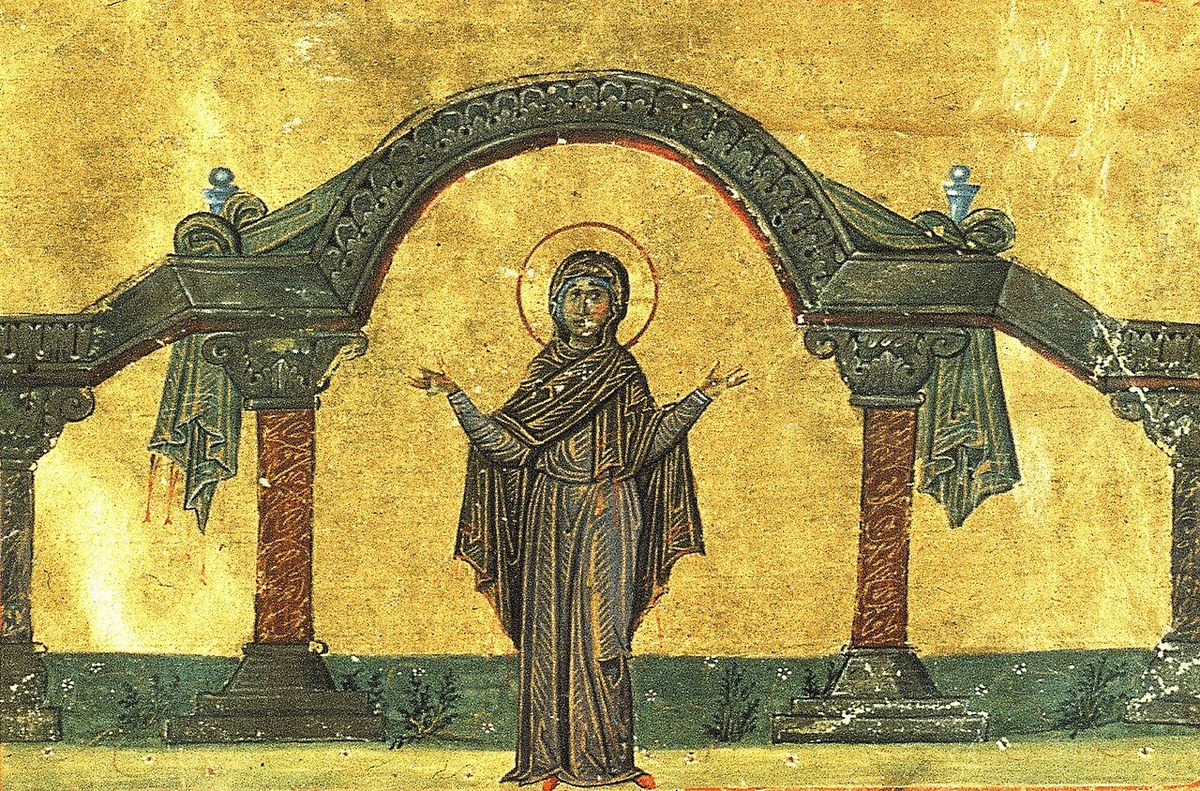
The stored image is the Menologion of Basil II miniature transmitted under Domnina's name: the mother alone, veiled, in the orans posture beneath an arch. The identification rests on the manuscript's description and on its coverage (September–February — the ascetic Domnina of March 1 falls outside it); the miniature shows a portrait rather than the drowning of the passio, a common Menologion convention. The three together would be depicted as a mother and two maidens bearing martyrs' crosses beside the river.
Disputed questions
- The moral question. Self-inflicted death to escape violation exercised the Fathers: Chrysostom and the Antiochene tradition honour the act without reserve; Augustine, discussing such cases in the City of God (I.16–26), holds that virtue is not lost by another's violence and declines to commend the choice, while refusing to condemn those whom the Church already venerated. Both positions are part of the tradition's record and are noted here without adjudication.
- Names and date. Eusebius leaves the three unnamed; the liturgical tradition supplies Domnina, Berenice (Bernike) and Prosdoce. The year is fixed only by the persecution's chronology (c. 302–306).
- The same moral question attends the companion Antiochene case of Pelagia the Virgin of Antioch (October 8), whose entry treats it in parallel.
- Not to be confused with Domnina the Younger of Syria (†c. 460), the ascetic of Cyrrhus (associated with the school of Maron) commemorated March 1, nor with Domnina of Anazarbus (October 12).