
Pelagia the Virgin of Antioch
The Holy Virgin Martyr Pelagia of Antioch
Martyr · Virgin · d. c. 303
Commemorated 8 October
Pelagia the Virgin of Antioch (†c. 303) was a fifteen-year-old Christian maiden of a noble Antiochene house who, when soldiers of the great persecution surrounded her home to seize her — and, the tradition says, to violate her — asked leave to change her clothing, prayed with hands lifted to heaven, and threw herself from the housetop, dying to preserve her virginity for Christ. Antioch venerated her from the first generation: Ambrose of Milan holds her up twice as a pattern of consecrated virginity, and John Chrysostom preached a surviving festal homily on her. She shares her feast, October 8, with a wholly different Antiochene saint of the same name, Pelagia the Penitent.
.jpg)
Pelagia belonged to a prominent Christian family of Antioch in Syria and was fifteen years old, a virgin dedicated to Christ, when the persecution broke over the city — the setting the patristic witnesses presuppose is the great persecution begun under Diocletian, about the year 303. Denounced as a Christian, she was alone in the house when the ruler's soldiers surrounded it with orders to take her; what awaited her, the tradition is explicit, was not only the tribunal but outrage — the deliberate violation by which persecutors broke consecrated virgins before or instead of execution.
The girl came to the door, showed no fear, and asked the soldiers' indulgence to withdraw and put on other clothing. Going up to the roof of the house, she lifted her hands and eyes to heaven and prayed to God that she might not fall into the soldiers' hands but depart to him a pure virgin; then she committed herself to the fall — adorned, as Chrysostom says, in the bridal garment of her body itself — and died of it. The soldiers were left, in Ambrose's phrase, guarding nothing.
Chrysostom, preaching on her feast at Antioch some ninety years later, dwells on the paradoxes of the death: that so young a girl outwitted armed men; that her executioner was, in a sense, her own will made courageous by Christ, "for it was not of herself that she was so fearless, but of Christ who dwelt in her"; and that the grace of God covered whatever in the act outran the common rule. Ambrose in Milan, within the same generation, twice sets her before consecrated virgins as proof that chastity is dearer than life. Churches were dedicated to her at Antioch — where her feast was kept with a full festal assembly in Chrysostom's day — and later at Constantinople.
Feast and commemoration
October 8 (church date; Old Calendar civil October 21), kept universally in the Byzantine rite alongside Pelagia the Penitent, whose service the Menaion appoints for the day; the virgin has her own synaxarion notice and verses ("Fleeing by the ledge the great ledge of shame, thou dost cast down the enemy featly, O Pelagia"). In the West, Ambrose's witness gave her an early cultus; the Roman calendar came to keep her on June 9.
Hymns
Troparion — Tone 4 (from the common of a virgin martyr)
Thy lamb Pelagia crieth unto thee with a great voice, O Jesus: Thee, my Bridegroom, do I love, and seeking thee I contend, and am crucified and buried with thee in thy baptism; and I suffer for thy sake, that I may reign with thee, and I die for thee, that I may live in thee. As a spotless sacrifice, then, receive her who with longing was slain for thee. By her intercessions, since thou art merciful, save our souls.
Original translation from the Greek
Iconography
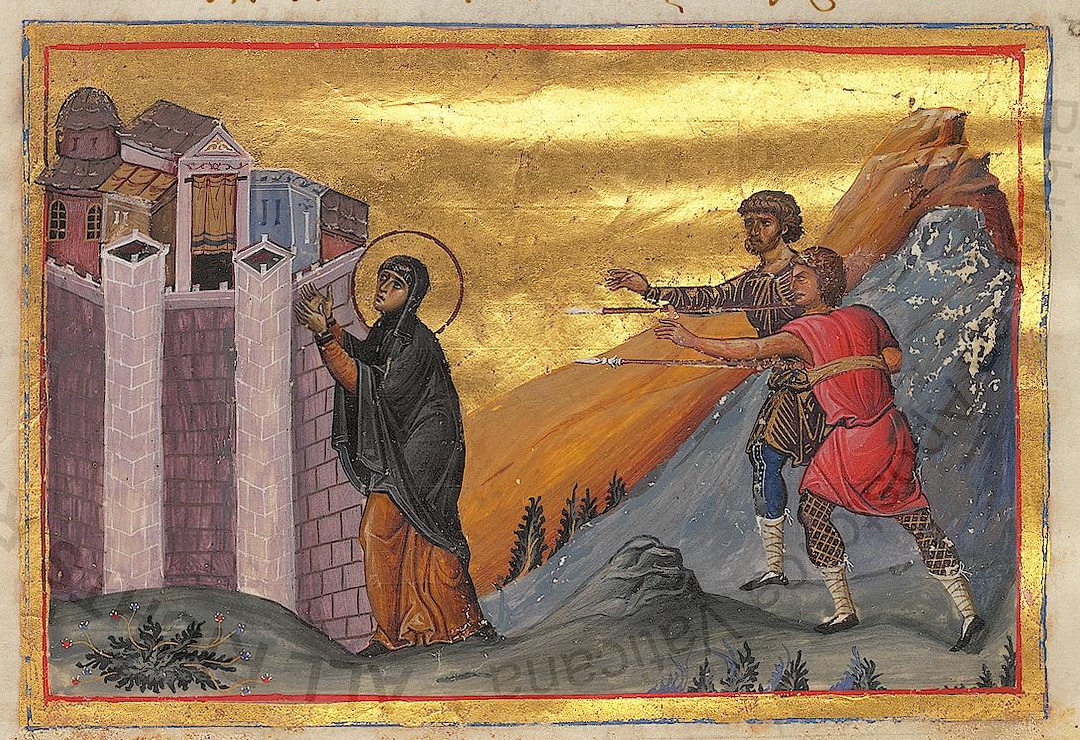
Pelagia is painted as a young maiden in the rich dress of a noble Antiochene house, bearing the martyr's cross; narrative images show her on the rooftop or walls of her house, at prayer or in the fall, with the soldiers below. The stored image is the miniature of the Menologion of Basil II (Constantinople, c. 985, Vatican Library, Vat. gr. 1613, p. 97): the saint, veiled and haloed, stands praying upon the walls of her house as two soldiers with levelled spears close in from the rocky slope at the right — the moment of the passio itself. (The Wikimedia Commons file description mislabels the miniature "the venerable Pelagia"; the scene — armed soldiers seizing a woman at prayer on the ramparts — belongs unmistakably to the virgin-martyr's story, no soldiers figuring in the penitent's Life, and the adjacent miniature on p. 98 of the manuscript depicts the penitent with bishop Nonnus.)
Disputed questions
- The moral question. A self-inflicted death to escape violation exercised the Fathers, and Pelagia is one of the two classic Antiochene cases — the other being Domnina and her daughters (October 4), who drowned themselves on the road four days earlier in the calendar and a few years at most apart in history. Chrysostom and the Antiochene tradition honour both acts without reserve, Chrysostom arguing in Pelagia's homily that the deed was wrought by Christ's own counsel in her ("she had Jesus within her to counsel her"); his encomium even allows that in throwing herself down she may have been seeking escape, hazarding rather than seeking death. Augustine, discussing precisely such cases in the City of God (I.16–26), holds that purity is not lost by another's violence, declines to commend the choice, and will not condemn those whom the Church already venerated, allowing that they may have acted by divine prompting. Both positions are part of the tradition's record and are noted here, as in the Domnina entry, without adjudication: the Church has never ceased to number Pelagia among the virgin-martyrs.
- Date and emperor. The patristic witnesses (Ambrose, Chrysostom) belong to the context of the Diocletianic persecution, and c. 303 is the usual scholarly and calendar dating; some Greek synaxaria and the OCA notice place her instead "in the reign of Numerian" (282–284). The discrepancy is recorded here; this entry follows the patristic setting.
- Not to be confused with Pelagia the Penitent (†c. 457), commemorated the same day: the celebrated actress and courtesan of Antioch converted by bishop Nonnus, who died as the disguised monk "Pelagius" on the Mount of Olives. The two Antiochene Pelagias of October 8 — one a historically attested virgin-martyr, one the heroine of a hagiographic romance built, in Delehaye's analysis, partly upon the martyr's cult — have been confused since antiquity, and the confusion is itself part of the history of both. Distinguish also Pelagia of Tarsus (May 4), a third early virgin-martyr of the name, burned in a brazen bull.