
Edward the Martyr
The Holy Passion-Bearer Edward, King and Martyr, King of the English
Passion Bearer · Martyr · King · b. c. 962 — d. 978, at Corfe in Dorset (March 18)
Commemorated 18 March — Murder at Corfe; his martyrdom
Edward the Martyr (c. 962 – 978) was King of the English for less than three years, and a saint of the undivided Church of the West before the Great Schism. The elder son of the reforming King Edgar the Peaceable, he came young to the throne in 975 amid a bitter succession dispute, and on 18 March 978 was murdered at Corfe in Dorset, at the estate of his stepmother Ælfthryth — cut down by armed retainers as he sat unsuspecting on his horse, having ridden to visit his young half-brother Æthelred, who succeeded him. Buried without honour at Wareham, his body was found incorrupt and translated with great reverence to Shaftesbury Abbey, which became the centre of a fervent cult; miracles were reported at his tomb, and within a generation the murdered king was venerated throughout England as a martyr. The Orthodox Church keeps him on March 18, honouring him among the passion-bearers — an innocent whose unjust death was borne, and crowned, as a witness. He is not to be confused with Edward the Confessor (†1066), the later English king-saint.

Origins and accession
Edward was born about 962, the eldest son of Edgar (King of the English, 959–975), the powerful and pious monarch under whom the great monastic reform of tenth-century England — led by Archbishop Dunstan of Canterbury, Bishop Æthelwold of Winchester, and Bishop Oswald of Worcester — reached its height. Edward's mother is uncertain in the sources; the strongest tradition names her Æthelflæd, Edgar's first consort. By a later marriage Edgar had a younger son, Æthelred, whose mother was Queen Ælfthryth — and it was between the partisans of these two boys that the realm divided when Edgar died suddenly on 8 July 975.
The succession was contested. Æthelred's party, led by his mother Ælfthryth and allied with nobles hostile to the monastic reform, pressed the claims of the younger boy; Edward's, led by Dunstan and the reforming bishops, prevailed, and Edward was consecrated king at Kingston. His brief reign fell in a time of trouble — a comet, then famine, and a violent reaction against the monasteries, in which nobles who resented Edgar's endowments seized back lands and drove out monks. The boy-king, by the sources' account devout but hot-tempered, reigned under the tutelage of Dunstan and the great men of the realm.
The murder at Corfe
On 18 March 978 Edward rode to Corfe, in the Isle of Purbeck in Dorset, where his stepmother Ælfthryth and his half-brother Æthelred were staying, to visit them — coming, the chroniclers say, with only a small company, unsuspecting and in good will. As he arrived and sat still on his horse, the retainers of the household came out to meet him, and — under the show of welcome, one taking his hand or his bridle as if to greet or to offer him drink — he was seized and stabbed. Wounded, he spurred his horse, but fell, and (some accounts add) was dragged with his foot caught in the stirrup until he died, his body left in a mean place. So perished the young king, in an act that horrified his contemporaries: the Anglo-Saxon Chronicle laments that "no worse deed than this was ever done among the English since they first sought the land of Britain… men murdered him, but God magnified him."
Relics and translation
Edward's body was buried hurriedly and without royal honours at Wareham. But the memory of the deed, and reports of wonders at the grave, would not be stilled; and about a year later, in 980, the Ealdorman Ælfhere had the body raised. It was found incorrupt, a sign taken at once for sanctity, and was translated with solemn procession to Shaftesbury Abbey, the great nunnery of Dorset, where it was enshrined. Shaftesbury — which came to be called Edwardstow, "Edward's holy place" — became a celebrated place of pilgrimage and healing, and the murdered king its glory. Later translations and elevations of the relics were kept as feasts. At the Dissolution of the monasteries the shrine was destroyed and the relics hidden; a casket of bones believed to be his was rediscovered at Shaftesbury in 1931, and after long dispute was in the end enshrined by the Orthodox at the Church of St Edward the Martyr, Brookwood (Surrey), kept by the St Edward Brotherhood — so that the passion-bearer king is today venerated with a living Orthodox cultus in the land of his martyrdom.
Veneration and cultus
Edward was reckoned a saint and martyr almost at once. His own half-brother and successor Æthelred — whatever the truth of his kin's part in the murder — became a chief promoter of the cult, and a law of the English (in the code of 1008, drawn up by Archbishop Wulfstan) ordered that the feast of Saint Edward be kept throughout England. His name entered the calendars and the litanies; his shrine at Shaftesbury drew pilgrims through the Middle Ages; and he was honoured, in the English manner, as "King and Martyr." Because he died before the Great Schism of 1054, Edward belongs to the saints of the undivided Church, and is received by the Orthodox among the holy men of the West — kept especially in the British Isles and by the Russian Church Abroad, whose brotherhood guards his relics.
Feast and commemoration
Edward is kept on March 18 (church date; Old Calendar civil March 31), the day of his murder at Corfe, within Great Lent, and his commemoration is sung with the Lenten services. His translation to Shaftesbury (980) and the later elevations of his relics were kept as feasts in medieval England (variously in February and June), and the modern Orthodox observance adds the day of the enshrinement of his relics at Brookwood; the principal feast is that of his martyrdom, March 18. As a saint of the undivided Church his veneration is chiefly of the West and of the British Isles, and among the Orthodox is kept especially by the Russian Church Abroad; he does not appear in the Greek or Slavic Menaia of the Byzantine East, being received rather among the pre-Schism Western saints.
Iconography
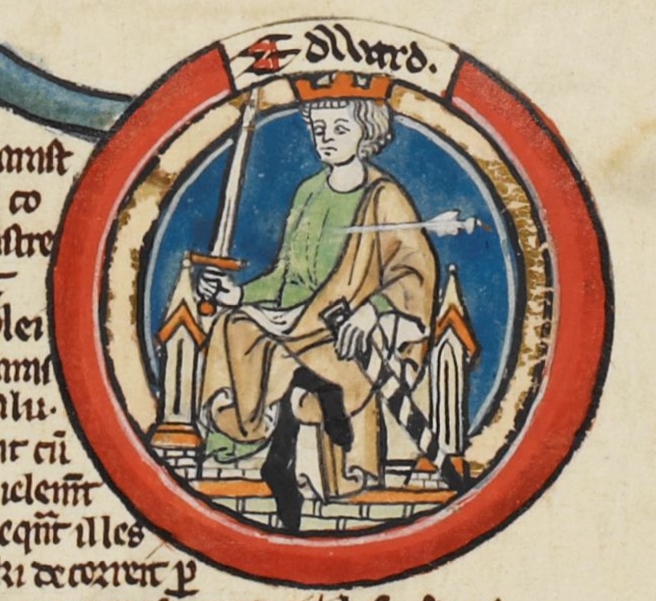
Edward is depicted as a young crowned king: a beardless youth in royal robes and crown, holding the sceptre or orb of kingship and often the cross of a martyr, and — in the developed Orthodox type — bearing a cup or chalice, recalling the drink offered him at Corfe under which the fatal blow was struck, or a sword or dagger, the instrument of his death. He is shown as the innocent royal passion-bearer, in the same family of images as Boris and Gleb and Wenceslaus, the boy-king martyred by treachery.
The stored image is a 14th-century English manuscript miniature from a genealogical roll-chronicle of the kings of England (British Library, Royal MS 14 B VI), depicting Edward the Martyr enthroned and crowned — a faithful reproduction of a medieval work.
Disputed questions
- Who killed him, and why. The near-contemporary sources — the Anglo-Saxon Chronicle and the Life of St Oswald — record the murder and name no murderer, ascribing the deed to the "men" or retainers of Æthelred's household at Corfe. Only the post-Conquest chroniclers (William of Malmesbury, Henry of Huntingdon, and others) fix the guilt firmly upon the stepmother Ælfthryth, who is said to have plotted the killing to set her own son on the throne — the tradition that has passed into legend. Modern historians are divided: some accept a court conspiracy around Ælfthryth and the anti-monastic faction, others see a killing by Æthelred's thegns acting on their own, or the outcome of the feud between the ealdormen of the realm. The Church venerates the innocence of the victim, not the certainty of the plot; the entry records the disagreement of the sources and does not resolve it.
- Martyr or passion-bearer. Edward was killed in a political murder, not slain expressly for confessing Christ, and in the strict sense of the taxonomy he is a passion-bearer — one who received an unjust death in innocence, as Boris and Gleb and Wenceslaus of Bohemia, rather than a martyr of the persecutions. Yet the English tradition has always styled him "the Martyr," and the Orthodox keep the title; the entry carries both, as with Wenceslaus, following the settled name while classing his death among the passion-bearers.
- Not to be confused with Edward the Confessor (c. 1003 – 1066), the pious last king of the old English line, builder of Westminster Abbey, kept in the West on October 13 — a different saint of a different century. "The Martyr" belongs to Edward the son of Edgar; "the Confessor" to Edward the son of Æthelred.