
Wenceslaus of Bohemia
The Holy Passion-Bearer Wenceslaus (Viacheslav), Prince of the Czechs
Passion Bearer · Martyr · Prince · b. c. 907 — d. 935
Commemorated 4 March — Translation of his relics to Saint Vitus, Prague, 28 September — Martyrdom at the church door of Stará Boleslav
Wenceslaus (Václav, in the Russian books Viacheslav; c. 907–935) was the prince of the Czechs, grandson and pupil of the martyr Ludmila of Bohemia. Raised by her in the faith and educated in Slavonic, Latin and Greek letters, he ruled Bohemia with a mildness his nobles read as weakness — building churches, ransoming enslaved children, and founding the church of Saint Vitus in Prague — until his younger brother Boleslav, drawn into a conspiracy of the discontented, invited him to a church feast and cut him down at the church door of Stará Boleslav on the morning of September 28, 935. The first of the Slavic princes to accept death in Christ-like meekness, he is venerated among the passion-bearers as the heavenly patron of the Czech lands, and his cultus in Kievan Rus' prepared the way for Boris and Gleb.

Origins and upbringing
Wenceslaus was born about 907, the eldest son of Vratislav I, prince of Bohemia of the house of Přemysl, and of Drahomíra, a princess of the still-pagan Havolan Slavs. His grandmother Ludmila, widow of the first Christian prince Bořivoj, took charge of his upbringing: under her roof he was formed in the faith, and from a priest of the Slavonic rite named Paul, a disciple of the Methodian mission, he learned Slavonic letters; at Budeč he was schooled in Latin, and the Lives add Greek — the legends delight in a prince who was, by the standards of his age and rank, a genuinely lettered man. His father fell in battle against the Magyars, and the boy of about eighteen (the Slavic tradition; historians place Vratislav's death in 921) inherited a throne he could not yet hold: power passed to his mother Drahomíra as regent. Within months the regent's men had strangled Ludmila at Tetín — the young prince's first teacher his realm's first martyr. When Wenceslaus took the government into his own hands (about 924/925), one of his first acts was to translate his grandmother's relics to Prague and lay them in Saint George's basilica.
Reign
The Lives and the earliest Latin legends agree on the character of his rule: just judgment, care for widows, orphans and the poor, the ransoming of captives and of children sold into slavery — whom he had raised as Christians — peace kept where war was expected, and an open hand to the Church. He honoured the clergy of both the Latin and the Slavonic rites, built and adorned churches, and in Prague raised the rotunda of Saint Vitus, having received a relic of that martyr from the East Frankish king Henry the Fowler; the church he founded grew into the cathedral of Prague, where his own relics now lie. His accommodation with Henry (the sources place a recognition of Frankish overlordship about 929) and his favour to churchmen fed the resentment of the war party among the nobles, who found their instrument in the prince's ambitious younger brother Boleslav; the Slavic Life says plainly that the devil put it into the hearts of the nobles to set brother against brother, as once Cain against Abel.
Martyrdom
Boleslav invited his brother to his own town (the later Stará Boleslav) for the feast of the church there — the dedication was to Cosmas and Damian, kept September 27 — and pressed him to stay the night. Wenceslaus was warned of the plot; the Lives insist he refused to believe evil of his brother, or, believing it, refused to flee, committing himself to the will of God. At dawn on September 28, 935, as he went up to the church for Matins, Boleslav met him at the doors and struck at him with a sword; the prince, the stronger man, disarmed him and cast him down — and would not kill him. Boleslav's retainers ran to their master's cry and cut Wenceslaus down at the church door; he died with a prayer, the Slavic Life says, "Into Thy hands, O Lord, I commend my spirit." His body was hacked and left without burial; his mother, hearing of it, laid him in the church at the princes' court. The blood splashed on the church doors, the tradition relates, could not be washed away, until on the third day it vanished of itself.
Relics and translation
Boleslav, seized in time by remorse — and instructed, the legends say, by the wonders at the grave — had his brother's body translated to Prague and laid in the church of Saint Vitus which the martyr himself had built. The translation, three years after the murder, is kept in the calendars on March 4. The relics rest in the Wenceslas chapel of Saint Vitus cathedral, built over his tomb, the holiest place of the Czech nation; the skull is borne in procession at the national pilgrimage of Stará Boleslav each September 28.
Veneration and later cultus
Veneration began at once and never lapsed. Within a generation Latin legends were written (Crescente fide, Gumpold of Mantua, Christian's Legend), and in the Slavonic rite two Church Slavonic Lives — the First Slavonic Life, composed in tenth-century Bohemia, and a second, translated from Gumpold; through the Sázava monastery and the common Slavonic book culture these passed to Kievan Rus', where the "holy Viacheslav" entered the calendar, the Prologue, and — decisively — the pattern-book of Russian sanctity: the Lives of Boris and Gleb (†1015) invoke Wenceslaus by name as the model of the prince who accepts an unjust death from a kinsman in the meekness of Christ rather than resist with the sword. The type of the passion-bearer, in which the Russian Church would glorify Boris and Gleb and, in time, the last imperial family, thus has Wenceslaus at its head. In Bohemia he became the eternal ruler of the land — the crown of the kingdom was the "crown of Saint Wenceslas," held by kings as his deputies — and his chorale ("Svatý Václave"), attested from the twelfth century, is still sung; September 28 is the Czech national day. The West knows him besides from the nineteenth-century English carol "Good King Wenceslas," which hangs a Victorian legend of winter almsgiving — true at least to his recorded charity — on his name. Portions of his relics have been shared with Orthodox churches, and the Orthodox Church of the Czech Lands and Slovakia honours him, with his grandmother Ludmila, at the head of its national saints.
Feast and commemoration
September 28 (church date; Old Calendar civil October 11) is his principal feast, the day of his martyrdom, shared with Chariton the Confessor whose service holds the day in the universal Menaion. The commemoration is not in the Greek books: it belongs to the Orthodox Church of the Czech Lands and Slovakia (as a chief national feast, with the pilgrimage of Stará Boleslav), to the Russian Church — whose Menaion transmits his proper service, and which has honoured "Viacheslav, prince of the Czechs" since Kievan times — and to the OCA; the Roman church keeps the same day, as does the Czech state holiday. The translation of his relics to Prague is kept on March 4. On the question of his styling (martyr or passion-bearer) see Disputed questions above.
Hymns
Troparion — Tone 4
Today the angels rejoice with men in common gladness; heaven and earth keep radiant festival in thy memory, O holy one. And we sinners cry to thee with fervour: pray to the Master for us, that we be delivered from the assaults of enemies visible and invisible, who honour thy most radiant memory.
Original translation from the Slavonic
Kontakion — Tone 1
Standing with the choirs of angels, O blessed prince Viacheslav, thou delightest in the divine and ineffable beauty, and drawing thence the gifts of grace and wonders, thou pourest out the gift of healing upon all who with faith have recourse to thy shrine.
Original translation from the Slavonic
Iconography
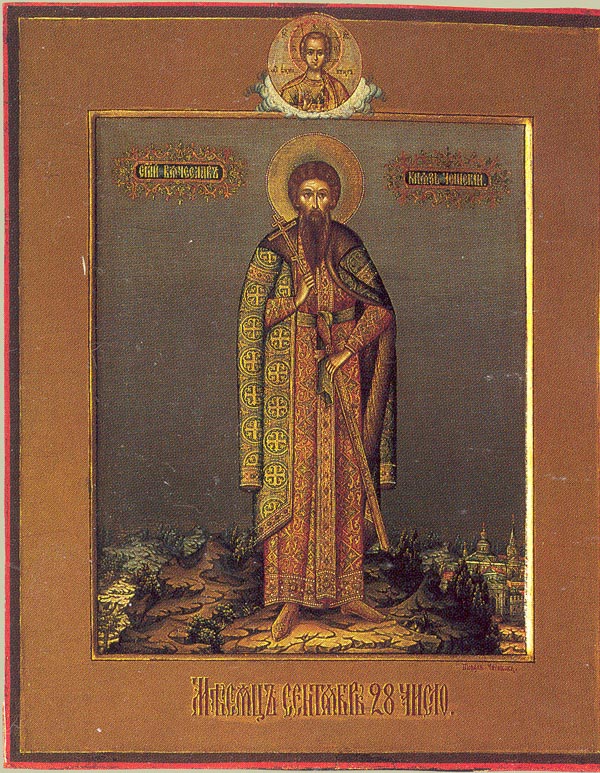
Wenceslaus is painted as a young prince: short-bearded, in the fur-trimmed mantle and cap or crown of a ruler, bearing the martyr's cross, sometimes a sword sheathed or reversed — the weapon he would not use; Czech medieval art gives him lance, shield and the black-eagle banner, and the murder at the church door is a constant narrative subject from the Romanesque period (the Wolfenbüttel Gumpold manuscript) onward. In Russian icons he stands among the holy princes, often paired with Ludmila. The stored icon is a Russian menaion icon for September 28 by Osip Chirikov (late nineteenth century; State Hermitage, Saint Petersburg): the prince stands full-length in patterned princely robes on a hillock before a distant church, cross in hand and sword lowered, Christ blessing from heaven, with the inscriptions "Holy Viacheslav, Prince of the Czechs" and "the month of September, the 28th day" — a companion piece to the Chirikov menaion icon of Ludmila stored with her entry.
Disputed questions
- Year of the martyrdom. The oldest sources allow both 929 and 935; Czech historiography long kept 929, and the Roman Martyrology retains it, but the prevailing modern reconstruction — and the OCA notice — give September 28, 935. The Russian service books, counting by the older date of his father's death (920), make him eighteen at his accession.
- His father's name appears in the Russian literature as Vratislav, Bratislav or even Rostislav (so azbyka's notice); Vratislav I is the historical form.
- Martyr, or passion-bearer? The calendars differ in styling: the OCA titles him "Martyr Wenceslaus, Prince of the Czechs," and the Czech Church calls him mučedník (martyr); the Russian calendar styles him "right-believing prince" (благоверный князь), and the hymnography — "as a second Abel thou didst suffer death without malice, beheaded by the hand of thy brother" — sings him precisely as the tradition sings Boris and Gleb, whose Lives cite him as the exemplar of the passion-bearer. He was killed by Christians in a dynastic plot, not for the confession of the faith as such; but the Church's books receive his death as a holy martyrdom. This entry therefore carries both classifications, passion-bearer first.