
Eleutherius of Illyricum
The Holy Hieromartyr Eleutherius, Bishop of Illyricum, and his mother the Martyr Anthia
Hieromartyr · Bishop · b. c. 100 — d. c. 120
Commemorated 15 December — Martyrdom at Rome under Hadrian, with his mother Anthia
Eleutherius was a young bishop of Illyricum martyred at Rome under the emperor Hadrian (117–138), traditionally about the year 120. Born of an illustrious Roman family and raised in the faith by his widowed mother Anthia, he was advanced to holy orders while still a boy — deacon at fifteen and, the synaxarion says, bishop of Illyricum at twenty — and won renown for the boldness of his preaching. Arrested for confessing Christ, he was subjected to a succession of torments — a heated iron bed, a gridiron, a fiery furnace — from which the tradition reports he emerged unharmed, converting his own persecutors; he was at last beheaded, and his mother, embracing his body, was slain over it. His name — from the Greek for "free" or "deliverer" — made him a patron especially invoked by women in childbirth.
.jpg)
The surviving account of Eleutherius belongs almost wholly to the hagiographic tradition — the Byzantine synaxaria, the Menaion office for December 15, and the later Passions that expand them — rather than to the documentary record. Its core is stable across the witnesses: a bishop consecrated in extreme youth, a mother who both raised and followed him in martyrdom, and a death at Rome under Hadrian.
Origins and early life
Eleutherius was born, the tradition holds, at Rome, the son of a distinguished Roman citizen — some accounts make his father a proconsul — who died while the boy was young. His upbringing fell to his mother Anthia (called Evanthia, Εὐανθία, in the Greek Menaion and in the OCA life), a Christian whom the tradition remembers as herself formed in the faith by the preaching of the Apostles: the day's sticheron hails Eleutherius as one born "of God-minded Anthia" and as "an initiate of the Apostles." She placed him young in the care of the church at Rome, where, the accounts say, a bishop the tradition names Anicetus ordained him deacon at fifteen, presbyter at eighteen, and bishop of Illyricum — the great Roman province spanning the western Balkans — at twenty. The precocity is the signature of his cult: a boy-bishop whose gravity and learning outran his years. (The OCA life compresses this to a single elevation "to bishop of Illyria" at twenty; see Disputed questions on the chronological tangles the names Hadrian and Anicetus create.)
Ministry
As bishop, Eleutherius governed and preached with a freedom that his hagiography plays upon as the living meaning of his name (Eleutherios, "the free man"). His success in bringing pagans to Christ — the office credits him with turning whole peoples — reached the imperial court and drew the persecution that made him a martyr.
Martyrdom
Under Hadrian, an officer — the accounts name the prefect Felix — was sent to arrest the bishop and bring him to Rome. According to the tradition, Felix was so moved by hearing Eleutherius preach on the journey that he confessed Christ and was baptised. Brought before the emperor and refusing to sacrifice, Eleutherius was put to a sequence of torments that the Passion recounts with the conventional amplitude of its genre: stretched on a bed of heated iron, roasted on a gridiron, cast into a fiery furnace or a cauldron of pitch — and preserved unhurt through each, so that his constancy converted onlookers rather than breaking him. The eparch Coribus (Caribus), who had directed the tortures, came in the end to believe in Christ himself and was executed. Eleutherius was finally condemned to the beasts, which the tradition says would not touch him, and was beheaded.
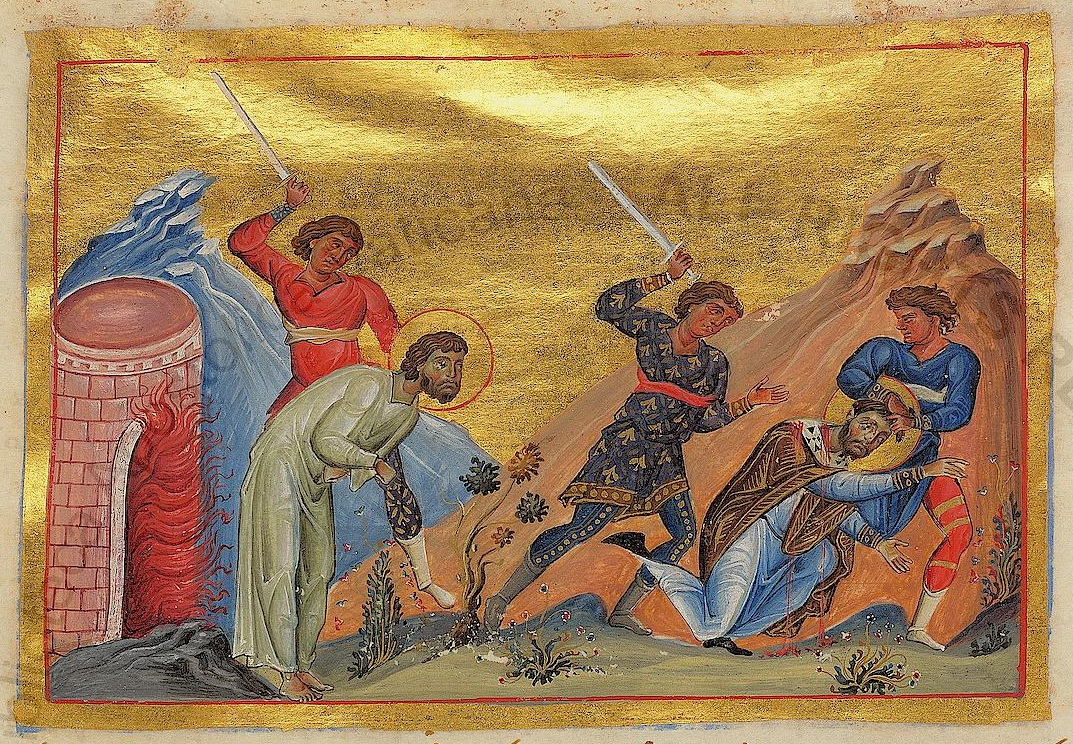
His mother Anthia, present at the end, threw herself upon her son's body, embraced it, and was beheaded over it — the scene the Menologion of Basil II chose for its miniature of the day. Their death is placed about the year 120.
Veneration and later cultus
Eleutherius became a widely venerated martyr of the undivided Church, kept on December 15 in both the Greek and the Slavic books and in the West (the Roman Martyrology commemorates a bishop Eleutherius with his mother Anthia on April 18). His name generated a distinctive patronage: because Eleutherios means "freedom" and "deliverance," the Greek office of the day repeatedly invokes him as one who "gives freedom" — and in particular, in a sticheron at the Aposticha, as the protector of "women in travail" who come to his church, granting them safe deliverance. He is thus among the saints traditionally called upon in childbirth. His relics and dedications spread through the Byzantine world and beyond; churches under his name stand in Greece and in the diaspora.
Feast and commemoration
December 15 (church date; Old Calendar civil December 28), a commemoration kept across the Orthodox world and, in the West, on April 18. The Greek Menaion carries a full proper office of the hieromartyr for the day — stichera, two canons, and proper apolytikion and kontakion — with the martyrdom of his mother woven into its hymns. The day falls within the Nativity Fast. Eleutherius shares December 15 with the Venerable Paul of Latros and, in the Slavic and OCA calendars, with Stephen the Confessor of Surozh, as well as with the separate Martyr Eleutherius the Cubicularius.
Hymns
Troparion — Tone 5
Arrayed in the priestly robe that falls to the feet, and bedewed with the streams of thine own blood, thou didst run up to Christ thy Master, O wise Eleutherius, overthrower of Satan. Wherefore cease thou never to intercede for those who in faith honour thy blessed contest.
Original translation from the Greek
Kontakion — Tone 6
As the comeliness of priests, O holy one, and the encouragement of the martyred champions, we all acclaim and entreat thee, O Hieromartyr Eleutherius: those who with longing keep thy memory, set thou free from manifold dangers, interceding without ceasing on behalf of us all.
Original translation from the Greek
Iconography
Eleutherius is shown as a bishop in episcopal vestments with the omophorion, often holding a Gospel — but, uncharacteristically for a hierarch, as a young, dark-bearded man, in keeping with the tradition of his youthful episcopate. Narrative images depict his martyrdom and that of his mother together. The stored image is the miniature for December 15 from the Menologion of Basil II (Constantinople, c. 1000; Vatican Library, Vat. gr. 1613, p. 246): against a gold ground, executioners with raised swords carry out a double martyrdom — at the left the haloed saint bows beside a brick furnace whose flames recall the torments he survived, while at the right his mother Anthia, haloed, cradles the body as the sword falls, the two deaths shown as one.
Disputed questions
- Chronology of the names. The tradition sets the martyrdom under Hadrian (117–138) yet has Eleutherius ordained by a bishop "Anicetus" — the name of a bishop of Rome who held office only c. 157–168, a generation later — and descends his mother's faith from the direct preaching of the Apostles, whose age had closed some fifty years before Hadrian. The strands cannot all be literal history; they express, rather, the cult's memory of Eleutherius as a martyr of the sub-apostolic Roman church. The entry gives them as the tradition transmits them.
- The see and the "Roman" epithet. The Greek and Slavic books call him bishop "of Illyricum"; the Slavic synaxarion adds "the Roman" (Illyrikíyskiy, Rímskiy), reflecting his Roman birth and the placing of his death at Rome. He is not a bishop of the city of Rome, and is to be distinguished from Pope Eleutherius of Rome (later 2nd century), a separate figure commemorated in the Western books.
- Anthia / Evanthia. The mother's name appears as Anthia in the Latin and much Slavic tradition and as Evanthia (Εὐανθία) in the Greek Menaion and the OCA life; both name one and the same martyr, beheaded over her son.
- Not to be confused with two others of the same name: the deacon Eleutherius, companion of Dionysius the Areopagite (October 3 / 9), martyred at Paris in the Western legend; and the Martyr Eleutherius the Cubicularius ("of Constantinople" / "of Byzantium," †c. 305–311), a chamberlain martyred under Maximian whose own feast is August 4 but who is also named in the Slavonic Menaion on this very day, December 15, and is a distinct saint.