
Elisha of Suma
Our Venerable Father Elisha of Suma, of the Solovki Monastery
Venerable
Commemorated 14 June — Repose and commemoration at Suma
Elisha was a monk of the Solovki monastery on the White Sea, remembered for one thing: the manner of his death. Taken mortally ill while fishing on the river Vyg sixty versts from the monastery, he grieved not at dying but at dying without the great schema; his companions carried him by boat through a storm toward Suma, where a priest-monk could clothe him, and he comforted them in the danger by saying that he saw Saint Zosimas in the boat with them. He was dead when they reached the shore — and at the brethren's prayer to Zosimas he revived, received the schema and Holy Communion, and then reposed in peace. More than a century later his grave was found standing above the ground and healings began at it; a chapel was built over it in 1668, and the fishermen and pilgrims of the Pomor coast have asked his blessing ever since.
.jpg)
A fisherman of the monastery
Nothing is recorded of Elisha's origins, and little of his monastic life; the Paterikon of Solovki says only that he lived without distinction among the brethren of the great island monastery in the fifteenth or sixteenth century, in the generations after its founders Zosimas and Sabbatius. Like many of the brethren he was employed in the fisheries on which the house lived — the Solovki monastery held the fishing stations of the Pomor coast and the rivers running into the White Sea — and it was at one of these, on the river Vyg some sixty versts from the monastery, that he was taken with a mortal sickness.
The journey to Suma
He was told that he was dying, and he wept — not, the account is careful to say, from fear of death, but because he had not received the great schema, and it was the custom of the Russian North that a monk should not go to God without it. His companions, having no priest, advised him to lay it upon himself, and he did so; but in the night, the account continues, the demons tore the schema from him, and it was plain that this was not enough. The brethren resolved to carry him to Suma on the coast, the monastery's mainland settlement, where a hieromonk could clothe him properly and give him the Mysteries.
They took him down the river and out into the Gulf of Suma, and a violent storm came up on the crossing. The boat was in real danger and the men in it were afraid; and the dying man was the calm one. I see Father Zosimas here with us in the boat, he told them, helping us. They came to shore — and Elisha was dead.
The revival, the schema, and the repose
The brethren would not accept it. They prayed over the body, calling on Zosimas of Solovki; and the account says plainly that Elisha came back to life. The priest was fetched; the dying man was tonsured into the great schema, was communicated of the Holy Mysteries, and then, having received what he had wept for, gave up his soul in peace. He was buried at Suma.
The tomb at Suma
More than a hundred years afterwards his grave was found standing above the ground — the sign by which the Russian North commonly recognised its saints — and healings began to be reported at it. In 1668 an inquiry sent from Moscow investigated the reports and a small chapel was raised over the tomb; a second investigation followed in 1710, and the veneration was confirmed. Pilgrims came to it, and the fishermen and seafarers of the coast made a custom of asking his blessing before going out; his intercession is sought for the sick and for those in peril on the water, which is what one would expect of a saint whose own story is a storm at sea and a death and a returning.
Feast and commemoration
June 14 on the church calendar (Old Calendar civil June 27). The commemoration is Russian and local to the Pomor coast and Solovki, kept by the Moscow Patriarchate and the Orthodox Church in America on the day the universal calendar keeps his great namesake the Prophet Elisha. He is also numbered in the regional synaxes — of the Karelian saints, of the Novgorod saints, and of the saints of Solovki — whose dates differ between books and which are not asserted here.
Hymns
Troparion — Tone 8 (common of a venerable father)
In thee, O father, was the divine image preserved with exactness, for taking up the cross thou didst follow after Christ; and thou didst teach by thy deeds to despise the flesh, for it passes away, and to care rather for the soul, a thing immortal. Wherefore, O venerable Elisha, thy spirit rejoices with the angels.
Original translation from the Slavonic
Kontakion — Tone 8 (common of a venerable father)
Having laboured in the Lord's fisheries and been kept in the storm by the prayer of thy father Zosimas, thou wast clothed in the angelic habit at the very gate of death, O venerable Elisha; wherefore thy grave pours out healings upon all who call upon thee.
Iconography
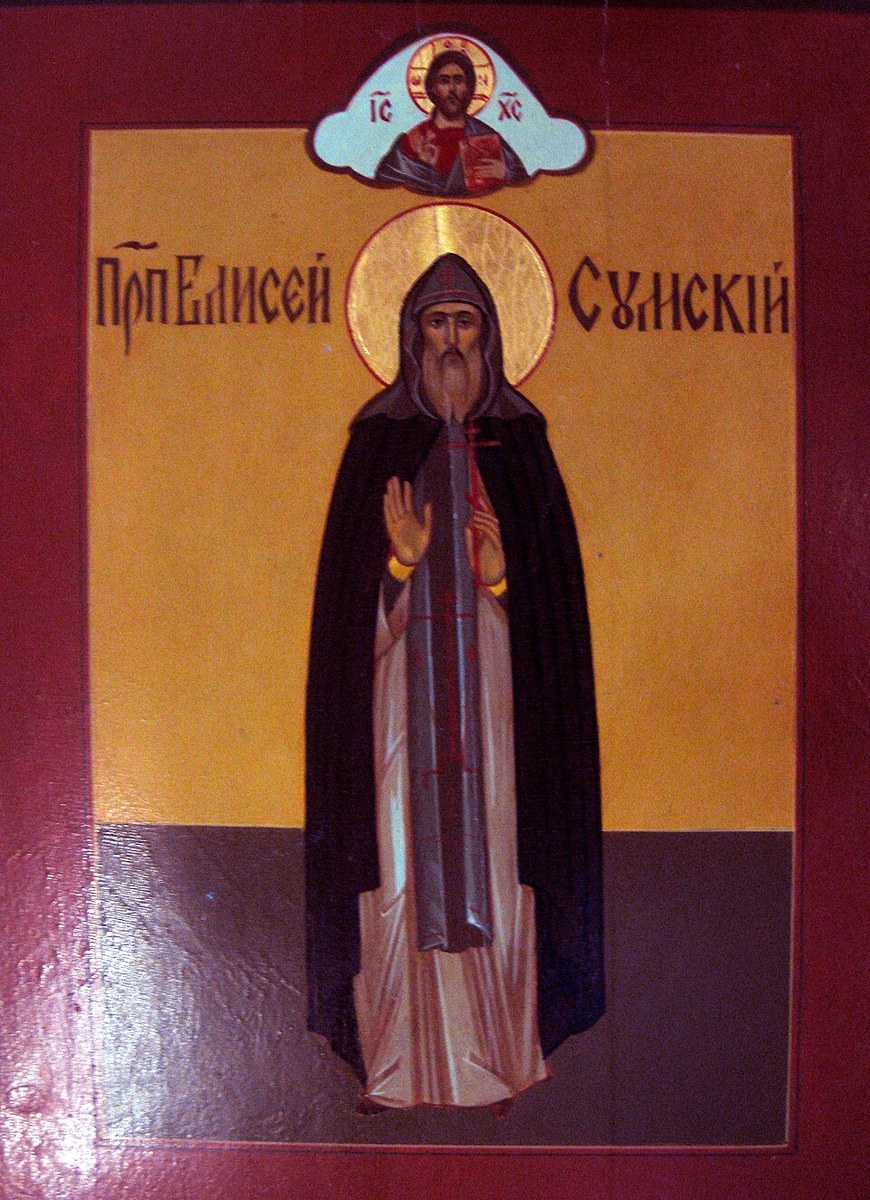
Elisha is painted as a monk of the Russian North — a middle-aged or elderly figure in the black mantle and cowl of the schema over a pale under-robe, hands joined at the breast or holding a scroll — and he is inscribed Преподобный Елисей Сумскій. He appears in the multi-figure panels of the Solovki saints gathered about Zosimas and Sabbatius, and in the local iconography of the Karelian and Pomor churches. He carries no attribute of his own; where a boat or a storm appears behind him, it belongs to the account of his death.
The stored image is a panel from the Church of the Dormition at Kondopoga in Karelia, a wooden church of 1774, dated by its record to the seventeenth or eighteenth century: the saint standing full length in a black mantle and pointed cowl, with the great schema falling over a white under-robe, his right hand raised, the Saviour blessing from a cloud above, and the inscription across the gold ground.
Disputed questions
- Dates. None is transmitted. The Russian calendars place him in the fifteenth to sixteenth century, the OCA in the sixteenth; this entry indexes him in the sixteenth. The one firm date in his dossier is 1668, the year of the inquiry and the chapel — a century and more after his death.
- The revival. The account of his death, restoration to life, tonsure and second repose is transmitted as it stands in the Solovki tradition and is not softened here; it is the whole substance of his veneration, and it turns on the intercession of Saint Zosimas rather than on any power of his own.
- Not to be confused with the Prophet Elisha, whose universal feast falls on the same day, June 14, and whose name he bears; the coincidence of day and name is the reason the two stand together in the Russian calendar of this date.