
Elisha the Prophet
The Holy Prophet Elisha
Prophet
Commemorated 14 June — Repose of the prophet
Elisha son of Shaphat, called in Greek Elissaios and in the Slavonic books Elisei, was the disciple, servant and successor of the Prophet Elijah, and the only prophet of Israel who asked for and received a double portion of his master's spirit. Called from the plough at Abel-meholah, he served through the reigns of six kings of Israel for more than half a century, and the record of his acts in the Books of Kings is the densest concentration of miracle in the whole Old Testament: the parting of the Jordan with Elijah's fallen mantle, the healing of the bitter spring at Jericho, the widow's inexhaustible oil, the raising of the Shunammite woman's dead son, the cleansing of Naaman the Syrian in the Jordan, the axe-head that floated, the blinding of the Aramean army at Dothan, and — after his own burial at Samaria — the dead man who came to life on touching his bones. The Church reads nearly every one of these as a figure of the Gospel, and keeps his memory on June 14.

From the plough to the mantle
Elisha appears first at the end of the great cycle of Elijah, at the mouth of the Lord on Mount Horeb: among the three commands given to the fugitive prophet in the cave — anoint Hazael king over Syria, anoint Jehu king over Israel — the third is "Elisha the son of Shaphat of Abel-meholah shalt thou anoint to be prophet in thy room" (1 Kings 19:16). Elijah found him ploughing with twelve yoke of oxen, and threw his sheepskin mantle over him. Elisha asked leave to kiss his father and mother farewell, then made his answer in a way that left no return: he slaughtered the yoke of oxen he had been driving, burned the wooden plough and gear for the fire, fed the people on the sacrifice, and "arose, and went after Elijah, and ministered unto him" (1 Kings 19:19–21). The hymnography of his feast never forgets this beginning: "From a ploughman thou wast shown forth a prophet," sings the exapostilarion, and the oikos of his kontakion salutes him, "Rejoice, thou who didst slay the yoke of oxen; rejoice, thou who didst leave behind thy whole livelihood."
Of his birthplace the synaxaria say more than the Scriptures: they name the village Abel-meholah (Greek Abelmaoum, the OCA life Abelmaum) in the Jordan valley, and, on the authority of the pseudo-Epiphanian Lives of the Prophets, add that he was of the tribe of Gad, that a portent attended his birth — the golden calves at Gilgal are said to have bellowed so loudly that they were heard in Jerusalem — and that a priest interpreted the sign to mean that a prophet had been born in Israel who would break the graven images.
The double portion
The Second Book of Kings opens with the parting. The two prophets went down together from Gilgal to Bethel, to Jericho, and to the Jordan, and three times Elijah bade his disciple stay behind, and three times Elisha answered, "As the Lord liveth, and as thy soul liveth, I will not leave thee." At the river Elijah struck the water with his rolled mantle and the two crossed over on dry ground. Then Elijah said, "Ask what I shall do for thee, before I be taken away from thee." And Elisha said: "I pray thee, let a double portion of thy spirit be upon me" (2 Kings 2:9). Elijah answered that it was a hard thing, and made it conditional on sight: "If thou see me when I am taken from thee, it shall be so unto thee."
So it happened. As they walked and talked, "there appeared a chariot of fire, and horses of fire, and parted them both asunder; and Elijah went up by a whirlwind into heaven." Elisha saw, and cried out the words that the Church has taken into her own mouth as the very cry of the disciple bereft of his teacher: "My father, my father, the chariot of Israel, and the horsemen thereof!" — and rent his own garments in two. The mantle fell from the ascending prophet; Elisha took it up, returned to the Jordan, struck the water with it, and said, "Where is the Lord God of Elijah?" And the river parted a second time, and he passed over; and the fifty sons of the prophets watching from Jericho said, "The spirit of Elijah doth rest on Elisha," and bowed to the ground before him (2 Kings 2:11–15). The Greek distich of his synaxarion turns on the same thought: horses bore Elijah up to heaven, but the second Elijah was borne up by angelic minds.
The Fathers read the "double portion" in two ways at once, and the liturgical texts keep both. Numerically it is the double share of the firstborn heir (Deuteronomy 21:17): Elisha is Elijah's son and heir in the Spirit, and the count of his recorded miracles in Kings — about double Elijah's — was noticed early and taken as the seal of the request granted. Spiritually it is the grace of the fathers passing whole and undiminished to the sons, so that the gift given is not divided by being shared. His feast day therefore never stands quite alone: the doxastikon at the Praises honours "the chief boughs of the prophets and the all-radiant luminaries of the world, Elijah and Elisha" together, and the apolytikion appointed on June 14 is Elijah's own, because on this day the Church contemplates the grace that came down from the fiery chariot upon the man left standing on the bank.
The acts of the prophet
The chapters that follow (2 Kings 2–13) are a chain of signs, and the Church has drawn her readings and her images from nearly every link.
The waters of Jericho (2:19–22). The men of the city complained that their spring was bad and the land barren. Elisha called for a new cruse with salt in it, cast the salt into the spring, and said, "Thus saith the Lord, I have healed these waters." The canon of the feast makes him the "divine salt" of the Gospel, sweetening what was barren — and the Church's Great Blessing of the Waters keeps the memory of the sign.
The mocking children and the bears (2:23–25). On the road up to Bethel a crowd of boys jeered at the prophet — "Go up, thou bald head" — and two bears came out of the wood and mauled forty-two of them. The synaxaria and the canon read the episode not as a prophet's vengeance but as the honour God places upon his own, and as a warning against the contempt of holy things; the mockery of his baldness is also the reason the icons show him with a high bare brow.
The widow's oil (4:1–7). A prophet's widow, whose creditors were about to take her two sons for debt, had nothing in the house but a single pot of oil. Elisha told her to borrow every empty vessel her neighbours had, shut the door, and pour. The oil ran until there was not a vessel left, and she sold it and paid the debt and lived on the rest. The Fathers set this beside the widow of Zarephath's meal and oil under Elijah, and beside the wine of Cana.
The Shunammite and her son (4:8–37). A wealthy woman of Shunem built a walled chamber on her roof with a bed, a table, a stool and a lampstand for the prophet's lodging, and for her hospitality he foretold that she should bear a son. The child grew, and one harvest morning cried out to his father in the field, "My head, my head!" and died on his mother's knees at noon. She laid him on the prophet's bed, rode to Carmel, and would not be answered by his servant Gehazi: "As the Lord liveth, and as thy soul liveth, I will not leave thee." Elisha came, shut himself in with the dead child, prayed, and lay upon him mouth to mouth, eyes to eyes, hands to hands, until the flesh warmed; the boy sneezed seven times and opened his eyes. This is the first raising of the dead by prayer in the Scriptures after Elijah's at Zarephath, and one of the Old Testament's plainest figures of the Resurrection: the prophet stretched out upon the dead body is read by the Fathers as a type of the Word taking to himself our dead humanity, limb answering to limb.
The deadly pottage and the twenty loaves (4:38–44). In the famine at Gilgal a disciple gathered wild gourds into the common pot, and the sons of the prophets cried, "There is death in the pot." Elisha threw in meal and the food was harmless. Then a man brought him twenty barley loaves and fresh ears of corn, and Elisha told his servant to set it before a hundred men. The servant objected that it was not enough; the prophet answered, "Give the people, that they may eat: for thus saith the Lord, They shall eat, and shall leave thereof." And they ate and left some over. The Church reads this as the direct forerunner of the multiplication of the loaves, even to the gathered remainder.
Naaman the Syrian (5). The commander of the army of Syria was a leper, and a captive Israelite girl in his household told her mistress of the prophet in Samaria. Naaman came with horses and chariots and a king's letter; Elisha did not come out to him, but sent word to go and wash seven times in the Jordan. Naaman went away angry — were not Abana and Pharpar better rivers than all the waters of Israel? — and it was his servants who reasoned him into obedience. He dipped seven times and his flesh came back like a little child's, and he confessed, "Now I know that there is no God in all the earth, but in Israel," and would have paid; and Elisha would take nothing. This is the one act of Elisha that the Lord himself names: preaching in the synagogue at Nazareth he said, "And many lepers were in Israel in the time of Eliseus the prophet; and none of them was cleansed, saving Naaman the Syrian" (Luke 4:27) — the sentence that turned the synagogue against him, because it granted the mercy of God to a Gentile before Israel. The Fathers therefore read the seven washings in the Jordan as the plainest Old Testament figure of baptism, and Naaman as the first-fruits of the Gentiles; the canon of the feast sings it in so many words, that Naaman, bathed by Elisha and washed of his leprosy in the Jordan, showed forth the divine cleansing of baptism. The chapter closes darkly: Gehazi, the prophet's servant, ran after Naaman for the money his master had refused, lied about it, and took Naaman's leprosy upon himself and his seed for ever.
The axe-head (6:1–7). The sons of the prophets were felling timber by the Jordan to build, and one man's borrowed iron axe-head flew off the handle into the water. Elisha cut a stick, cast it in at the place, and the iron floated up. The Fathers see in the wood that raises the iron the wood of the Cross raising the sunken weight of our nature out of the deep, and the hymnography of the Elevation of the Cross uses the image; some read it also of Adam drowned in the Jordan of death and drawn up by the Tree.
The blinding of the Arameans (6:8–23). The king of Syria found that his every ambush was known in Samaria before he reached it, and learned that "Elisha, the prophet that is in Israel, telleth the king of Israel the words that thou speakest in thy bedchamber." He sent horses and chariots and a great host by night to take him at Dothan. The prophet's servant rose early, saw the city ringed with armies, and cried out; and Elisha answered, "Fear not: for they that be with us are more than they that be with them," and prayed, "Lord, I pray thee, open his eyes, that he may see" — and the young man saw the mountain full of horses and chariots of fire round about Elisha. Then the prophet prayed the opposite prayer over the enemy: "Smite this people, I pray thee, with blindness." He led the blinded army into the middle of Samaria, opened their eyes there, and — when the king of Israel asked twice, "My father, shall I smite them?" — refused it: set bread and water before them, feed them and send them home. They went, and the bands of Syria came no more. It is one of the great Old Testament witnesses both to the unseen armies that guard the saints and to the returning of good for evil.
The lifting of the siege of Samaria (6:24–7:20). In the famine of the Aramean siege, when the city had come to cannibalism and an ass's head sold for eighty pieces of silver, and the king swore to have the prophet's head, Elisha foretold that by the next day a measure of fine flour would sell for a shekel in the gate of Samaria; and the king's officer who scoffed, "though the Lord should make windows in heaven," was told he should see it and not eat of it. That night the Lord made the Syrian host hear the noise of chariots, and they fled and left their camp, and four lepers at the gate found it empty; and the scoffing officer was trampled to death in the gate by the crowd that ran out to plunder.
Kings and the last arrow (8–9, 13:14–19). Elisha completed the commissions given to Elijah at Horeb: he foretold to Hazael, sent to him by the sick king of Syria, that he should be king, and wept at what he saw him doing to Israel; and he sent one of the sons of the prophets with a vial of oil to anoint Jehu king over Israel in Ramoth-gilead, and the revolution that ended the house of Ahab followed. At the end of his life, on his sick-bed, he made King Joash of Israel shoot an arrow eastward out of the window — "the arrow of the Lord's deliverance" against Syria — and then strike the ground with the remaining arrows. The king struck three times and stopped; and the dying prophet was angry with him: he should have struck five or six times, and would have smitten Syria to the end, but now he would beat her only thrice.
Repose and the miracle at the tomb
Elisha prophesied, on the reckoning of the synaxaria, for more than sixty-five years, under six kings of Israel — from Ahab and Ahaziah, through Jehoram, Jehu and Jehoahaz, to Joash — and died in great old age at Samaria, where he was buried. He is the only prophet whose recorded wonders continue after his death. "And it came to pass, as they were burying a man, that, behold, they spied a band of men; and they cast the man into the sepulchre of Elisha: and when the man was let down, and touched the bones of Elisha, he revived, and stood up on his feet" (2 Kings 13:20–21). The Church reads this as the founding text of the veneration of relics: the grace that dwelt in the prophet did not leave his bones, and the dead man raised by a dead man's skeleton is the answer given in advance to every objection that holy remains are only dust. Jesus son of Sirach, praising the fathers, gathers Elisha's whole life into three verses: "Elisha was filled with his spirit... while he lived he was not moved with the presence of any prince... and after his death his body prophesied. He did wonders in his life, and at his death were his works marvellous" (Sirach 48:12–14).
His tomb at Samaria — the city refounded as Sebaste by Herod — was venerated together with those of the Prophet Obadiah and of John the Baptist. Rufinus and the Church historians report that in the reign of Julian the Apostate (361–363) the pagans of Sebaste broke open the sepulchres, scattered and burned the bones of Elisha and of the Forerunner, and mixed the ashes with the dust of animals; Christians who had come from Jerusalem gathered what they could and carried the portions away, and relics of the prophet were afterwards shown at Alexandria and, in the middle ages, in the West. A church of the Prophet Elisha stood in Constantinople and is named in the sources for the capital's topography; his memory was kept there with the customary solemnity of a prophet's feast.
Feast and commemoration
June 14 on the church calendar (Old Calendar civil June 27). The Greek Menaion heads the day "Memory of the holy Prophet Elisha, and of our father among the saints Methodius, Archbishop of Constantinople the Confessor," and appoints one office to the two together, with six stichera at "Lord, I have cried" divided between them and a canon apiece. The day is kept universally, with a full prophet's office; the Slavonic books add the local commemorations of the Russian calendar. Because the position of June 14 in the year's cycle — in the afterfeast of Pentecost, or within the Apostles' Fast — depends on the date of Pascha, the Menaion states no fixed rule for it.
Elisha is also commemorated with all the righteous of the Old Covenant on the Sunday of the Holy Forefathers before the Nativity, and is named with Elijah wherever the Church honours the prophets of Carmel. His grace is invoked in the blessing of waters and, following the healing of Naaman, in prayers for the leprous and the incurably sick.
Hymns
Apolytikion — Tone 4
The angel in the flesh, the foundation of the prophets, the second forerunner of the coming of Christ, the glorious Elijah, sending down his grace from on high upon Elisha, drives away diseases and cleanses lepers; wherefore he pours forth healings upon those who honour him.
Troparion
As we celebrate the memory of thy prophet Elisha, O Lord, through him we entreat thee: save our souls.
Original translation from the Greek
Kontakion — Tone 8
Having received a twofold grace from the Spirit, thou wast shown forth a wondrous prophet to all the ends of the earth, delivering from dangers those who sing thy praise, and granting the grace of thy wonders to those who run to it in faith and cry to thee: Rejoice, O prophet divinely inspired!
Original translation from the Greek
Oikos
The Sun of righteousness, shining down within thy enlightened soul, drove out from it every mist of sin and showed thee forth a most radiant prophet of God; wherefore we also cry aloud to thee: Rejoice, thou who preferred nothing to God; rejoice, thou who didst slay the yoke of oxen. Rejoice, thou who didst leave behind thy whole livelihood; rejoice, thou who wast made rich with the wealth that cannot be stolen. Rejoice, for thou didst follow the God who called thee; rejoice, for now thou hast received his gifts. Rejoice, for thou didst take up the mantle of Elijah; rejoice, for thou dost swiftly cleave the water. Rejoice, thou who passest the waters unwetted; rejoice, helper of many souls. Rejoice, thou who didst learn the hidden knowledge; rejoice, thou who art dead and yet watchest as one alive. Rejoice, O prophet divinely inspired!
Exapostilarion — Tone 3
From a ploughman thou wast shown forth a prophet, O Elisha; and receiving the mantle of Elijah and his spirit in double measure, thou didst draw it to thyself; and with him we honour thee.
Synaxarion
Horses bore Elijah up; but the twofold Elijah, angelic minds bore up to the heavens as horses. On the fourteenth Elisha received his appointed end.
Iconography
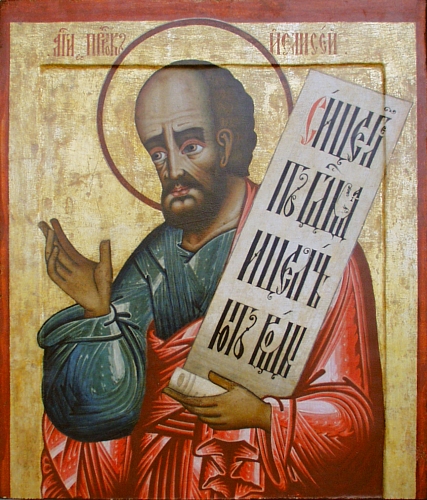
Elisha is painted as an old man in the prophet's tunic and himation, with a high bald brow and a short rounded beard — the baldness that the boys of Bethel mocked is his fixed distinguishing mark, and it separates him at once from the long-haired, hair-clad Elijah beside whom he most often stands. He holds an open scroll; in the Slavonic panels the text is commonly his cry at the parting, "Where is the Lord God of Elijah?" or the words of the double portion. He belongs by right to the prophet tier of the Russian iconostasis, and in the great cycles he appears twice: once alone as prophet, and once in the scene of the Ascent of Elijah, standing on the bank of the Jordan with hands stretched up to the fiery chariot, catching the falling mantle — an image so standard that Byzantine and Cretan painters treat "Elijah and Elisha" as a single composition. Narrative cycles of his own acts (the widow's vessels, the Shunammite's son, Naaman in the river, the floating axe) are found in illuminated Octateuchs and Books of Kings and on the walls of monastic refectories.
The stored image is a Russian prophet-tier panel of the first quarter of the eighteenth century from the iconostasis of Kizhi in Karelia, inscribed СТЫЙ ПРОР(ОКЪ) ЕЛИСЕЙ: the prophet half-length in a blue-green chiton and red mantle, the great bare forehead and short beard, his right hand raised in the gesture of speech and his left holding a long inscribed scroll.
Disputed questions
- Date. The received synaxarion places him about 900 BC; the OCA and Russian lives say "the ninth century before Christ." The chronology of Kings puts his call late in the reign of Ahab (c. 850s BC) and his death in the reign of Joash of Israel (c. 800–790 BC). This entry indexes him in the ninth century BC, which satisfies both.
- Length of ministry. "More than sixty-five years" is the figure of the Russian and OCA lives; the Greek synaxarion says only that he prophesied long and under six kings. Both are reckonings from the regnal data of Kings, not independent traditions.
- Tribe and birthplace. The tribe of Gad and the bellowing of the calves at his birth come from the Lives of the Prophets attributed to Epiphanius, a late and legendary collection; the Scriptures name only his father Shaphat and the place Abel-meholah. The manuscripts of the synaxaria spell the place variously (Abelmaoum, Abelmaum, Abelmeoula).
- Not to be confused with Elisha of Suma at Solovki (below on the same day), nor with the various later monastic Eliseis of the Slavonic calendars; and note that the name in Greek service books is Elissaios (Ἐλισσαῖος/Ἐλισαῖος), which older English translations render Eliseus, the form used in the Authorised Version at Luke 4:27.