
Epiphanius of Cyprus
Our Father among the Saints Epiphanius, Bishop of Constantia and Archbishop of Cyprus
Bishop · Venerable · Wonderworker · b. c. 310–320, at Besanduke near Eleutheropolis in Palestine — d. May 12, 403, at sea on the voyage from Constantinople to Cyprus
Commemorated 12 May — Repose at sea, kept jointly with Germanus of Constantinople
Epiphanius (c. 310/320 – 403), Bishop of Constantia (ancient Salamis) and metropolitan of Cyprus for some thirty-six years, is the great heresiologist of the early Church and one of the most learned and least comfortable of the Fathers. Formed as a monk in Egypt and Palestine and long abbot of his own monastery near Eleutheropolis, he brought to the episcopate an ascetic's austerity, a prodigious philological learning — Jerome calls him pentaglossos, "five-tongued" — and an implacable hostility to every deviation from the Nicene faith. His Panarion, the "medicine chest" against eighty heresies, and his Ancoratus are irreplaceable: much of what survives of Gnostic, Marcionite, Ebionite and Manichaean literature survives only because Epiphanius quoted it in order to destroy it. In old age his zeal was turned against Origen and, disastrously, exploited by Theophilus of Alexandria against John Chrysostom; he withdrew from that intrigue too late and died at sea on May 12, 403, sailing home. The Seventh Ecumenical Council names him among the Fathers and Teachers of the Church.

Origins and early life
Epiphanius was born about the year 310–320 in the village of Besanduke (Bisanduke), in the territory of Eleutheropolis — the modern Beit Guvrin — in southern Palestine. His Life, composed in Greek and standing behind the Byzantine synaxaria, makes him the child of poor Jewish parents, orphaned young, converted and baptised after being struck by the almsgiving of a monk named Lucian; his sister, the same Life says, he placed in a convent. His own writings never claim Jewish birth, and modern scholars therefore hold the tradition unproven — but they grant that his knowledge of Hebrew, unusual in a Greek bishop of the fourth century, is real and demonstrable from his works, and that a Palestinian upbringing among Jews and Samaritans would explain a good deal in him.
What is certain is that he became a monk young and remained one all his life. He spent time in Egypt among the monks of the Thebaid — his own pages record his encounters there with living Gnostic sects, including a first-hand account of being solicited by women of the sect he calls the Phibionites, from whose company he fled and whose members he reported to the bishops. Returning to Palestine about the 330s, he founded a monastery at Ad, near his native place, and governed it for roughly thirty years. The house became known throughout Palestine as a stronghold of uncompromising Nicene orthodoxy and of exact ascetic discipline; from it Epiphanius corresponded widely and began to assemble the vast dossier of heresies that would become the Panarion.
Bishop of Constantia in Cyprus
About the year 365–367 the bishops of Cyprus elected him to the see of Constantia — the rebuilt Salamis, metropolis of the island. The hagiographical tradition surrounds the election with providential signs: that the people of a Lycian city had first sought him; that he consulted Hilarion the Great (October 21), whose disciple the Life makes him, and was sent by him to Salamis where the bishops were gathered; that the aged Bishop Papius was shown by revelation whom to consecrate; and, in another version, that Epiphanius was on his way home to Palestine when a storm drove his ship to Cyprus and into the hands of the electors. He held the see for thirty-six years, until his death.
As metropolitan he kept the monk's rule: extreme personal poverty, and an almsgiving so uncalculating that it became proverbial and, his critics said, ruinous to the treasury of his church. He is credited with a gift of discernment — the Life tells that at the Liturgy he saw the descent of the Holy Spirit upon the Gifts, and that on one occasion, seeing nothing, he quietly withdrew an unworthy clergyman from the altar — and with wonderworking, which he tried to hide. His disciples wrote his life down as it happened: first John, a robber who had held him captive in the desert of Spanidrion and was converted, baptised and made his companion; and after John's death, Polybius, later bishop of Rinocorura in Egypt. Sabinus, who had been tonsured by him and shared his asceticism for five years, succeeded him at Constantia. At Salamis he began a great basilica, left unfinished at his death; its excavated ruins still bear his name.
His episcopate was not spent on Cyprus alone. He intervened in the affairs of the Church at large wherever he thought the faith at stake — and above all in the schism of Antioch. In the long division of the Antiochene Nicenes between Paulinus and Meletius, Epiphanius took the side of Paulinus, went to Antioch about 376, disputed there with the Apollinarian Vitalis, and carried his support for Paulinus to Rome in 382, to the synod under Pope Damasus, in the company of Paulinus and of Jerome. In Rome he lodged in the house of the noble widow Paula, whose ascetic vocation his presence helped to kindle — one of the quieter and happier fruits of his long life.
The heresiologist: Panarion and Ancoratus
About 374 Epiphanius wrote the Ancoratus (Ἀγκυρωτός, "the well-anchored man") for the church of Suedra in Pamphylia: a compact statement of the faith against the errors of the day, strong on the divinity of the Holy Spirit — written in the very years when that question was being fought out — and on the resurrection of the body, and preserving an early creedal formula of great interest to historians of the Creed.
Between about 374 and 377 he composed his monument, the Panarion (Πανάριον — a "medicine-chest" or "bread-basket" of antidotes), also known as Against Heresies. In three books he describes and refutes eighty heresies, the number chosen in allusion to the eighty concubines of the Song of Songs. Twenty belong to the age before Christ — the philosophical schools, the Samaritan sects, the Jewish parties — and sixty to the Christian era, running down to the Arians, the Apollinarians and the Messalians of his own day.
Its value is double and its two halves pull against each other. As history the Panarion is irreplaceable. Epiphanius quotes his opponents at length, and because he does, we possess: the Letter of Ptolemy to Flora, the fullest surviving Valentinian document; extracts from the Gospel of the Ebionites and the Gospel of the Hebrews; the chief evidence for the shape of Marcion's canon, his abridged Gospel and his Apostolikon, reconstructed by Epiphanius from Marcionite books he had before him; material on Mani, on the Montanists and Quartodecimans, on the Melitian schism in Egypt, on the Arian genealogy from Arius to Aetius; and the only real account of the Collyridians, women who offered bread-cakes to the Theotokos, and of the Antidicomarianites who denied her perpetual virginity — passages that stand at the head of the documentary history of Marian devotion and Marian doctrine alike.
As polemic it is notoriously unreliable. Epiphanius multiplies sects to reach his number, conflates groups, repeats hostile rumour, argues by invective, and is capable of grave error about movements he had not read. His treatment of Origen — heresy 64 — condemns as Origen's what is often the teaching of later Origenists, and he was frank, when pressed at Constantinople, that he had not read the books he was condemning. Modern scholarship therefore uses him as one uses a hostile witness who happens to be the only witness: gratefully and with care.
Two further works belong to his learning rather than his polemic. On Weights and Measures (392) is a handbook of biblical scholarship — the canon of Scripture, the Greek versions and the Hexapla, biblical metrology, and the topography of Palestine; it survives complete only in Syriac, with Armenian and Georgian fragments. On the Twelve Gems expounds the stones of the high priest's breastplate and their allegorical meanings, and likewise survives chiefly in oriental versions. A great mass of homilies circulated later under his name; almost all are pseudo-Epiphanian, including the famous Holy Saturday homily "What is this? Today there is a great silence over the earth," which is the work of an unknown later Greek preacher.
The Origenist controversy
In 393 an agitator named Atarbius went about Palestine demanding subscriptions against Origen. Epiphanius, who had condemned Origen in the Panarion twenty years before, threw himself into the campaign. Visiting Jerusalem in 394, he preached in the Church of the Resurrection, in the presence of John II of Jerusalem, a sermon against Origen's errors; John answered from the same pulpit with a sermon against the anthropomorphites — those who imagine God with a body — which everyone present understood as a counter-thrust. Epiphanius rose and declared that he anathematised anthropomorphism as heartily as John did, and Origenism besides. The breach did not close.
It widened into scandal when Epiphanius, in John's territory, ordained Paulinianus — the brother of Jerome — to the diaconate and presbyterate for the monastery at Bethlehem, over the protests of the ordinand and without the diocesan bishop's leave. John charged him with breaking the canons; Epiphanius replied in a letter which Jerome translated into Latin and which survives among Jerome's correspondence as Epistle 51. Jerome took Epiphanius's side; Rufinus of Aquileia, and John, took the other; and out of this quarrel grew the long and bitter feud of Jerome and Rufinus that poisoned Latin theology for a generation. Peace between Jerome and John was patched up only in 397, through the mediation of Theophilus of Alexandria — the same Theophilus who would shortly make use of Epiphanius for a purpose of his own.
That same letter contains the incident at Anablatha, more discussed in later centuries than anything else Epiphanius ever did. Passing through the village, he found a curtain hanging in the doorway of a church, painted with the image "of Christ or of some saint — I do not exactly remember which," and tore it down, telling the wardens that such images in churches are contrary to the Scriptures, and directing that the cloth be used to bury a poor man; he promised to send a plain curtain in its place. Whether this reflects a considered iconoclasm or a local scruple about painted cloths, the iconoclast council of 754 was glad to claim him, producing also a Testament to the Cypriots, a Dogmatic Letter, and a treatise Against Images under his name. At Nicaea II (787) the iconodule fathers rejected the florilegium and treated the iconoclast Epiphaniana as forgeries — while in the same session naming Epiphanius himself among the Fathers and Teachers of the Church. The authenticity of those fragments is still argued: some modern editors have defended it, others deny it. The honest position is the one the Council took in substance: whatever Epiphanius thought about painted curtains in 394, the Church's dogma of the holy icons was settled by the whole tradition and not by one bishop's scruple, and his standing as a Father does not rest on that page.
The Chrysostom affair and repose
The last and darkest episode came in 402. Theophilus of Alexandria, pursuing the four Origenist monks known as the Tall Brothers whom John Chrysostom had received charitably at Constantinople, needed a name of unimpeachable orthodoxy. He wrote to Epiphanius, now about eighty years old. Epiphanius convened a synod in Cyprus which condemned the books of Origen, wrote to Constantinople urging the same, and then, at Theophilus's urging and with the encouragement of the Empress Eudoxia, sailed to the capital himself.
The historians Socrates and Sozomen, who are our sources, do not flatter him. He landed at the Hebdomon, refused to lodge with the archbishop, refused to pray with him or to enter his church, celebrated an ordination in a Constantinopolitan church without John's permission, and pressed John to subscribe the condemnation of Origen and to expel the Egyptian monks. John answered that he would do nothing before a general synod had judged the matter, and — with more patience than he is usually credited with — did not retaliate. Epiphanius was preparing to denounce John publicly in the Church of the Apostles when the Tall Brothers obtained a meeting with him and asked whether he had read their writings, or knew their persons, before condemning them. He had not. He saw then how he had been used. He left the city abruptly, without taking part in the synod Theophilus was assembling — the Synod of the Oak, which deposed Chrysostom later that same year, after Epiphanius was dead.
Socrates and Sozomen preserve the exchange the two men are said to have had at parting: Epiphanius telling John, "I hope that you will not die a bishop," and John answering, "I hope that you will not reach your own country." Both words were fulfilled. On the return voyage the old bishop knew that he was dying; he charged his disciples to keep the commandments of God and to guard the mind from unclean thoughts, and two days later gave up his soul at sea, on May 12, 403. Chrysostom died in exile at Comana four years later.
The Byzantine synaxaria — including the account behind the OCA and Greek entries — tell only that Epiphanius, perceiving the council to be unlawful, refused to take part in it and departed. That is true as far as it goes, and it is not the whole truth: he had lent his name and his presence to the campaign before he withdrew from it. The Church has never needed to pretend otherwise. It is precisely characteristic of the Orthodox reckoning of sanctity that both Epiphanius and the man he was brought to Constantinople to destroy are saints, and that they are honoured in the same Menaion — Chrysostom on November 13 and January 27, Epiphanius on May 12 — the one for a lifetime of unwearied defence of the faith into which an old man's zeal was turned by cleverer men, the other for enduring what was done to him.
Relics and later cultus
His body was carried to Constantia, received with processions, and buried in the basilica he had built. In the tenth century relics were translated to Constantinople under the Emperor Leo VI the Wise; portions are venerated today at the monastery of Iveron on Athos and at Kykkos in Cyprus, and his memory is kept with particular honour throughout the Church of Cyprus, of which he is among the chief hierarch-saints. His works were read, excerpted and abridged all through the Byzantine period; the Panarion was epitomised in the Anakephalaiosis, and Byzantine heresiology — down to the Panoplia of Euthymius Zigabenus — is in large measure his descendant.
Feast and commemoration
May 12 (church date; New Calendar civil May 12, Old Calendar civil May 25), the day of his repose at sea in 403. The day is a joint commemoration of Epiphanius of Cyprus and Germanus, Patriarch of Constantinople, and the Menaion appoints them a common apolytikion: two hierarchs, three and a half centuries apart, set together as defenders of the faith. The Antiochian Archdiocese and the Greek calendars keep the day as a commemoration of a Father and Teacher of the Church; in Cyprus, where he is a national saint, it is kept with far greater solemnity, and his memory is also honoured among the hierarchs of the island. The Seventh Ecumenical Council's citation of him by name secured his place among the recognised Fathers, and he is invoked in the synaxaria as "the last relic of ancient piety."
Hymns
Apolytikion — Tone 1
O God of our Fathers, interpreters of the Godhead that has no beginning, all-wise heralds of the doctrines that God Himself has stamped upon you, shining guides of the ineffable mysteries, Epiphanius and Germanus: you have enlightened those who cry to Him — glory to Him who crowned you, glory to Him who magnified you, glory to Him who through you has made firm the Orthodox faith.
Kontakion — Tone 4
As a hierarch you shone forth in the Church of Christ, and as a teacher you drove away the darkness of the heresies; wherefore, having received the crown of victory, O all-blessed Epiphanius, you intercede unceasingly for those who honour your memory.
Original translation from the Greek
Iconography
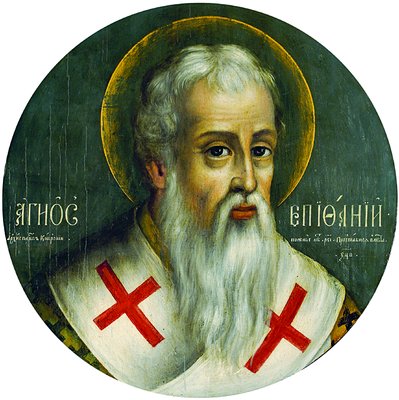
Epiphanius is painted as a hierarch of great age: a high bald or thinly-haired brow, a long full white beard, in the phelonion or in the many-crossed polystavrion, with the omophorion crossed on the breast, blessing with the right hand and holding the Gospel or a closed codex in the left. Because he is a Father and Teacher, the codex is often shown jewelled and closed rather than open at a text; in fuller compositions he appears in the ranks of the hierarchs in the sanctuary programme, and in the menologion cycles for May he stands beside Germanus of Constantinople, whose feast he shares. Cypriot churches show him with Sabinus and other bishops of the island, and occasionally with the basilica of Constantia in his hands as its builder. The stored image is an early eighteenth-century panel icon inscribed ΑΓΙΟСЪ ЕПІѲАНІЙ: the aged hierarch bust-length in a white cross-marked omophorion, the type as it was fixed in the post-Byzantine East.
Disputed questions
- Jewish birth. Asserted by his Life and by the synaxaria; not claimed by Epiphanius himself. His command of Hebrew is real; the birth is unproven and is best reported as the tradition it is.
- The empress "Honoria." The Life and the synaxarion make an empress Honoria his sister. No such empress existed in his lifetime (Justa Grata Honoria belongs to the fifth century), and the detail is legendary.
- The Second Ecumenical Council. Greek accounts place him at Constantinople in 381. His name is absent from the subscription lists, and most modern historians doubt that he attended; his known interventions in the eastern churches fall in 376 (Antioch) and 382 (Rome).
- The iconoclast fragments. The Testament to the Cypriots, the Dogmatic Letter and Against Images, cited at the council of 754, were rejected as spurious at Nicaea II and remain contested in modern scholarship. The Anablatha curtain in Epistle 51 (Jerome's Latin) is a different matter: that text is not doubted.
- Date of birth and of accession. Sources give birth anywhere between c. 310 and c. 320, and the Cypriot election in 365, 366 or 367. "Thirty-six years a bishop," which the tradition repeats, fits an accession of 367 with a death in 403.
- Not to be confused with the later Epiphanii of the calendar, nor with Epiphanius the Deacon of Catania, who read the iconodule testimonies at Nicaea II — a distinct person of the eighth century.