
Germanus of Constantinople
Our Father among the Saints Germanus, Archbishop of Constantinople and Ecumenical Patriarch, the Confessor
Patriarch · Bishop · Confessor · b. c. 634–640, at Constantinople — d. c. 740, at Platanion
Commemorated 12 May — Repose at Platanion, kept jointly with Epiphanius of Cyprus
Germanus (c. 634/640 – c. 740) was Patriarch of Constantinople from 715 to 730 and the first great confessor of the holy icons. Son of a patrician whom the Emperor Constantine IV put to death, castrated as a boy and given to the clergy of the Great Church, he rose to be Metropolitan of Cyzicus and then Ecumenical Patriarch. At a synod in 715 he undid the last vestiges of Monotheletism and restored the honour of the Sixth Council. When Leo III the Isaurian turned against the sacred images, Germanus withstood him for four years — teaching, writing to the iconoclast bishops of Asia Minor, and appealing to Rome — and when the emperor demanded his signature to the decree against the icons in January 730, the old patriarch laid his omophorion on the holy altar and resigned rather than sign, saying that the faith could not be altered without an ecumenical council. He died in retirement at Platanion, some hundred years old. The iconoclast council of 754 anathematised him; the Seventh Ecumenical Council in 787 read his letters aloud, vindicated him, and entered his name in the diptychs of the saints. He is also one of the notable hymnographers and liturgical commentators of the Greek Church.

Origins: the patrician's son
Germanus was born at Constantinople about 634–640, the son of the patrician Justinian, a senator of the first rank. In 668, in the political convulsion that followed the murder of Constans II, his father was implicated in conspiracy and executed by order of the Emperor Constantine IV Pogonatus. The boy — the sources say he was about twenty — was castrated and committed to the clergy of the Great Church, where he was set to the study of Scripture. It was the standard Byzantine disposal of a dangerous house's heir: the line was ended and the survivor made harmless. In Germanus's case it produced a churchman of the first rank.
He served in the patriarchal clergy and, the Greek accounts say at about thirty-seven, was made Metropolitan of Cyzicus on the Hellespont, a see of consequence.
Cyzicus, the synod of 712, and the patriarchate
His episcopate began under difficult skies. The Emperor Philippicus Bardanes (711–713) attempted to restore Monotheletism and to annul the Sixth Ecumenical Council; at the synod of Constantinople in 712 Germanus was among the bishops who subscribed the imperial policy. Two years later the Emperor Anastasius II reversed course, and Germanus, now nearing the patriarchal throne, reversed with him. When the see fell vacant he was elected — with imperial consent and the support of the senate, clergy and people — and enthroned as Patriarch of Constantinople in 715. He at once summoned a synod (715) which repudiated the acts of 712, anathematised the Monothelete leaders, and restored the Sixth Council to full honour. His early submission and his later reversal have both been recorded honestly by the Byzantine historians; the sequel showed which of the two expressed the man.
His fourteen and a half years on the throne fell in a desperate period. In 717–718 the Arabs laid the great siege of Constantinople; Germanus led the processions of supplication with the relics and the icon of the Mother of God, and afterwards preached the deliverance of the City as her work — the homily is among his surviving pieces, and it stands in the tradition of Marian intercession for the capital that runs from 626 to the Akathist. He laboured as a preacher, and the substantial body of his homilies and his liturgical writing dates from these years.
The iconoclast crisis and the resignation
About 726, after the eruption of the volcano at Thera was read as a sign of divine anger, Leo III the Isaurian began to move against the veneration of images. His first agents were bishops of Asia Minor — Constantine of Nacoleia, Thomas of Claudiopolis, and others — and Germanus's first response was pastoral and epistolary. His letters to John of Synada, to Constantine of Nacoleia, and to Thomas of Claudiopolis survive and are the earliest reasoned Orthodox defence of the icons that we possess: that the images are not idols, since the Church worships none of them; that the honour paid to them is a matter of memory, reverence and love, referred to the person depicted; that the Incarnation of the Word has made the depiction of Christ possible and right; that images are the ancient and universal custom of the churches and a support to the unlearned; and that no bishop may innovate in the tradition on his own authority. He also wrote to Pope Gregory II in Rome, who backed him firmly.
Leo pressed on. Germanus refused to lend the patriarchate to the policy, and — the synaxaria say — encouraged the people of the City in their resistance; the tradition also records that soldiers manhandled him and drove him from the patriarchal residence. The emperor summoned a silention, a council of state, at which the decree against the images was to be subscribed by the patriarch. On January 730 — the Greek sources give 22 January, the Latin tradition sometimes 17 January — Germanus refused. He answered that he would not innovate in the faith without an ecumenical council, and that if the emperor was a second Jonah he himself was no Jonah's shipmate; then he took off his omophorion, laid it upon the holy altar, and abdicated the throne he had held for fourteen years and five months. Anastasius, his own synkellos and a compliant man, was installed in his place.
Retirement, repose, and vindication
Germanus withdrew to his family estate at Platanion, near the City, and lived out his days there as a monk. He died, after a short illness, about 740 — the Greek synaxarion makes him a hundred years old — and was buried in the monastery of the Chora at Constantinople. Relics of him were later carried to the West and are venerated in France, at Bort-les-Orgues in the Limousin among other places.
The iconoclast council of Hieria in 754 anathematised his memory together with those of John of Damascus and George of Cyprus. At the Seventh Ecumenical Council, held at Nicaea in 787, the fathers read his three dogmatic letters on the icons aloud in session, praised them, restored his name to the diptychs of the saints, and used his arguments in framing the definition on the holy images. He is thus the one patriarch of Constantinople whose sanctity was pronounced by an ecumenical council in the acts themselves.
Writings and hymnography
Germanus's surviving works are more considerable than his short entry in the calendars suggests:
- The Historia Ecclesiastica et Mystica Contemplatio — a commentary on the Divine Liturgy and on the church building, explaining the rites and the furnishings symbolically. Whatever its precise textual history (it grew by accretion in the manuscripts), it circulated under his name through the whole Byzantine period and shaped the way Greeks and Slavs alike understood the Liturgy; it is one of the ancestors of all later Orthodox liturgical mystagogy.
- Three dogmatic letters on the holy icons (to John of Synada, Constantine of Nacoleia, and Thomas of Claudiopolis), read at Nicaea II.
- On the Term of Life (De vitae termino), a dialogue on providence and the appointed span of human life, against fatalism.
- Homilies — eight or more survive, chiefly for feasts of the Theotokos (the Annunciation, the Entry into the Temple, the Dormition) and for the Cross, together with the sermon on the deliverance of the City.
- Hymnography. The Greek tradition credits him with a large body of liturgical poetry — one reckoning gives 104 stichera and 22 canons — including material for the Entry of the Theotokos into the Temple and for the Exaltation of the Cross. Because Byzantine manuscripts label hymns "Germanou" without distinguishing him from later Germani, the exact extent of his authentic corpus is disputed; that he was a hymnographer of real importance is not.
Feast and commemoration
May 12 (church date; New Calendar civil May 12, Old Calendar civil May 25). The day is a joint commemoration with Epiphanius of Cyprus, and the Menaion gives the two hierarchs a common apolytikion — a deliberate pairing of two defenders of the faith, an eastern heresiologist of the fourth century and the iconodule patriarch of the eighth. The commemoration is universal. Germanus is also honoured among the Fathers of the Seventh Ecumenical Council (kept on the Sunday nearest October 11 in the Greek usage) as the confessor whose letters that Council took up, and his name occurs in the Sunday of Orthodoxy's proclamation of the champions of the icons.
Hymns
Apolytikion — Tone 1
O God of our Fathers, interpreters of the Godhead that has no beginning, all-wise heralds of the doctrines that God Himself has stamped upon you, shining guides of the ineffable mysteries, Epiphanius and Germanus: you have enlightened those who cry to Him — glory to Him who crowned you, glory to Him who magnified you, glory to Him who through you has made firm the Orthodox faith.
Kontakion — Tone 2
You would not exchange the tradition of the Fathers for the favour of kings, O holy Germanus, but laying down your throne you kept the faith undefiled, and taught the faithful to honour the image of the Word made flesh. Therefore, O confessor of Christ, entreat Him that our souls may be saved.
Original translation from the Greek
Iconography
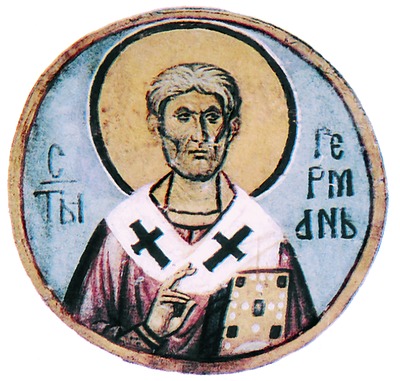
Germanus is painted as a hierarch: in phelonion or polystavrion with the omophorion, often bareheaded in the Byzantine manner, with a short rounded grey beard and thin grey hair, the right hand blessing and the left holding a jewelled Gospel-book or a scroll. Because he was a eunuch from boyhood, painters sometimes give him a notably smooth, spare, almost beardless face; the Studenica fresco is of this type. Where his confession is the subject he holds a scroll with a sentence on the veneration of the images, or an icon of Christ — the attribute that marks the iconodule confessors as a class, and by which he is distinguished from other bishop-saints. In the programmes of the Seventh Council he stands with John of Damascus and Tarasius, and in the Sunday of Orthodoxy compositions among the champions of the holy icons; in the May menologia he appears beside Epiphanius. The stored image is a fresco of 1208–1209 in the sanctuary of the Church of the Mother of God at Studenica in Serbia, inscribed in Slavonic СТЫ ГЕРМАНЬ: the patriarch in a medallion, in a rose-coloured phelonion and white cross-marked omophorion, blessing and holding the Gospel.
Disputed questions
- The date of his repose. The synaxaria and the Greek calendars give 740; some modern historians prefer c. 733, on the ground that his successor's dealings suggest an earlier death. The age of a hundred years given by the synaxarion depends on the earlier birth-date and the later death-date together.
- The date of the resignation. 730 is certain; the day is given as 22 January by the Greek tradition and as 17 January in some Western handbooks.
- The synod of 712. That Germanus, then of Cyzicus, subscribed the Monothelete acts under Philippicus is reported by the Byzantine sources and is not concealed in them; his synod of 715 undid it. The episode is sometimes passed over in devotional lives, but it belongs to the record.
- The hymnographic corpus. Attributions to "Germanus" in the manuscripts are frequently ambiguous between this patriarch, Germanus II (†1240), and the later hymnographer Germanus of New Patras; individual hymns must be judged case by case. The attribution to him of the Akathist's proemium "To thee, the Champion Leader" is one such uncertain tradition, urged by some and denied by others in favour of Patriarch Sergius or Photius.
- Not to be confused with Germanus II, Patriarch of Constantinople at Nicaea (1223–1240), nor with the Athonite and Russian saints of the same name; nor with the two great Western Germani — Germanus of Paris (May 28, †576), whose feast falls sixteen days after this one, and Germanus of Auxerre (July 31, †448), who is the subject of most Western images labelled simply "Saint Germain."