
Erasmus of Formia
The Holy Hieromartyr Erasmus, Bishop of Formia in Campania
Hieromartyr · Bishop · Confessor · d. c. 303, at Formia in Campania
Commemorated 4 May — Repose after tortures under Diocletian and Maximian, 2 June — Greek and Serbian usage (Erasmus of Ohrid), with the Twenty Thousand Martyrs
Erasmus (†c. 303), bishop of Formia in Campania, is one of the most widely venerated and least securely documented of the martyrs of the great persecution. The tradition the Orthodox calendars have received makes him a bishop who fled the persecution to Mount Lebanon and lived there seven years in hiding; who was brought at an angel's bidding out of concealment, seized, and tried before Diocletian and afterwards before Maximian; who was scourged, smeared with pitch and set alight, shut in a spiked cask and rolled downhill, and each time preserved; who converted great multitudes — the Slavic and Greek notices say twenty thousand — by his endurance; and who at length was brought to Formia and reposed there. In the West he became Saint Elmo, patron of sailors, and one of the Fourteen Holy Helpers; the Orthodox books keep him on May 4, and the OCA styles him confessor rather than martyr, since the tradition has him die of his sufferings rather than by the sword.

The received tradition
Nothing about Erasmus can be recovered by the ordinary historical means; there is no contemporary acta, and the passion that survives is a composite legend of no earlier than the sixth century, in which two or three originally separate figures may have been fused. What can be described faithfully is the tradition as the Church received it and as it stands in the Orthodox synaxarion notices, and that is what follows — recorded as tradition, not as chronicle.
He is presented as a bishop, and in some recensions as a bishop of Antioch — the eastern half of his legend is set in Syria and Lebanon — who, when the edicts of Diocletian and Maximian were published, withdrew from his city to Mount Lebanon and lived hidden there for seven years, in a cave, fed (the account says) by a raven, in the manner of Elijah. An angel then appeared to him and bade him leave his concealment and go back to the work of preaching, since the crown was prepared for him.
The tortures
Returning, he was arrested and brought before the emperor — Diocletian, in the eastern recension, at Antioch. He refused to sacrifice and rebuked the emperor for the worship of demons. The tortures assigned to him in the legend are extravagant even by the standards of the genre, and they are the reason the West found him so memorable: he was beaten with clubs and scourged, smeared with pitch and resin and set on fire, shut inside a barrel driven full of iron spikes and rolled down a hill, cast into a heated cauldron, and had hot oil and brimstone poured over him. From each of these he came out alive, and the account attributes the preservation to angelic help; twice, it says, an angel loosed him from prison and carried him away.
The consequence of the tortures was not death but conversion on a great scale: the notices say that as many as twenty thousand of the pagans who saw his endurance believed in Christ, and were themselves put to death — which is why the Slavic and English lists title the day's commemoration "Erasmus, bishop of Formia, and 20,000 martyrs." Whatever the number is worth, the structure of the claim is the ordinary hagiographic one: the martyr's constancy preaches better than his sermons.
Formia and repose
Carried at last, by the angel or by the course of his wanderings, into Italy — through Illyricum, in some recensions, and then through Lycia and across to Campania — he came to Formia on the Appian coast, where he is said to have been made bishop and where he preached and taught for a short time before reposing of the injuries he had received, about the year 303. His body was buried at Formia, and it is there that his cultus is first historically visible: Gregory the Great, writing at the end of the sixth century, mentions the church of Formia possessing the body of St Erasmus, which is the earliest solid evidence that the veneration existed.
Relics and later cultus
When Formia was destroyed by Saracen raiders in 842, the relics were removed to Gaeta, which took Erasmus for its patron and whose cathedral holds them still. From Gaeta his veneration spread through the maritime cities of the western Mediterranean, and he became pre-eminently the patron of sailors — invoked against storm and lightning, so that the electrical discharge seen at the mastheads of ships in a charged sky is still called St Elmo's fire, from the Italian contraction of his name. In the late-medieval West he was enrolled among the Fourteen Holy Helpers, and his Roman feast is June 2.
Feast and commemoration
May 4 (church date; New Calendar civil May 4, Old Calendar civil May 17). He is kept on this day by the Slavic Menaion (Священномученик Еразм, епископ Формийский), by the OCA day-page, and by the English lists (OrthodoxWiki: "Hieromartyr Erasmus, Bishop of Formia, with 20,000 martyrs, 303"). He does not appear in the Greek synaxarion listings for the day consulted for this entry, which is the reverse of the pattern seen with several other May 4 commemorations — here the Slavic and American calendars carry a saint the Greek notices omit. In the West his feast is June 2, and at Gaeta, which holds his relics, he is the patron of the city. No proper Byzantine service is transmitted; the common of a hieromartyr is sung.
Hymns
Troparion — Tone 4 (from the common of a hieromartyr)
As a sharer in the ways and a successor to the thrones of the Apostles, O divinely-inspired one, thou didst find in contemplation the means to ascend to divine heights; rightly dividing the word of truth, thou didst struggle for the faith even unto blood, O hieromartyr Erasmus: intercede with Christ God that our souls may be saved.
Original translation from the Greek
Kontakion — Tone 2
Neither fire nor pitch nor the iron teeth of the cask could turn thee from the confession, O hierarch Erasmus, but by thy patience thou didst draw a countless people to Christ; wherefore the sea and them that sail upon it cry out to thee: deliver us, O father, from the tempest.
Iconography
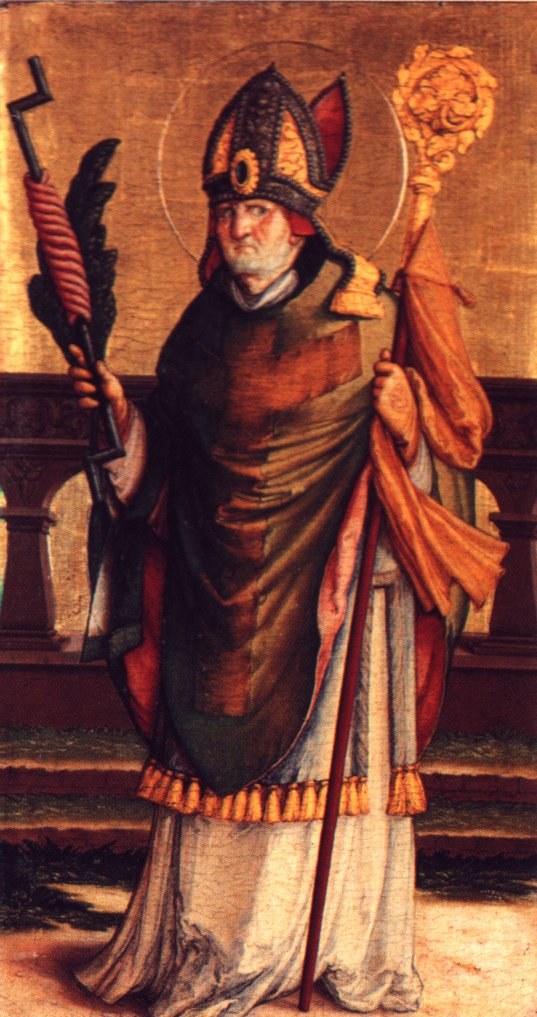
Erasmus's iconography is overwhelmingly Western, and it is dominated by two things: his episcopal rank and the windlass. In Latin painting and sculpture from the fourteenth century onward he appears as a bishop in mitre and cope, holding a capstan or windlass — originally the seaman's emblem of his patronage, and afterwards misunderstood as the instrument of his martyrdom, so that the more brutal images (Bouts, Grünewald's Isenheim panel of Erasmus with Maurice, and the many South-German altarpieces) show the winch with the entrails wound on it. This is not an Orthodox type and should not be reproduced as one.
In Byzantine and Slavic usage, where his commemoration is a calendar entry rather than a popular cultus, he is painted simply as a hierarch-martyr: in phelonion and crossed omophorion, holding the Gospel, with the martyr's cross; the beard dark or grizzled. Where a scene accompanies him it is one of the tortures he survived — the spiked cask on the hillside, or the flames — rather than the windlass. Sailors' chapels of the Greek islands that keep him give him the ordinary hierarch's form with a ship in the background, an Orthodox adaptation of his maritime patronage.
No pre-1900 image conformable to the Orthodox type has been identified for this collection. The abundant pre-1900 Western paintings of him are out of copyright but are Latin devotional works, several of them centred on the disembowelment which the Orthodox tradition does not carry, and none has been stored here.
The stored image is a Western work per §34: a panel of the Falkenstein retable (c. 1530), the bishop-martyr with the windlass of his passion. An Eastern image remains wanted and is listed among the upgrade-wanted icons.
Disputed questions
- Martyr or confessor? The Orthodox notices differ. The Slavic Menaion and the Greek lists call him священномученик / ἱερομάρτυς — hieromartyr. The OCA entry titles him "Holy Confessor Erasmus, Bishop of Formia," reflecting the tradition that he died of his injuries in his own city rather than under sentence. Both are defensible on the received narrative, and this entry carries hieromartyr, bishop and confessor together, which is the honest representation of a tradition that cannot decide.
- How he died, and where. The Western legend in its fullest form gives him the notorious death by disembowelment, his intestines wound out on a windlass. Modern scholarship regards this as a late misreading of his own iconography: he was shown with a capstan or windlass as the emblem of his patronage of sailors, and a later age, seeing an instrument in a martyr's hand, supplied a torture to match. The Orthodox notices do not have the windlass and do not have the disembowelment; they have him die of the earlier tortures at Formia. This entry follows them.
- One Erasmus or two? The doubling of the legend between Antioch/Lebanon and Formia/Campania has long suggested that an eastern martyr Erasmus and a bishop of Formia of the same name were conflated, the eastern passion having been attached to the Italian tomb. There is no way to separate them from the surviving material, and the Church venerates the single figure the tradition delivered.
- The twenty thousand. The number is a hagiographic magnitude and not a count; it appears in the notices as a mark of the scale of the conversions rather than as a register of names. No names are transmitted, and the company has no separate entry here.
- Not to be confused with Erasmus of the Kiev Caves (†c. 1160, February 24), the monk who spent his substance adorning the church of the Dormition — an entirely different saint of a different millennium, and the only other Erasmus in this collection.
- The date of the feast. The Orthodox May 4 and the Roman June 2 are both ancient; the Byzantine calendars took the earlier date. The coexistence is recorded, not resolved.