
Eroteis of Cappadocia
The Holy Martyr Eroteis
Martyr · Virgin
Commemorated 6 October
Eroteis (Erotheis) was a virgin martyr who was put to death by fire; the calendars that transmit her memory place her in Cappadocia. She is known from a single line of the synaxaria, kept on October 6 with its distich: "They burn the virgin Eroteis, who was aflame beforehand with love for Christ" — a play on her name, which is formed from erōs, love. Neither her century nor the persecution in which she suffered is transmitted.

The whole surviving record of this martyr is the notice of the Synaxarion of Constantinople for October 6 — "On the same day, the commemoration of the holy martyr Eroteis" — with its accompanying verse couplet, and the Great Synaxaristes' one-sentence summary: "She was martyred by fire." The distich turns her name into her epitaph: Ἐρωτηΐδα πυρπολοῦσι παρθένον, / Ἔρωτι Χριστοῦ τὴν προπυρπολουμένην — "They consign the virgin Eroteis to the fire, her who was already all aflame with the love (erōs) of Christ." From the verse we learn the two facts of her sanctity: she was a consecrated virgin, and she died in the flames. The attribution to Cappadocia is carried by later calendar compilations and English-language lists, which style her "Eroteis of Cappadocia"; the oldest notices name no place. Nothing further — date, persecutor, circumstances — has been transmitted, and per the honesty this repository owes its readers, nothing further is asserted.
Feast and commemoration
October 6 (church date; Old Calendar civil October 19), in the Greek synaxaria, alongside the Apostle Thomas, whose feast dominates the day. She does not appear on the OCA or Russian calendar lists for the day consulted live for 2026. No proper service is appointed; the common of a virgin martyr serves where her memory is kept liturgically.
Hymns
Troparion — Tone 4 (from the common of a virgin martyr)
Thy lamb Jesus, O Jesus, crieth with a great voice: Thee, my Bridegroom, do I love, and seeking Thee I contest, and I am crucified and buried with Thee in Thy baptism; and I suffer for Thy sake, that I may reign with Thee, and I die for Thee, that I may live in Thee: receive me then as a spotless sacrifice, slain with love for Thee. By her intercessions, O Merciful One, save our souls.
Original translation from the Greek
Iconography
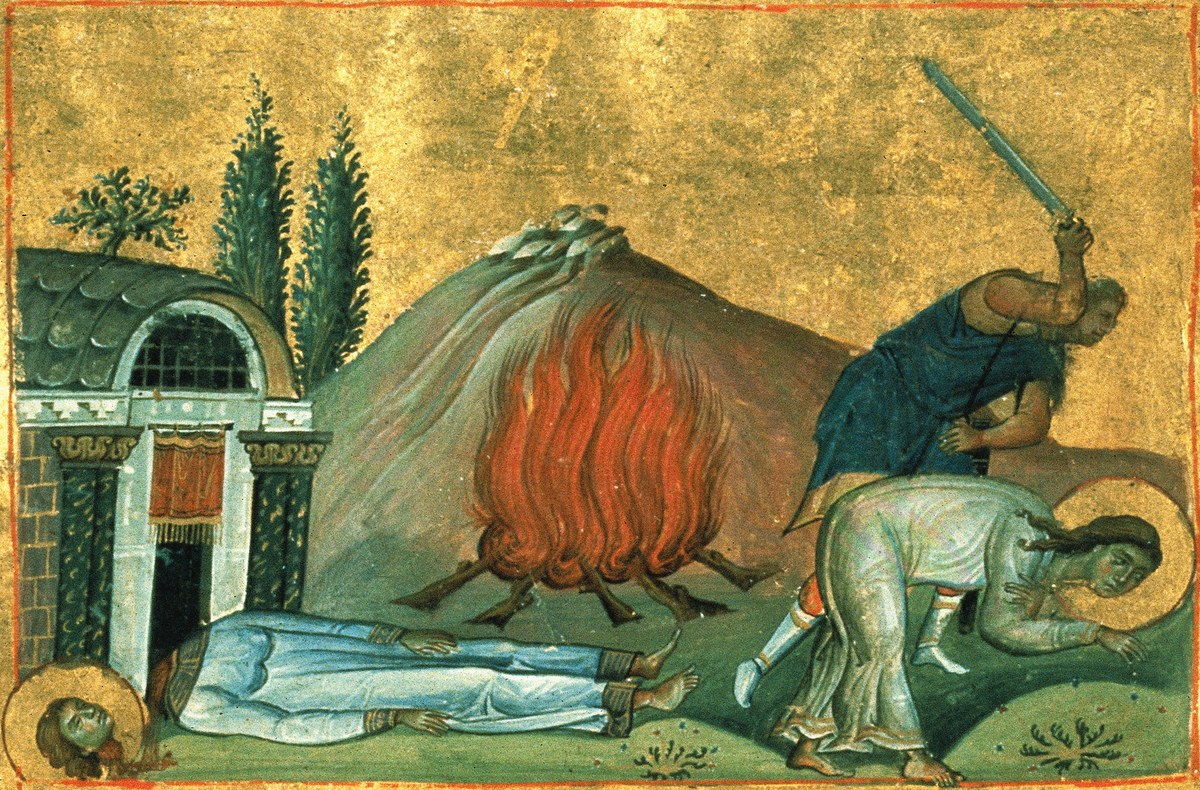
The stored image is the miniature of the Menologion of Basil II (Constantinople, 985), which paints the two martyrs of the day together: Capitolina lies beheaded before the fire of the contest while Eroteis, her maidservant, bows beneath the falling sword. A portrait icon would show her as a virgin martyr with the martyr's cross, the flames of her contest sometimes shown; the distich's image — the fire of divine love answered by the fire of martyrdom — is the natural programme for any icon of her.
Disputed questions
- The Cappadocian origin is not in the Synaxarion of Constantinople notice or the Great Synaxaristes, which give only the name, the virginity, and the death by fire; it enters through later calendar lists. It is retained here (in the slug and name) as the received English styling, and flagged as resting on the later tradition only.
- The name is variously transliterated Eroteis, Erotheis, Erotis, and (in Slavic-influenced lists) Eroteida.
- Not to be confused with the servant Eroteis (Eroteida) of Capitolina and Eroteis of Cappadocia, a distinct martyr of the same name-form kept on 27 October, who was beheaded by the sword together with her mistress Capitolina under Diocletian. This Eroteis (6 October) is a lone virgin martyr who died by fire; the two share the name and the Cappadocian styling but are kept by the Church as separate commemorations on different days.