
Euphemia the All-praised
The Holy Great-martyr and All-praised Euphemia
Great Martyr · Virgin · d. 304
Commemorated 11 July — Miracle of the Tome at the Council of Chalcedon (451), 16 September — Martyrdom at Chalcedon
Euphemia the All-praised (†304) is the great-martyr of Chalcedon, a senator's daughter who suffered under the proconsul Priscus in the last great persecution and died in the arena, wounded by a she-bear after fire, wheel and water had left her unharmed. Her fame rests above all on the miracle of 451: the Fourth Ecumenical Council met in her basilica at Chalcedon, and when the orthodox and the Monophysite definitions of faith were laid in her coffin, she was found holding the orthodox tome — whence she is honoured as the seal and patroness of the Council of Chalcedon. Her relics rest today in the patriarchal church of Saint George at the Phanar in Constantinople. She is commemorated on September 16 (martyrdom) and July 11 (the miracle of 451).

Origins and early life
Euphemia was born at Chalcedon, the city on the Asian shore of the Bosphorus opposite Byzantium, the daughter of the senator Philophron and his wife Theodosia, Christians of rank and piety. She was consecrated to virginity and was still young when the persecution of Diocletian's reign reached Bithynia at the opening of the fourth century.
Martyrdom
The passio relates that Priscus, proconsul at Chalcedon, decreed that the whole population attend the festival of the god Ares and share in its sacrifices, on pain of torture. Forty-nine Christians, Euphemia among them, kept away and worshipped in a hidden house. Discovered and brought before Priscus, they withstood nineteen days of torments without yielding, and were finally sent to the emperor for judgment; the proconsul kept back only Euphemia, the youngest, reckoning that a girl alone would break.
Her contest then unfolded as a series of frustrated cruelties. Bound to a wheel set with knives, she was cut about until, at her prayer, the wheel stopped and — the passio says — an angel lifted her from it healed. Ordered into a burning furnace, the soldiers Victor and Sosthenes saw angels in the flames and refused to cast her in, confessing Christ on the spot; they were condemned to the beasts and died in the arena, called by a voice from heaven, their bodies untouched (they are commemorated with her on September 16). Other soldiers threw Euphemia into the fire, where she remained unharmed while flames burst outward on her tormentors. She was preserved likewise from a pit of blades concealed under earth, from drowning — the canon of her feast sings of her kept whole "with the beasts in the waters," as Jonah in the deep and Daniel among the lions — and from other engines of torture. At last she was condemned to the beasts in the arena. Bears and lions did no more than lick her feet, until one she-bear gave her a single wound, and with that, her prayer to be received was granted and she gave up her spirit. An earthquake shook the city at that moment, and in the panic her parents recovered her body and buried it near Chalcedon. The year was 304 (some sources 303); the Greek synaxarion's verses for September 16 remember precisely this manner of death: killed for God by the jaws of a bear, and crowned with fair speech — a play on her name, "she of good report."
Relics and translations
Over her grave outside Chalcedon rose a great martyrium basilica, one of the most celebrated shrines of the East. Evagrius Scholasticus describes the splendid three-part complex on its rise above the Bosphorus and records the wonder for which it was famous: from her relics there issued at intervals a flow of fragrant blood, gathered by the clergy with sponges and distributed to the faithful — a miracle the kontakion and oikos of her feast still celebrate. Egeria and the pilgrim literature knew the shrine; the empress Pulcheria and the court honoured it, and it was here that the Fourth Ecumenical Council convened in 451.
When the Persians overran Chalcedon in 617, the relics were carried across the strait to Constantinople (c. 620), where a church of Saint Euphemia was established in the former palace rotunda of Antiochus beside the Hippodrome. Under iconoclasm the tradition relates that the reliquary was cast into the sea — the deed is ascribed to Leo III or to Constantine V in different accounts; it was rescued by pious shipmasters, sheltered on the island of Lemnos, and solemnly returned to Constantinople in 796 under Constantine VI and the empress Irene, the church by the Hippodrome being restored to receive it. In the later centuries the relics were kept in the quarter of Petrion on the Golden Horn, in the church of Saint George; when that church became the seat of the Ecumenical Patriarchate in 1601, the great-martyr's shrine remained with it, and her marble sarcophagus stands today in the north aisle of the patriarchal church of Saint George at the Phanar, where the faithful venerate her incorrupt relics. Portions of the relics are found elsewhere, notably at Kykkos Monastery on Cyprus and in the Alexander Nevsky Lavra in Saint Petersburg.
Veneration and later cultus
Euphemia's cultus was universal from the fourth century, in both East and West: churches bore her name in Constantinople, Rome, Ravenna, and across the Adriatic (the town of Rovinj in Istria keeps a rival tradition of her body — see Disputed questions). In the Byzantine world her veneration acquired a second, dogmatic dimension after 451: she is not only a great-martyr but the guardian of the Chalcedonian definition, "the boundary-stone of the Fathers." The title Πανεύφημος, "All-praised", became inseparable from her name.
Miracles and traditions
The miracle of the Tome (451). The Fourth Ecumenical Council — six hundred and thirty bishops, summoned by the emperor Marcian and the empress Pulcheria against the Monophysite teaching of Eutyches — met in October 451 in Euphemia's martyrium at Chalcedon. The tradition of the Church relates that when the disputing parties could not be brought to one confession, the Patriarch Anatolius of Constantinople proposed to commit the judgment to the great-martyr herself. Two tomoi were written — the orthodox definition of the two natures of Christ united without confusion, change, division or separation, and the contrary confession of the Monophysites — and both scrolls were sealed inside her coffin upon her breast. The shrine was sealed in the presence of the emperor, and after days of prayer and fasting (the accounts speak of three) it was opened: the heretical tome lay beneath the saint's feet, and the orthodox definition she held in her right hand, extending it to the assembled Fathers as if alive. The council's own letter to Pope Leo speaks of Euphemia as the one who presided over their gathering, receiving their definition as her own confession and crowning it; the exaposteilarion of her feast sings that "she received the definition of orthodoxy from the Fathers and keeps it." On the strength of this miracle she is venerated as the patroness of the Council of Chalcedon, and the Church appointed her a second feast, July 11, in commemoration of it.
The flow of blood. The periodic effusion of blood from her relics at Chalcedon, attested by Evagrius and celebrated in the oikos of her service ("the dead body, as though living, pours forth blood that fragrances all"), made the shrine one of the great healing sanctuaries of the East.
Hymnographic and literary legacy
The full service of September 16 in the Menaion carries idiomela ascribed to Anatolius and to Byzantios, a complete canon, and the kathismata and exaposteilarion proper to her; the whole cycle interweaves her contest with her guardianship of the Chalcedonian faith. Asterius, bishop of Amasea (c. 400), delivered a celebrated ekphrasis describing a painted cycle of her trial and martyrdom — one of the earliest surviving Christian descriptions of narrative religious art, later read into the acts of the Second Council of Nicaea (787) in defence of the holy icons.
Feast and commemoration
Her principal feast, the day of her martyrdom, is September 16 (church date; Old Calendar civil September 29), falling within the afterfeast of the Elevation of the Cross: the Menaion joins her full service to that of the feast, and she is the only saint of the day with a complete proper service. The feast is universal. Her second feast, July 11, commemorates the miracle of the Tome at the Council of Chalcedon in 451; on that day the Greek books style her "Euphemia the All-praised, who confirmed the definition of the faith," and the Slavic calendars keep the same commemoration (sharing the day with Olga, princess of Kiev). The Roman Martyrology likewise keeps her on September 16.
Hymns
Troparion — Tone 4
Thy lamb Euphemia, O Jesus, crieth out with a great voice: Thee, my Bridegroom, do I love, and seeking Thee I contend; I am crucified and buried with Thee in Thy baptism, and suffer for Thee, that I may reign with Thee; I die for Thee, that I may live in Thee. As a spotless sacrifice receive her who with longing was slain for Thee. By her intercessions, as Thou art merciful, save our souls.
Original translation from the Greek
Kontakion — Tone 4
In thy contest thou didst contend well, and after death thou dost hallow us with the wellings-forth of wonders, O all-praised one. Wherefore we honour thy holy falling-asleep, standing in faith beside thy venerable relics, that we may be delivered from ailments of soul and draw up the grace of thy wonders.
Original translation from the Greek
Iconography
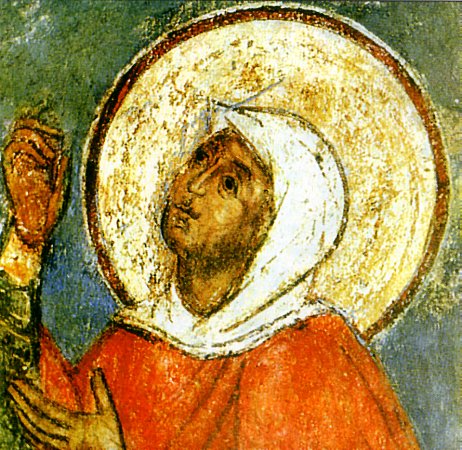
Euphemia is depicted as a young virgin-martyr in the rich dress of her rank, usually in a red maphorion or jewelled robes, holding the martyr's cross; often she also holds a scroll — the tome of Chalcedon — her distinctive attribute among the women martyrs. Narrative cycles of her passion are ancient: Asterius of Amasea described a painted sequence of her trial, torture and death around the year 400. Scenes of her martyrdom show her among the beasts of the arena with the she-bear at her feet; images of the council of 451 place her coffin in the midst of the Fathers. The stored image is a seventeenth-century depiction of the great-martyr, identified by its source as Euphemia; a higher-resolution, inscribed Byzantine icon is wanted in its place.
Disputed questions
- Year of martyrdom. The sources divide between 303 and 304; 304 is the conventional date, kept by the OCA and the Slavic calendars.
- The Tome miracle and the acta. The miracle of the two tomoi is not recorded in the surviving conciliar acta of 451; it is transmitted by the later Byzantine tradition and the Synaxarion, while the council's letter to Leo already speaks of Euphemia as confirming the definition. The Church's liturgical tradition receives the miracle; historians note the silence of the acta. Both witnesses are recorded here.
- Which iconoclast emperor cast the relics into the sea is variously given (Leo III the Isaurian or Constantine V); the return under Constantine VI and Irene in 796 is common to the accounts.
- The Rovinj tradition. The town of Rovinj (Istria, Croatia) venerates a late-antique sarcophagus said to have arrived by sea in 800 as the body of Euphemia of Chalcedon, and she is its patroness. This tradition competes with the Constantinopolitan line of transmission, which the Orthodox Church follows; the two are recorded, not reconciled.
- Not to be confused with an earlier martyr Euphemia said to have suffered under Hadrian (listed separately in some sources), nor with Euphemia the empress, wife of Justin I.