
Euphrasia of Nicomedia
The Holy Virgin-Martyr Euphrasia of Nicomedia
Martyr · Virgin · d. c. 303, at Nicomedia
Commemorated 19 January — Martyrdom by the sword
Euphrasia (†c. 303) was a Christian virgin of noble birth at Nicomedia, martyred in the great persecution under the emperor Maximian. Arrested for her confession of Christ and refusing to sacrifice to the idols, she was tortured; and when the judge, unable to break her, handed her over to a barbarian soldier to be violated and her virginity destroyed, she preserved her chastity by a stratagem — telling the man she knew of a herb that would make him invulnerable in battle, and offering to prove it upon herself, she bade him strike her neck with his sword. He struck, and so she died by the sword with her virginity intact, gaining the crown of martyrdom and outwitting the shame prepared for her. She is commemorated on January 19.
.jpg)
Euphrasia belonged to a distinguished and wealthy family of Nicomedia in Bithynia — the eastern capital of the Roman Empire under Diocletian, and one of the chief theatres of the last and greatest persecution of the Church. In the persecution under Maximian (the tradition names the co-emperor Maximian, the persecution beginning about 303) she was denounced as a Christian, arrested, and brought before the magistrate. Confessing Christ and refusing to offer sacrifice to the gods, she was subjected to torture.
When neither threats nor torments could shake her, the judge devised a crueller punishment aimed at her consecrated virginity: he condemned her to be given over to a barbarian soldier to be defiled. The account — a type well known in the acts of the virgin-martyrs — tells how Euphrasia, resolved to die rather than lose her purity, met force with wit. She told the soldier that she possessed the knowledge of a herb which, rubbed upon the body, would render a man invulnerable to any weapon in war, and promised to give it to him if he would spare her; and to convince him of its power she offered to let him test it upon her own neck — telling him to strike her there with all his strength, that he might see the blade turn. Believing her, the soldier raised his sword and struck off her head. So the ruse preserved her virginity and won her the martyr's crown at a single stroke, about the year 303.
The account is transmitted in the synaxaria and menaia and is honoured as the Church has received it. Euphrasia belongs to the great company of the martyrs of Nicomedia under Diocletian and Maximian — a city whose Christians suffered in their thousands in those years, and several of whose martyrs the calendar keeps.
Feast and commemoration
Euphrasia is kept on January 19 (church date; Old Calendar civil February 1), among the martyrs of the day, together with the two great fathers of the desert, Macarius the Great and Macarius of Alexandria. Her commemoration is universal in the Byzantine calendars.
Hymns
Troparion — Tone 4
Thy lamb, O Jesus, cries out with a loud voice: Thee, O my Bridegroom, do I love, and seeking Thee I endure the contest; I am crucified and buried with Thee in Thy baptism, and I suffer for Thy sake that I may reign with Thee; I die for Thee that I may live in Thee: receive me as a spotless sacrifice, offered to Thee in love. By her prayers, O Merciful One, save our souls.
Original translation from the Greek
Iconography
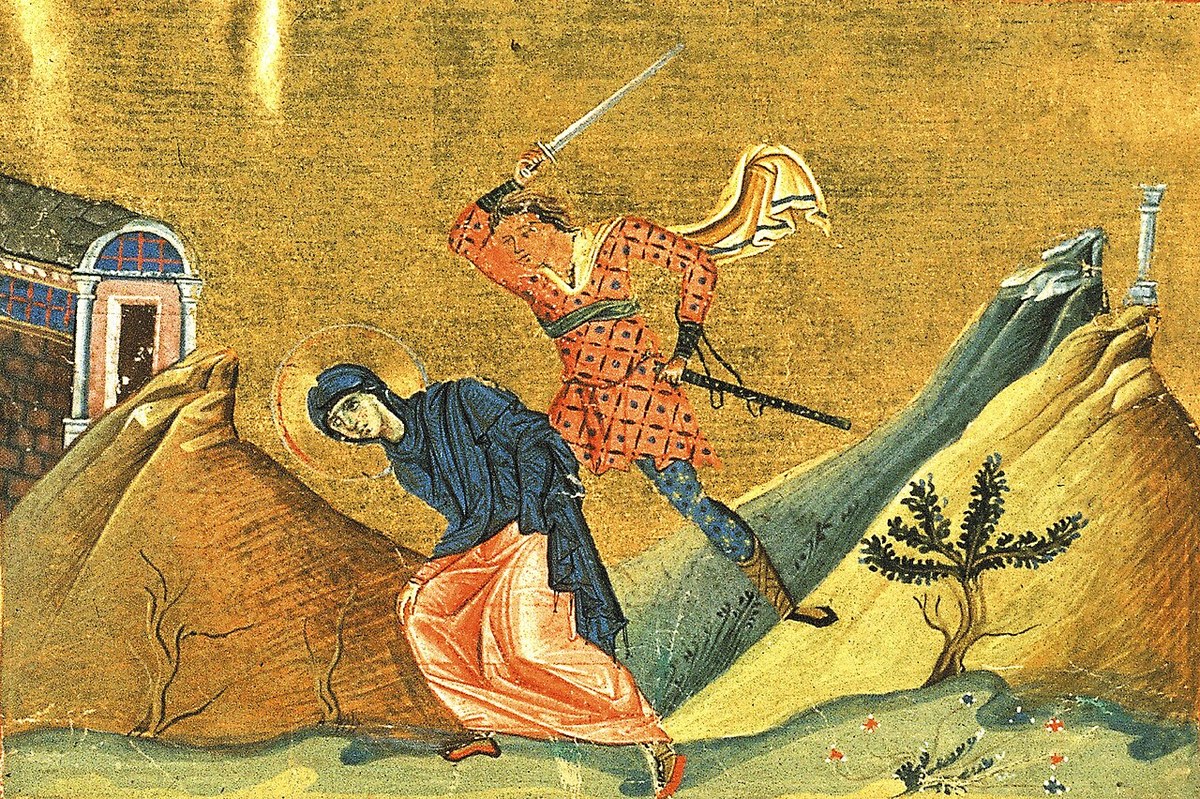
Euphrasia is depicted as a young woman of noble bearing, in the manner of the virgin-martyrs — in a maphorion, often holding the cross of martyrdom in her right hand, the sign of her confession. The narrative image of her passion shows her beheading by the barbarian soldier.
The stored image is her miniature from the Menologion of Basil II (Constantinople, c. 985; Vatican, Vat. gr. 1613) for January 19 — the martyr depicted in the illuminated synaxarion of the emperor (source, public domain, pd-old-work).
Disputed questions
- Not to be confused with the several other holy women named Euphrasia (Eupraxia) of the calendar — in particular Euphrasia (Eupraxia) the Younger of the Thebaid, the venerable abbess (kept July 25) — nor with the virgin-martyr Euthasia (†c. 305, kept January 12), whose name is easily confused with hers. This Euphrasia is the virgin-martyr of Nicomedia of January 19. She is likewise not the Euphrasia of Ancyra who is one of the seven virgins martyred with Theodotus of Ancyra (May 18) — the saint whom some English day-lists detach from that company and print separately under May 18 as "Martyr Euphrasia of Nicaea," a phantom commemoration whose city appears to be a corruption.