
Theodotus of Ancyra and the Seven Virgins
The Holy Martyr Theodotus of Ancyra and the Seven Holy Virgin-Martyrs Tecusa, Alexandra, Claudia, Phaina, Euphrasia, Matrona and Julitta
Martyr · Virgin · d. 303 or 304, at Ancyra in Galatia
Commemorated 18 May — The drowning of the seven virgins in the lake and the beheading of Theodotus, 7 June — Second commemoration in Greek and OCA usage
Theodotus was an innkeeper of Ancyra in Galatia — a married layman, a wine-seller, whose tavern became in the Great Persecution the hiding-place of the hunted Church, the house where the Liturgy was served when the churches were pulled down, and the office from which the bodies of the martyrs were ransomed and buried. With him are honoured seven aged consecrated virgins — Tecusa his own aunt, Alexandra, Claudia, Phaina, Euphrasia, Matrona and Julitta — who were seized under the governor Theoteknos, refused to serve as priestesses at the washing of the images of Artemis and Athena, were handed over to be violated and preserved their purity, and were at last drowned in the lake outside the city with stones tied to them. Theodotus recovered their bodies by night and buried them, and for that act was betrayed, tortured and beheaded, about the year 303–304. Their passion, told by an eyewitness named Nilus, is one of the most vivid and most disputed documents of the Diocletianic persecution in Asia Minor.
_-_%D0%B8%D0%BA%D0%BE%D0%BD%D0%B0_09182_7_%D0%B4%D0%B5%D0%B2.png)
Ancyra under Theoteknos
The scene of the passion is Ancyra (Ankara), the metropolis of Galatia, in the years when the edicts of Diocletian and Galerius were being enforced with method: the churches thrown down, the Scriptures burnt, the clergy imprisoned, the whole population called out by name to sacrifice. The governor is named Theoteknos, a man the account paints as an ingenious persecutor rather than a merely brutal one — he preferred to corrupt where he could not terrify, and he had a particular relish for making Christians defile themselves by the smallest ritual compliance. Food and wine in the markets were sprinkled with the libations of sacrifice, so that a Christian could scarcely eat without communion in the idols; the faithful of Ancyra withdrew to caves and to the houses of those brave enough to receive them.
Theodotus the innkeeper
Among these Theodotus stands out precisely because he was nobody in particular: not a bishop, not a monk, not a soldier, but a tradesman with a wife and a business, an innkeeper (xenodochos, keeper of a kapēleion) who sold wine and lodging. The passion insists on his ordinary standing and on his chastity within marriage, and it makes his trade the instrument of his sanctity. His inn became:
- a house of refuge, where fugitive Christians were fed and hidden;
- a house of prayer, in which — the churches being demolished — the Divine Liturgy was celebrated, so that the tavern served as the altar of the city;
- a house of the dead, from which he went out to buy back the bodies of the martyrs from the soldiers and the executioners, washing them, wrapping them and burying them at his own cost.
One such errand is remembered by name: hearing that the martyr Valens lay unburied, he went out to the village of Malos, some five miles from Ancyra on the river Halys, and brought the body to honourable burial. There, in the vineyard country round Malos, he met the priest Fronto (Phronto, Phrontonos), who was raising a small church and wanted relics for its altar. Theodotus promised him a martyr's body — and, the account says, gave him his ring as the pledge, telling him to look for the fulfilment soon. Fronto did not understand that the relics promised him were to be Theodotus's own.
The seven virgins
The seven women were not girls but elderly consecrated virgins, of whom Tecusa — Theodotus's mother's sister — was the eldest and the spokeswoman. They had lived from their youth in prayer, fasting and works of mercy, in that pre-monastic order of parthenoi who kept virginity in their own households under the bishop's blessing. Denounced as Christians, they were brought before Theoteknos, confessed Christ, and refused to sacrifice.
The governor's sentence was calculated to destroy them without killing them. He first handed them over to young men, that they might be violated in a public place; and the account preserves the scene that has made this passion famous — when a youth approached her, Tecusa let fall her veil and showed him her grey head, asking whether he had come to shame a woman old enough to be his mother; and the young men went away weeping, and touched none of them. Foiled, Theoteknos next appointed the seven to serve as priestesses at the annual lustration in which the images of Artemis and Athena were carried out of the city and washed in the lake, and commanded them to walk in the procession, unclothed and crowned, as the ritual required. They were led out with the statues; they would not perform the rite, and they confessed Christ before the crowd. So Theoteknos had a stone tied to the neck or the feet of each of the seven and all of them drowned in the lake, and set a guard upon the water lest the Christians should recover them.
The recovery of the bodies
Theodotus was not present; the account says he was at prayer with the brethren when the news came, and that he wept less for the seven than for the danger that their bodies should be left in the water. On the night that followed, Tecusa appeared to him — reproaching him gently for sleeping while his aunt lay unburied, and asking for Christian burial and for the promise she had once had of him. He rose, took Polychronius, a kinsman or a friend, and a few others; they came to the lake with hooks and cords by night. Here the passion sets its most striking wonder: a light went before them, and the martyr Sosander — a soldier-martyr of Ancyra already crowned — appeared armed above the water, so that the guard fled in terror; and a wind drove the bodies to the shore. The seven were carried up and buried at Malos, in the ground Theodotus had bought, with the priest Fronto keeping the grave.
The passion of Theodotus
The theft could not be hidden. The guard's report and the search that followed put the city's Christians to the torture, and Polychronius, unable to bear it, named Theodotus as the man who had taken the bodies. Theodotus did not wait to be hunted: the account has him go of his own accord to the tribunal, so that no one else should suffer for his act, and confess both the burial and his faith.
Theoteknos tried him at length — the passion gives their exchanges at the length of a courtroom record, with the governor arguing from the antiquity of the gods and Theodotus answering from the impotence of the demons and the resurrection of Christ. Then came the torments: he was hung up and torn with iron hooks, his wounds rubbed with vinegar and salt and seared with torches, his teeth broken, until the executioners themselves gave out. He was returned to prison, and there — the narrator says — the Christians of the city came to him, and he spoke to them of the confidence of the martyrs. At the last he was brought out and beheaded, on the 18th day of May, in the year 303 or 304.
The relics and Malos
The governor ordered the body burnt, that the Christians should have no relics; and here the account brings its threads together. A sudden storm (some copies say the fire would not take hold) left the body unconsumed, and the soldiers set to watch it were drinking on the road when there came by, with an ass laden with wine, the old priest Fronto — coming down from Malos, and knowing nothing. He gave the guards his wine freely; and when they were heavy with it he took up the martyr's body, laid it on the ass, and let the beast go. The ass carried it to Malos and stopped on the very plot where Fronto had wished to build; and there, recognising at last the ring he had been given in pledge, he buried Theodotus beside the seven virgins and raised over them the church whose relics he had asked for. The place became a place of pilgrimage; the passion was written at that shrine.
Feast and commemoration
The commemoration falls on May 18 (church date; Old Calendar civil May 31), where it is the day's second notice, after the martyrs Peter of Lampsacus and his companions. In the Greek Menaion the day's proper hymnody is shared between the two companies, the common of several martyrs serving for both. Theodotus is honoured in the Latin martyrologies as well, on the same day, and the seven virgins with him.
The cult was local and early: a shrine at Malos on the Halys, in the territory of Ancyra, over the graves of the eight, with a written passion attached to it. Galatia afterwards became one of the great martyr-landscapes of Asia Minor, and Theodotus — the layman who buried the dead — belongs with the small class of saints crowned not for refusing to sacrifice in the first instance but for the corporal work of mercy of burying the martyrs, a work the persecuting edicts deliberately criminalised. For that reason he is remembered particularly as a patron of innkeepers and vintners, and of those who care for the bodies of the dead.
Hymns
Apolytikion — Tone 4 (common of several martyrs)
Thy martyrs, O Lord, in their contests received incorruptible crowns from Thee, our God; for possessing Thy strength, they cast down the tyrants and shattered the feeble insolence of the demons. By their supplications, O Christ God, save our souls.
Kontakion — Tone 2 (common of martyrs)
O athletes who shone forth as stars in the firmament of the Church, ye did not spare your bodies for the love of the Master; the wine-seller and the seven aged virgins are glorified together, for the lake became for them a font, and the grave a fountain of healing.
Iconography
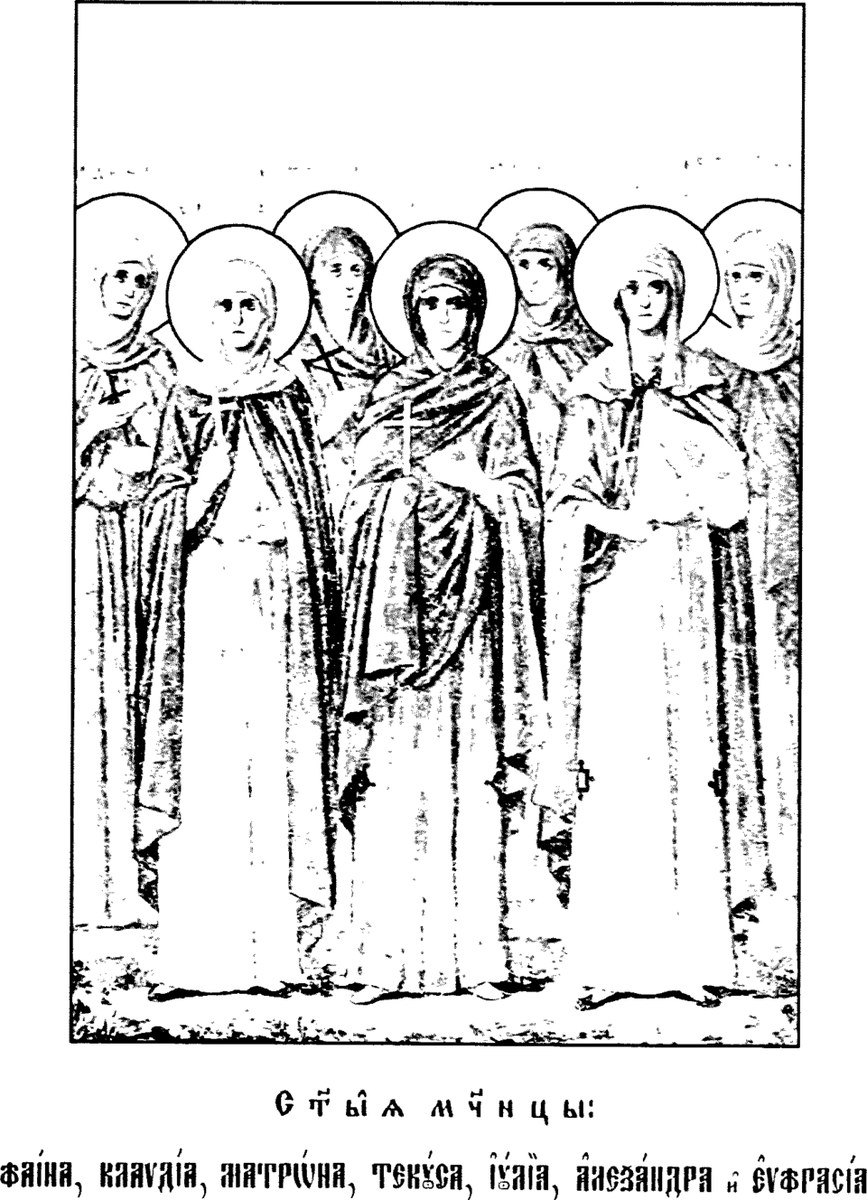
The eight are painted as martyrs of the lay estate. Theodotus is shown as a middle-aged bearded man in the tunic and mantle of a townsman, holding the small cross of the martyrs; where his trade is signalled, a wine-vessel or flask stands beside him, and in narrative scenes the ass laden with wine-jars, the lake with the bodies of the virgins, and his own beheading are the recognisable episodes. The seven virgins are painted as a row of elderly women in the maphorion, veiled and haloed, each holding a cross — deliberately not the young crowned virgin-martyrs of the usual type, since the whole point of their passion is their great age. Their drowning, with the stones at their necks and the pagan images being carried down to the same water, is the scene proper to them.
The stored image is the engraved plate of the seven virgins from the May volume of the nineteenth-century Russian Lives of the Saints after St Dimitri of Rostov (published before 1911, and public domain by publication): the seven stand in a close rank in maphoria, three of them holding crosses, the Slavonic inscription naming them beneath — Ст҃ы́я мч҃цы: Фаи́на, Клаѵді́а, Матрѡ́на, Тєкꙋ́са, Іꙋлі́а, Алєѯа́ндра и Еѵфрасі́а ("the holy martyrs Phaina, Claudia, Matrona, Tecusa, Julia, Alexandra and Euphrasia") — which identifies the company beyond doubt. Theodotus is not in this plate; no identity-verified pre-1900 image of him alone was located. A candidate file on Wikimedia Commons captioned "Teodot Ankirski," taken from a diocesan website and tagged public-domain by its uploader with no author, no date and no provenance for the underlying painting, was rejected: an uploader's licence cannot dispose of an unidentified painter's rights, and the image may equally depict Theodotus the bishop of Ancyra.
Disputed questions
- The Passion of Theodotus and its narrator. The whole story rests on a single Greek text, the Martyrdom of Theodotus of Ancyra, whose narrator names himself Nilus and claims to have been on the spot, a fellow-prisoner and eyewitness. Thierry Ruinart printed it in 1689 among his Acta sincera — the authentic acts — and for two centuries it was read as first-hand reportage. Hippolyte Delehaye then subjected it to criticism and judged it a work of hagiographical art rather than a court record, noting its literary borrowings (the drowning of the virgins in a lake and the miraculous recovery of the bodies have Herodotean and romance parallels) and its improbably full dialogue. Later scholarship has been less severe than Delehaye and readier to allow that a local text composed at the shrine of Malos preserves genuine local memory — topographical detail of Ancyra and its territory, the annual lake-lustration of Artemis and Athena, the pagan cults and the vine-growing villages of the Halys — even where the narrative frame is literary. This repository treats the passion as an early Galatian document of real value, with its wonders reported as the text reports them.
- This Nilus is not St Nilus of Sinai. The narrator of the passion is not to be identified with Nilus the Faster (Nilus of Sinai/Ancyra, †c. 430), the ascetic writer, though the coincidence of name and city has caused the confusion more than once. The narrator claims to write in the persecution itself, a century earlier.
- Not to be confused with Theodotus, Bishop of Ancyra (Wikidata Q4891141), the fifth-century hierarch of the same city who took part in the Council of Ephesus against Nestorius and is commemorated separately. Nor with Theodotus, Asclepiodota and Maximus of Adrianople (September 15; also February 19), nor with Theodotus of Cyrenia. The Byzantine calendars also carry a June 7 commemoration of "Theodotus of Ancyra," which some lists refer to this martyr and others to the bishop; the Armenian Church keeps him on the Thursday after the third Sunday of Pentecost.
- Seven virgins or eight? The Greek Menaion, the Slavic Menaion and the Roman Martyrology all number them seven; but a well-attested variant reading inserts Theodota and gives eight, and some Russian lists print that form. The seventh name also varies between Julitta (Ἰουλίττα, the older form) and Julia (Ἰουλία, the form used by the OCA and by the Slavonic engraving reproduced below), and Phaina appears as Phaine, Thaina and Faina. The name Euphrasia in this company has further generated a phantom: some day-lists for May 18 carry a separate "Martyr Euphrasia of Nicaea (c. 303)," which is most probably this Euphrasia detached from her sisters and given a wrong city — she is not the same as Euphrasia of Nicomedia (January 19), a distinct virgin-martyr with her own passion.
- The Matrona of this company is one of several saints of that name and must be kept apart from Matrona of Thessalonica (March 27, the Christian slave beaten to death by her Jewish mistress), Matrona of Constantinople (November 9, the venerable foundress who lived disguised as the monk Babylas) and Matrona of Chios (October 20).
- One commemoration or two? Because the seven virgins die first and Theodotus dies for burying them, the calendars could have separated them; they do not. The Greek Menaion keeps them in a single notice on May 18, the Slavic Menaion and the OCA give a single life, and the sole source is a single narrative in which neither half is intelligible without the other. They are therefore kept here as one entry, with all eight names indexed.