
Euplus of Catania
The Holy Martyr Euplus the Archdeacon of Catania
Martyr · Deacon · d. 304, Catania in Sicily
Commemorated 11 August — Martyrdom by beheading at Catania with the Gospel-book about his neck
Euplus was a deacon of the church of Catania in Sicily who was put to death in the year 304, at the height of the persecution of Diocletian and Maximian, for refusing to surrender the books of the Gospels. His trial before the governor Calvisianus is preserved in an unusually sober and circumstantial passion, surviving in both a Greek and a Latin recension, which is counted among the small handful of genuinely authentic acts of the martyrs: it records the interrogation almost as a court clerk would have taken it down. Ordered to explain why he possessed writings the emperors had commanded to be given up, Euplus answered that he was a Christian and that it was not lawful for him to hand them over. He was tortured, imprisoned, and finally led out to execution with the Gospel-book hung about his neck, reading and expounding it to the crowd as he went, and was beheaded. He is honoured as a patron of Catania beside the city's great martyr Agatha.

Catania in the Great Persecution
The persecution launched by Diocletian in February 303 began not with blood but with paper. Its first edict ordered the churches pulled down, the assemblies of Christians forbidden, and — the provision that shaped Euplus's death — the Scriptures surrendered to the magistrates and burned. Across the empire the demand created a new category of Christian failure, the traditor, "the man who handed over," and a corresponding new category of confession: the refusal to give up the books. Sicily, a senatorial province governed from Syracuse, felt the edicts through its corrector, and in Catania, the great city under Etna, the church had a living memory of persecution already, for the maiden Agatha had died there half a century earlier under Decius.
Euplus belonged to the clergy of that church as a deacon. The Byzantine tradition styles him archdeacon, the first of the deacons of the city; the Latin passio calls him simply diaconus. His name, Εὔπλος, is a Greek nautical word — eu- and pleō, "of the fair voyage," "sailing well" — the kind of name borne by the Greek-speaking maritime populations of eastern Sicily, and a name the Byzantine hymnographers played on happily: he made a fair voyage indeed, from earth to heaven.
"I am a Christian, and I wish to die"
The acta open with an act of deliberate self-exposure. On the day of the hearing Euplus did not wait to be denounced. He stood outside the secretarium — the closed chamber where the governor sat in judgment — holding the book of the Gospels openly in his hands, and shouted so that the court could hear him: he was a Christian, and he wished to die for the name of Christ. The officials brought him in with the books still in his arms.
Calvisianus, the governor, asked him where he had got the writings and whether he had brought them out of his own house. Euplus said he had none, for he had given up everything; these he carried with him. Ordered to read from them, he read, in the Latin recension, the beatitude of those persecuted for righteousness' sake, for theirs is the kingdom of heaven, and the word of the Lord that whoever wishes to come after me, let him deny himself and take up his cross and follow me. Asked what that meant, he answered that it was the law of his Lord, which had been delivered to him. Asked from whom, he said: from Jesus Christ, the Son of the living God.
The governor then put the decisive question — did he not know that the emperors had ordered these books to be given up and burned? Euplus's reply is the centre of the passion, and the reason the Church remembers him: he was a Christian, and it was not lawful for him to surrender them; he would rather die than hand them over. The refusal was not obstinacy about property. To surrender the Scriptures was to consent that the word of God was the emperor's to destroy, and the confessors of 303–305 understood the demand exactly as the demand to sacrifice: an act of submission in a symbol.
Torture, prison, and the water
Calvisianus ordered him tortured. Through the racking Euplus repeated his confession, and when the executioners paused he was heard giving thanks; the acta record him saying that he owed thanks to Christ, and asking that Christ guard him, for it was for Christ that he suffered. He was returned to prison, where he was held for some days.
The Byzantine synaxarial tradition preserves at this point a detail not in the bare court record: that in the prison, where he was left without water, a spring of water welled up for him, and that he baptised some of his fellow prisoners with it. The motif is a familiar one of eastern hagiography, and it is not in the sober Latin acta; but it is what the Greek Church remembers about his imprisonment, and the day's hymns allude to it.
The Gospel about his neck
Brought out a second time and found unmoved, Euplus was condemned. The sentence was executed with a piece of judicial theatre that fixed his memory for ever: the book of the Gospels was hung around his neck, and the herald went before him proclaiming the crime for which he died — that he had kept and would not surrender the Christian writings. The authorities meant it as a placard of guilt. The Church read it as a decoration.
The passion says that as he was led out, with the book hanging on his breast, Euplus went on reading it aloud and explaining it to the people who lined the way, and that many of the pagans who heard him believed. At the place of execution he prayed, gave thanks that his contest had come to its end, and was beheaded. The Christians of Catania took the body away and buried it with honour. The year was 304.
Relics and later cultus
Euplus became, with Agatha, one of the two great patrons of Catania; churches under his name stood in the city, and he was invoked in the towns beneath Etna, most conspicuously at Francavilla di Sicilia, whose patron he is. Relics claimed as his came in time to the mainland: the body venerated at Trevico in Campania is the principal Italian relic, and in the seventeenth century — the recorded date is 5 February 1654 — the bishop of Trevico authorised the giving of a bone of the saint back to the diocese of Catania, which had lost its own.
In the East the cult was as firm as in the West and quite independent of it. Euplus stands in the Constantinopolitan synaxaria for 11 August, in the received Greek Menaion, and in the Slavonic and Russian calendars translated from it; and he is painted among the deacon- martyrs in the monumental programmes of the Middle Byzantine period, from Daphni near Athens to the Norman-Byzantine mosaics of Monreale in his own island.
Feast and commemoration
August 11 (church date; New Calendar civil August 11, Old Calendar civil August 24). The day falls within the afterfeast of the Transfiguration (August 6–13) and within the Dormition Fast (August 1–14), and the office of the martyr is therefore sung together with the propers of the feast: the Transfiguration governs the kontakion and the festal stichera of the day, and Euplus receives his canon and his stichera at Vespers. The Latin Church keeps him on August 12, the date its acta give for the execution.
He is a universal commemoration, kept alike in the Greek, Slavonic, Antiochian and Western calendars; in Sicily his day is a civic as much as an ecclesiastical one, and at Catania and Francavilla it carries the honours of a patronal feast.
Hymns
Troparion — Tone 4 (common of a martyr)
Thy martyr Euplus, O Lord, in his contest received an incorruptible crown from Thee, our God; for possessing Thy strength, he cast down the tyrants and shattered the feeble insolence of the demons. By his intercessions, O Christ God, save our souls.
Original translation from the Greek
Iconography
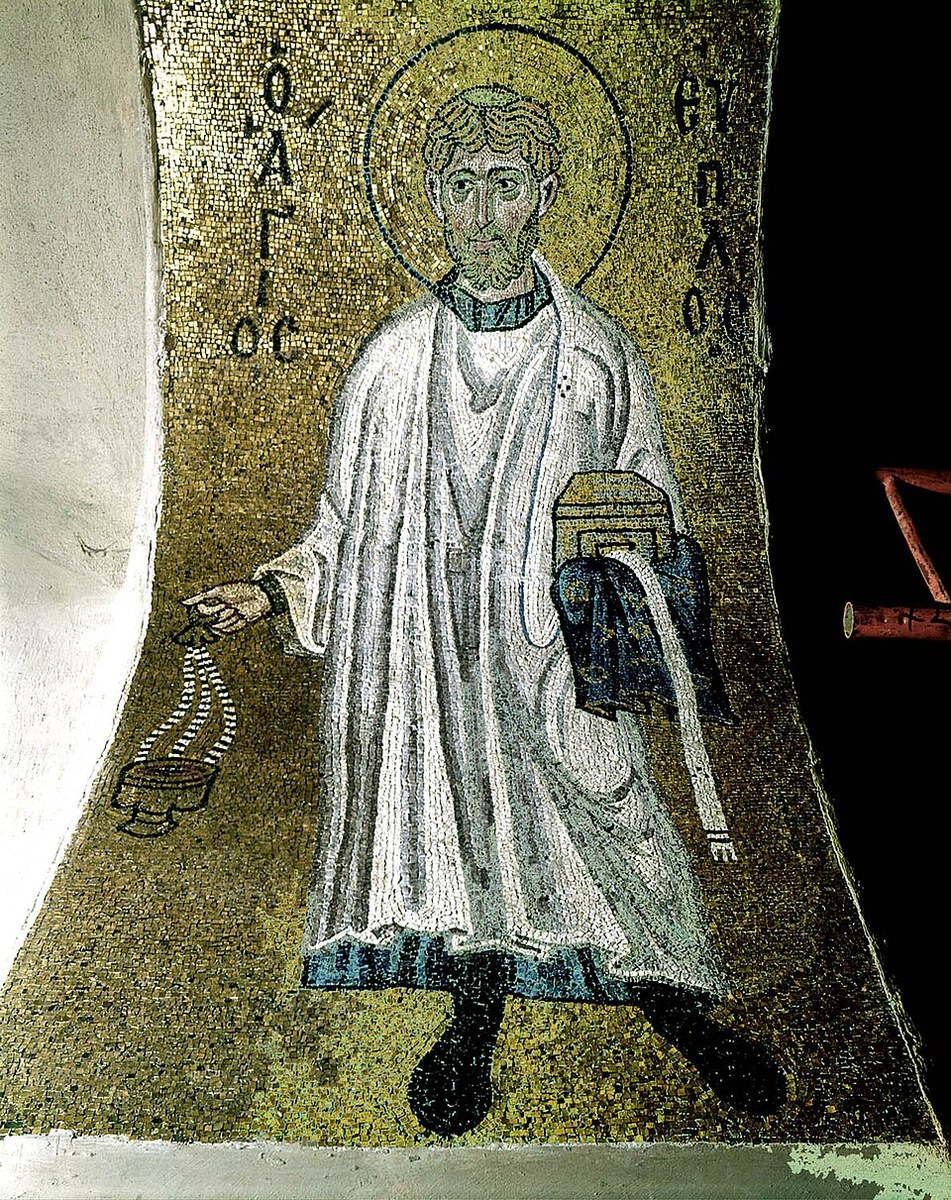
Euplus is painted as a deacon, and the deacon's dress is the whole of his type: the white or pale sticharion falling to the feet, the orarion crossed or hanging over the left shoulder, the censer swinging from the right hand and the pyxis — the covered box of incense — held in a cloth in the left. He is shown young or, more often, in early middle age, with a short dark beard, and his inscription is Ο ΑΓΙΟΣ ΕΥΠΛΟΣ. Where the painter wishes to name his passion rather than his order, the attribute is the book of the Gospels, either carried in his hands or, in narrative scenes, hanging from a strap about his neck as he is led to execution — an image that turns the instrument of his accusation into his crown. Because his order rather than his martyrdom governs the type, he is usually placed with the other deacon-martyrs — Stephen, Lawrence, Romanus — on the piers, soffits and lower registers of a church, where the deacons stand as though serving the altar above.
The stored image is the mosaic of c. 1100 in the Monastery of Daphni near Athens, one of the finest surviving Middle Byzantine ensembles: the saint stands full-length on the curved soffit of an arch against a gold ground, inscribed Ο ΑΓΙΟС / ЄΥΠΛΟС, in the white deacon's tunic with the dark orarion, holding out the censer on its chains in his right hand and the incense-box wrapped in a blue cloth in his left. Other pre-modern images of him include the twelfth-century medallion in the presbytery of the cathedral of Monreale in Sicily and a twelfth- to thirteenth-century fresco in the church of St Nicholas at Melnik, evidence of how widely the Sicilian deacon travelled in Byzantine painting.
Disputed questions
- Two dates in the record. The Latin acta head the interrogation with a consular date in April (29 April 304) and place the execution on 12 August, which is the day the Latin Church keeps; the Greek recension carries the whole trial in August, and the Byzantine calendar keeps him on 11 August. The two-stage structure of the passion — a first hearing, an imprisonment of some days, a second hearing and sentence — is easiest to reconcile with the Latin dating, the April session being the arrest and first examination and the August session the condemnation; but the manuscripts do not agree, and the one-day discrepancy between the eastern and western feast is not resolved.
- Deacon or archdeacon. The Latin text calls him diaconus; the Greek synaxaria and the Slavonic Menaion call him archdeacon. Nothing turns on it except the honour of the title, which is a Byzantine refinement of a plain Latin fact.
- Greek or Latin original. Because the acta survive in both languages and neither is obviously derived from the other, the question of which recension stands nearer the lost official record has been argued since the Bollandists first printed them. What is not in dispute is the general verdict on their quality: the text is not a romance but reads like a transcript, and it is habitually printed among the "genuine" acts of the martyrs.
- Not to be confused with Euplus the Martyr of May 30, the saint of a single line of the Greek synaxarion who was sewn into an ox hide and left in the sun. The name is rare enough that a relationship between the two notices has been suspected — the same martyr doubled into two days, with the mode of death in one branch drawn from another passion — but no source consulted asserts it, the manner and day of death differ entirely, and the Greek books carry both entries independently. The repository keeps them apart, as the calendar does. Images found under the name Euplus belong, with almost no exceptions, to this saint, the Sicilian deacon, and must not be used for the martyr of May 30.