
Eusebius of Samosata
The Holy Hieromartyr Eusebius, Bishop of Samosata
Hieromartyr · Bishop · Confessor · b. early 4th century — d. 379 or 380
Commemorated 22 June — Martyrdom at Doliche by a tile thrown from a roof
Eusebius, bishop of Samosata on the Euphrates from about 361, was the strongest Nicene hierarch of the Syrian provinces in the generation of the Arian ascendancy, and the closest episcopal ally in the East of Basil the Great, some twenty of whose surviving letters are addressed to him. He refused, at the threat of losing his right hand, to surrender the record of the election of Meletius of Antioch; exiled to Thrace by the Arian emperor Valens in 374, he crossed Syria, Phoenicia and Palestine in the dress of a soldier, secretly ordaining presbyters, deacons and bishops for the orphaned Orthodox churches. Restored after Valens's death, he was killed at Doliche by a roof-tile flung by an Arian woman, and died forbidding under oath that anyone avenge him. The Church keeps him as a hieromartyr on June 22.
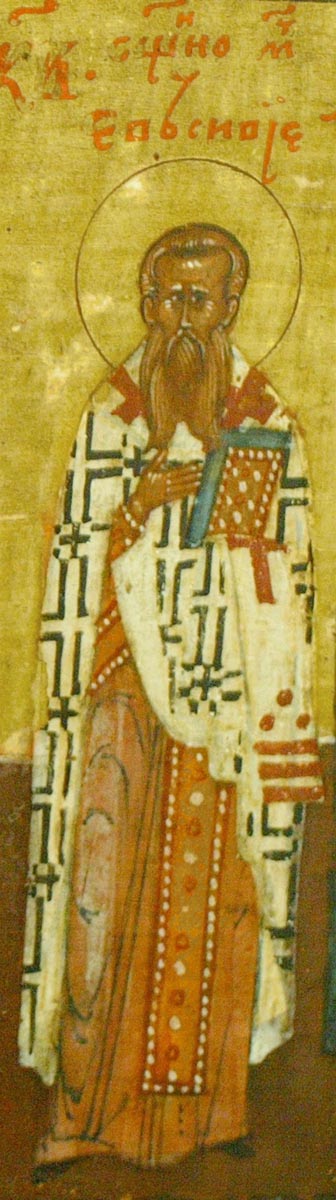
_-_June_-_35_Eusebius_of_Samosata.jpg)
Samosata and the see
Samosata (Σαμόσατα; Syriac Shmishat, the modern Samsat, now beneath the waters of the Atatürk Dam in south-eastern Turkey) was the old royal city of Commagene on the west bank of the Euphrates, at one of the great crossings of the river and the station of the Sixteenth Legion. Ecclesiastically it lay in the province of Euphratensis, whose metropolis was Hierapolis, and therefore within the patriarchate of Antioch: Eusebius is, in the strict sense, an Antiochian bishop, and everything he did — his defence of Meletius, his ordinations, his exile, his death — belongs to the internal history of the Church of Antioch in its hardest century.
Of his origins nothing certain is transmitted. He appears in the record already a bishop, elected to Samosata about 361, at the moment when the long Arian crisis had reached its most tangled point in Syria. Almost all that is known of him comes from two bodies of contemporary evidence rather than from a later legend: the letters of Basil the Great and of Gregory the Theologian, and the narrative of Theodoret of Cyrus, himself a bishop of the same province a generation later, whose Ecclesiastical History preserves the Samosata material with obvious local pride.
The record of Meletius' election
In 360 the see of Antioch was given to Meletius, who had the support of the Arianising bishops of the court party; they had judged him one of themselves. The document of his election — the tomos, the signed record — was placed for safekeeping in the hands of Eusebius. Within a month of his enthronement Meletius preached before the emperor Constantius a sermon of unmistakably Nicene sense, and was deposed and banished; and the party that had elected him now wanted the incriminating record of their own signatures back.
Constantius sent an official to Samosata to demand the document. Eusebius refused it. The messenger returned with the threat that the emperor would have his right hand cut off if he persisted; Eusebius, in the account Theodoret received, held out both hands, and told him to take them and carry them to the emperor, but that he would not surrender a paper which convicted the impiety of the Arians. Constantius, told of the answer, is said to have admired the man who gave it and let the matter drop. The story fixes Eusebius's character at the outset: entirely immovable, and entirely without violence.
The friend of Basil
Eusebius's importance in the 360s and early 370s is that he was the one Nicene bishop of the Syrian East with whom the Cappadocians could work. In 370, when the see of Caesarea in Cappadocia fell vacant, it was Eusebius who came the long distance to take part in the election and consecration of Basil, over the resistance of a part of the province's episcopate, and — with the aged Gregory the elder, bishop of Nazianzus — carried it. The correspondence that follows is one of the most valuable dossiers of the fourth century: Basil writes to him about the healing of the schism of Antioch, about an embassy to the bishops of the West, about the churches of Armenia which the two of them travelled to set in order, about the ordination of bishops for vacant sees, and, repeatedly, about the loneliness of standing for the Nicene faith in a Church whose hierarchy the emperor had bought or broken. Gregory the Theologian's letters to him are fewer but of the same temper. It is from these letters, and not from a hagiographer, that the affection Eusebius commanded can be measured.
Exile under Valens
In 373 Meletius' great supporter Athanasius died; in 374 the emperor Valens, wholly committed by then to the Arian party, moved against the Nicene bishops of the East, and Eusebius was sentenced to exile in Thrace.
Theodoret's account of the night the sentence arrived is among the finest pages of his history. The imperial officer reached Samosata in the evening. Eusebius read the edict, and then told the man to say nothing to anyone: the people here have been reared in zeal for God, and if they learn why you have come they will drown you in the river, and I shall be held guilty of your death. He went to church, kept the evening office, said nothing; and after nightfall he left the city on foot with a single servant carrying nothing but a cushion and a book, went down to the water, and told the boatmen to row for Zeugma.
At daybreak the city discovered what had happened. The Euphrates, Theodoret says, was crowded with the boats of the citizens rowing after their bishop; when they came up with him they wept and begged him not to leave them to the wolves. Eusebius answered them out of the Apostle — that the powers that be are ordained of God — exhorted them to hold the faith, and went on into exile. The Christians of Samosata sent after him gifts of money and clothing, which he sent back.
The city that would not receive an Arian
What followed is the most celebrated episode in the whole dossier, and Theodoret tells it for a reason: it shows that the fourth-century conflict was not merely a quarrel of bishops.
An Arian named Eunomius was intruded into the see. He was, by the historian's own admission, a man of decent manners; but not one inhabitant of Samosata, of any rank or age, would come to church while he held it. He came to know how completely he had been rejected when he went to the public bath: the attendants shut the doors after him, and the citizens who had come to bathe stood outside and would not enter, though he ordered the doors opened. Understanding at last that they held the water itself polluted by his heresy, he had the bath emptied and refilled, and soon afterwards left the city, saying he could not overcome such a people.
His successor was Lucius, whom Theodoret calls plainly a wolf and an enemy of the sheep. Under him the ball-game story belongs: boys were playing ball in the marketplace, and the ball rolled between the feet of the ass on which Lucius was riding; the children shouted that it was defiled, kindled a fire in the open street, and threw the ball through the flames to purify it. Theodoret, who knows the tale sounds like a childish joke, says he records it precisely to show how deeply the hatred of the heresy had struck root in that town. Lucius for his part exiled the orthodox clergy of the city — among them Antiochus, Eusebius's own nephew, and the reader Evolcius — to Thrace and to the mines of Phoenicia.
The soldier's tiara: ordinations in disguise
Exile did not stop Eusebius; it converted him into something the Arian administration had no way of catching. Theodoret says that he went about Syria, Phoenicia and Palestine dressed in the garb of a soldier, his head covered with a tiara, and in that disguise ordained presbyters and deacons, performed the other priestly offices, and where he found the churches without shepherds consecrated bishops of the Nicene faith. This is the act for which he is chiefly remembered in the Antiochian tradition: at the moment when the Arian ascendancy was in a position to strangle the Orthodox hierarchy of the Syrian provinces simply by controlling who was ordained, one exiled bishop walked the whole length of the region in disguise and kept the succession alive. Nearly every Nicene see of Euphratensis and its neighbours in the years after 378 owes something to that journey.
Later retellings, including some Western ones, place the disguised journeys under Julian the Apostate rather than under Valens. Theodoret sets them in the years of the Valentine exile, and that is the placement followed here.
Return, and the tile at Doliche
Valens was killed at Adrianople in 378, and the edict of Gratian recalled the exiled bishops. Eusebius came back to Samosata, and immediately resumed on a larger scale the work he had been doing secretly. He travelled from church to church consecrating bishops for the devastated sees — among them Acacius for Beroea, Theodotus for Hierapolis, another Eusebius for Chalcis, Isidore for Cyrrhus, and Maris for Doliche.
Doliche (Δολίχη, the modern Dülük near Gaziantep) was a small town whose population had gone over almost entirely to Arianism. Eusebius went there in person to install Maris. As he entered the town, a woman, Theodoret says, thoroughly infected with the Arian plague, let fall from the roof of a house a tile, which struck the bishop on the head and crushed his skull.
He lived long enough to do one more thing. He charged those standing by not to exact the least penalty from the woman, and bound them under oath to obey him. Theodoret sets the death beside the Lord's prayer for those who crucified him and Stephen's prayer for those who stoned him, and concludes that Eusebius, dying at the hands of heretics rather than of pagans, nonetheless won the martyr's crown. The year was 379 or 380. His body was carried back up the Euphrates to Samosata and buried among his own people.
Feast and commemoration
June 22 (church date; Old Calendar civil July 5). The commemoration is universal — Greek, Antiochian, Slavonic, Romanian — and Eusebius heads the day everywhere. In the Antiochian usage he has a particular claim: he is a bishop of the patriarchate, the chief defender of Meletius of Antioch, and the man to whom a large part of the Syrian episcopate of the late fourth century owed its orders. The Latin martyrology keeps him on June 21, a day earlier, which accounts for the divergence occasionally seen in Western reference works.
Hymns
Apolytikion — Tone 4
As a sharer in the ways and a successor to the thrones of the Apostles, O divinely-inspired one, thou didst find in contemplation the means to ascend to divine heights; rightly dividing the word of truth, thou didst struggle for the faith even unto blood, O hieromartyr Eusebius: intercede with Christ God that our souls may be saved.
Kontakion — Tone 4
Thou didst shine in the priesthood and wast made radiant in thy contest, O all-blessed Eusebius; thou didst quench the raging of the ungodly and guard the flock entrusted to thee. Wherefore we honour thee, and cry aloud: deliver us from dangers by thine intercessions.
Original translation from the Greek
Iconography
Eusebius is painted as a hierarch of middle years: a long, pointed, dark or greying beard, the polystavrion phelonion of crosses or a plain phelonion with the omophorion, holding the Gospel-book in the left hand covered or bare, the right hand raised in blessing. He is not given a martyr's palm or the instrument of his death in the ordinary type; the tile is shown only in the narrative martyrdom scenes of the menologia, where a woman is depicted on a roof above the bishop as he enters a town gate. In Slavonic books the inscription runs сщенномученикъ Еvсевiй Самосатскiй.
The stored image is a detail from a seventeenth-century Russian menaion icon for the month of June (Church Archaeological Cabinet of the Moscow Theological Academy): the saint stands full-length in a white cross-covered phelonion over a red sticharion, the omophorion crossed on his breast, holding the jewelled Gospel, with the red Slavonic inscription naming him hieromartyr above the halo.
Disputed questions
- The year of death. Theodoret gives no year. It must fall after the recall of the exiles in 378 and before the accession of Meletius' successor at Antioch; 379 and 380 are both defensible and both are printed. The synaxaria and the Slavonic books usually say 380, and that figure is retained in the calendar data here.
- Under which emperor the disguised journeys took place. Theodoret places them within the exile imposed by Valens (374–378). A parallel strand of the tradition, followed in some Western reference works, assigns them to the reign of Julian (361–363). The two are not strictly exclusive — Eusebius was bishop through both reigns — but only the Valentine placement has a contemporary narrative behind it.
- Martyr or confessor? Eusebius was killed by a Christian heretic in a street accident of sorts, not sentenced by a persecuting magistrate. Theodoret argues the case for the martyr's crown explicitly, and the Church has followed him: the calendars style him hieromartyr. The confessor classification is carried here as well, since the exile itself, and the refusal of the record before Constantius, are confessions in the technical sense.
- Not to be confused with the several other sainted Eusebii of the Syrian calendar — Eusebius the Hermit of Syria (January 23, a stylite-like ascetic of the region of Antioch), Eusebius of Phoenicia (September 21, a martyr), and the martyr Eusebius commemorated with Charalampus (Eusebius and Charalampus) — nor with the historian Eusebius of Caesarea or the Arian Eusebius of Nicomedia, neither of whom is a saint.
- Doliche and the cult of Jupiter Dolichenus. The town where Eusebius died had been, in the second and third centuries, the cult-centre from which the worship of Jupiter Dolichenus spread through the Roman army. That a bishop should be killed there, by a Christian heretic, while installing another bishop, is one of the sharper ironies of the fourth-century record; it is not drawn out by the sources, but it explains why so small a place had a see at all.