
Athanasius the Great
Our Father among the Saints Athanasius the Great, Archbishop of Alexandria, Great Hierarch and Ecumenical Teacher
Bishop · b. c. 296, at Alexandria — d. 373, at Alexandria (May 2)
Commemorated 18 January — Commemorated with Cyril of Alexandria — the two hierarchs and teachers of Alexandria, 2 May — Repose (†373) and translation of his relics
Athanasius the Great (c. 296 – 373) was Archbishop of Alexandria, the champion of the Nicene faith and, with Basil the Great, one of only two Eastern fathers whom the Church styles by universal consent "the Great." Present at the First Ecumenical Council of Nicaea (325) as a young deacon, he became through a long episcopate the tireless defender of the Council's confession that the Son is homoousios — "of one essence" — with the Father, against the Arianism that for two generations captured emperors, courts, and councils. Five times driven from his see and some seventeen years an exile, he held the faith when almost the whole world had gone over to Arius, so that his name became a proverb — Athanasius contra mundum, "Athanasius against the world." He wrote the classic statement of the Incarnation, On the Incarnation of the Word; the Life of Antony, which carried the monastic ideal through the whole Church, East and West; and, in his thirty-ninth Festal Letter of 367, the first listing of the twenty-seven books of the New Testament exactly as the Church now receives them. He died in peace at Alexandria on May 2, 373, having outlived his persecutors and secured the triumph of Orthodoxy. He is kept on January 18 together with Cyril of Alexandria, and on May 2, the day of his repose.
.jpg)
Origins and formation at Alexandria
Athanasius was born about the year 296 at Alexandria, the second city of the Roman Empire and the intellectual capital of the Christian East — the see of the Evangelist Mark, the home of the great catechetical school of Clement and Origen, and a church whose bishop already carried, in popular usage, the title of "Pope." Of his family little is known beyond that it was Christian and gave him a thorough education both in Greek letters and, unusually for a man of his standing, in the Scriptures, which he seems to have known from childhood with an intimacy that marks all his writing; he had also some command of Coptic, the tongue of the Egyptian countryside and of the monks who would one day shelter him. A cherished tradition, transmitted by the historian Rufinus, tells how the boy Athanasius, playing at church on the seashore with other children, "baptised" some catechumens among them with such evident seriousness that Bishop Alexander of Alexandria, watching from a window, judged the baptisms valid in intent and took the boy into his household to be trained for the Church — a story that, true or not, rightly makes Alexander the maker of Athanasius.
He was ordained deacon and became Alexander's secretary and archdeacon, the bishop's right hand in the storm that was already gathering. For it was in Alexandria itself, and in these very years, that the greatest of the ancient heresies was born.
The rise of Arius
About the year 318 a presbyter of Alexandria named Arius, a learned and austere man in charge of the church of Baucalis, began to teach that the Son of God is a creature — the first and highest of creatures, through whom God made all things, but a creature nonetheless, made out of nothing, not eternal, not of the Father's own being. "There was when he was not" (ἦν ποτε ὅτε οὐκ ἦν) was the watchword of his party: the Son had a beginning, was of a different essence (heteroousios) from the Father, and was called God only by grace and title, not by nature. The teaching had the appeal of a fierce monotheism and a tidy logic, and it spread with alarming speed through Egypt and the East. Bishop Alexander, after patient warning, condemned Arius and his followers in a synod of the Egyptian bishops; but Arius had powerful friends abroad — above all Eusebius of Nicomedia, close to the imperial house — and the controversy soon threatened to tear the newly-tolerated Church in two. The emperor Constantine, who had just united the empire and looked to the Church for its concord, resolved to settle the matter by a council of the whole world.
Nicaea, and the homoousion
The First Ecumenical Council met at Nicaea in Bithynia in the summer of 325 — some three hundred and eighteen bishops, many of them confessors still bearing the scars of the last persecution. Athanasius attended not as a bishop but as Alexander's deacon and theological adviser, and though he had no vote he was, the tradition and the sources agree, one of the chief minds and voices against the Arians, marked out from that day as the coming champion of the Nicene cause. The Council condemned Arius, and — to exclude every evasion by which the Arians slipped through the language of Scripture — it confessed the Son to be "of one essence with the Father," homoousios tō Patri (ὁμοούσιος τῷ Πατρί): true God of true God, begotten not made, of the very being of the Father. The word homoousios was not scriptural, and its choice was bold; but it drew the one line the Arians could not cross, and it became the touchstone of Orthodoxy and the labour of Athanasius's whole life. He would spend the next half-century defending that single word — and the reality it guards, that in Jesus Christ we meet not a demigod or an exalted creature but God himself come to save.
Archbishop of Alexandria
Bishop Alexander died in 328, and Athanasius — though barely past the canonical age, and against the resistance of the Arian and Meletian factions — was elected and consecrated Archbishop of Alexandria, head of the whole Egyptian church, of Libya, and of the Pentapolis, with jurisdiction over some hundred bishops. He was about thirty-three, and he would hold the see for forty-five years, of which some seventeen were passed in exile. From the first he governed with energy and made the visitation of his vast and turbulent province — travelling as far as the Thebaid and the monastic deserts, binding the monks to the Nicene cause, and standing immovable against both the Arians and the schismatic Meletians of Egypt, who now made common cause against him.
The five exiles
The story of Athanasius's episcopate is the story of the long war for Nicaea, fought out in the reigns of five emperors, and it is measured by his five exiles — the fullest ancient record we have of a bishop's endurance.
The first came in 335. His enemies, unable to answer his theology, turned to calumny: he was accused, among much else, of the murder of a Meletian bishop named Arsenius, whose severed hand he was said to keep for magic — until Athanasius produced Arsenius alive before the court, both hands attached, and the charge collapsed in ridicule. But the packed Council of Tyre (335), managed by the Eusebians, deposed him regardless, and Constantine, weary and misinformed, banished him to Trier (Trèves) in Gaul. He was recalled on the emperor's death in 337.
The second exile followed almost at once. The Arians intruded a rival, Gregory of Cappadocia, into Alexandria by force, and Athanasius fled (339) to Rome, where Pope Julius I received him, examined his case, and declared him innocent; the Western council of Sardica (343) confirmed him. He returned in 346 to a decade of relative peace under the emperor Constans.
The third and longest exile — the heart of the "contra mundum" years — came under Constantius II, sole emperor after 350 and a determined Arianiser. On the night of February 8, 356, imperial soldiers stormed the church of Saint Theonas during the all-night vigil to seize the archbishop; Athanasius, refusing to leave until his people were safe, was carried out by the monks and vanished into the Egyptian desert, where for some six years the monks of the Thebaid hid him and passed him from cell to cell under the very noses of the searchers. These were the years in which Constantius, by threat and exile, bent one great see after another to the Arian or the compromising "Homoian" creed — pressing even Pope Liberius of Rome and the aged Hosius of Cordova, the hero of Nicaea, to yield — until, in Jerome's famous words, "the whole world groaned and was astonished to find itself Arian." It was now that Athanasius stood, to the eye of the world, almost alone; and it was now, in hiding, that he wrote his greatest polemical and historical works. He was recalled briefly on the accession of Julian the Apostate (361), only to be exiled a fourth time (362–363) when the pagan emperor found the bishop's influence over the city intolerable; and a fifth time, briefly, under the Arian Valens (365–366), before the emperor, fearing the people of Alexandria, let him return for good.
Through all of it Athanasius never yielded a syllable of the faith, never bought peace with silence, and never ceased to govern and to write. His endurance made his name a proverb of steadfastness — Athanasius contra mundum, "Athanasius against the world" — the one man who would not be moved though the world moved against him.
On the Incarnation and the doctrine of salvation
Athanasius's theology is all of a piece, and its centre is the Incarnation. His early double work — the Against the Heathen (Contra Gentes) and On the Incarnation of the Word (De Incarnatione), written probably before the Arian storm broke — sets out, in prose of luminous simplicity, why God the Word became man. Humanity, made in the image of God for incorruption, had by sin fallen back toward the nothingness from which it was made; and God would neither let his handiwork perish nor save it by a mere decree, for the corruption had gone too deep. Therefore "the Word of God became man that we might become god" — that is, that human nature, united to the immortal Word, might be restored, renewed, and deified. "He became what we are that he might make us what he is": the Incarnation is not a lesson but a rescue, and only if the one who took our flesh is truly God could that flesh be made incorruptible and God-bearing. Here is the marrow of his case against Arius: if the Son is a creature, then a creature cannot save us, no bridge is thrown across the gulf, and our deification is a fiction. The whole Arian debate, for Athanasius, was never a quarrel over a word but a struggle for salvation itself — whether we are redeemed by God or only by a servant.
Against the Arians directly he wrote the three (or four) Orations against the Arians, the classic refutation, patiently answering their proof-texts and showing that the Son is eternally begotten of the Father's own being, the Father's own Word and Wisdom, in whom the Father is fully known. And when a party arose that granted the Son's divinity but denied the Holy Spirit's, he wrote the Letters to Serapion (c. 359–361), the earliest sustained defence of the Spirit's full divinity and consubstantiality — the ground on which the Cappadocian fathers would build, and which the Second Ecumenical Council would seal.
The Life of Antony, and the monks
Amid the polemic Athanasius wrote a book of another kind, and it may have travelled farther than any of the rest. About 357–362, during or just after his desert years, he composed the Life of Antony — the biography of Antony the Great, the father of monasticism, whom Athanasius had known and whose disciples had sheltered him. It is the first great work of Christian hagiography, and it did more than any other single book to spread the monastic ideal through the whole Church: carried west and read in Latin, it drew Romans and Gauls to the desert life, and it was over a chance account of it, Augustine tells us in the Confessions, that his own conversion turned. Athanasius's bond with the monks was no literary pose: the monks of Egypt were his refuge, his army, and his surest allies for Nicaea, and he in turn was their bishop, their defender, and the interpreter of their sanctity to the world.
The canon of Scripture
One further legacy of his pen shaped the Church for all time. Each year the Bishop of Alexandria sent out a Festal Letter fixing the date of Pascha and teaching his people; and in the thirty-ninth Festal Letter, of the year 367, Athanasius, listing the books that may be read as Scripture, gave the first surviving enumeration of the twenty-seven books of the New Testament — the four Gospels, the Acts, the fourteen letters of Paul, the seven Catholic Epistles, and the Revelation — exactly, and only, as the Church now receives them, sharply distinguished from the useful-but-non-canonical and the apocryphal. No council had yet spoken; Athanasius's letter is a decisive witness to the settling of the canon, and the councils that followed confirmed the list he gave.
Athanasius and Antioch
The Antiochian tradition has its own stake in Athanasius, for one of the last great labours of his life was directed at the healing of the schism of Antioch. The Nicene party of that great see had split — the majority under Meletius, a smaller rigorist party under Paulinus — and the division weakened the whole Nicene cause in the East. At the Council of Alexandria of 362, Athanasius, newly returned, issued the Tomus ad Antiochenos ("Letter to the Antiochenes"), a masterpiece of theological statesmanship: distinguishing between those who used the Trinitarian words rightly and those who abused them, it laid down that unity should not be broken over hypostasis and ousia where the faith itself was one, and sought to reconcile the parties of Antioch on the sole ground of the Nicene confession. That the reconciliation was only partly achieved in his lifetime does not lessen the greatness of the attempt, and it binds Athanasius, like Basil after him, to the peace of the Church of Antioch.
Repose
Athanasius's last years, under the tolerant Western emperor Valentinian and after the death of Valens's persecution, were passed in peace at Alexandria, governing his church and writing to the end. He died on May 2, 373, some seventy-seven years old, in his own city and on his own throne — a thing that, after five exiles and a lifetime of warfare, was itself a kind of miracle. He had outlived Arius, outlived the emperors who hunted him, and lived to see the Nicene cause turning at last toward the victory that the Second Ecumenical Council would confirm at Constantinople eight years after his death. The Church buried him as the "Father of Orthodoxy" and the "Pillar of the Church," and gave him, with Basil alone among the Eastern fathers, the title "the Great."
Feast and commemoration
Athanasius is kept universally on January 18 (church date; Old Calendar civil January 31), a feast that commemorates the two great hierarchs and teachers of Alexandria together — Athanasius, who slew the Arian heresy, and Cyril of Alexandria, who slew the Nestorian — the two pillars of Alexandrian Orthodoxy joined in a single office much as Basil, Gregory, and Chrysostom are joined on January 30. His own day is May 2 (Old Calendar civil May 15), the day of his repose in 373 and of the later translation of his relics, kept as a distinct feast with its proper hymns; it is recorded here as a secondary commemoration and authored at its own place in the calendar. The Antiochian, Greek, and Slavic calendars agree on both days. The West keeps Athanasius on May 2 as well, a Doctor of the Church.
Hymns
Troparion — Tone 3
Thou wast made a pillar of Orthodoxy, upholding the Church with divine doctrines, O Hierarch Athanasius; for proclaiming the Son to be of one essence with the Father, thou didst put Arius to shame. O venerable Father, entreat Christ God to grant us great mercy.
Original translation from the Greek
Kontakion — Tone 2
Having planted the doctrines of Orthodoxy, thou didst cut away the thorns of false belief, and didst multiply the seed of the faith by the rain-shower of the Spirit, O venerable one; therefore we hymn thee, O Athanasius.
Original translation from the Greek
Apolytikion
Shining forth in the works of Orthodoxy and quenching every false belief, ye became victors crowned with triumph; enriching all things by your piety and greatly adorning the Church, ye worthily found Christ God, who grants great mercy unto all.
Appointed readings
Epistle — Hebrews 13:7–16
7Remember them which have the rule over you, who have spoken unto you the word of God: whose faith follow, considering the end of their conversation. 8Jesus Christ the same yesterday, and to day, and for ever. 9Be not carried about with divers and strange doctrines. For it is a good thing that the heart be established with grace; not with meats, which have not profited them that have been occupied therein. 10We have an altar, whereof they have no right to eat which serve the tabernacle. 11For the bodies of those beasts, whose blood is brought into the sanctuary by the high priest for sin, are burned without the camp. 12Wherefore Jesus also, that he might sanctify the people with his own blood, suffered without the gate. 13Let us go forth therefore unto him without the camp, bearing his reproach. 14For here have we no continuing city, but we seek one to come. 15By him therefore let us offer the sacrifice of praise to God continually, that is, the fruit of our lips giving thanks to his name. 16But to do good and to communicate forget not: for with such sacrifices God is well pleased.
Gospel — Matthew 5:14–19
14Ye are the light of the world. A city that is set on an hill cannot be hid. 15Neither do men light a candle, and put it under a bushel, but on a candlestick; and it giveth light unto all that are in the house. 16Let your light so shine before men, that they may see your good works, and glorify your Father which is in heaven. 17Think not that I am come to destroy the law, or the prophets: I am not come to destroy, but to fulfil. 18For verily I say unto you, Till heaven and earth pass, one jot or one tittle shall in no wise pass from the law, till all be fulfilled. 19Whosoever therefore shall break one of these least commandments, and shall teach men so, he shall be called the least in the kingdom of heaven: but whosoever shall do and teach them, the same shall be called great in the kingdom of heaven.
Iconography
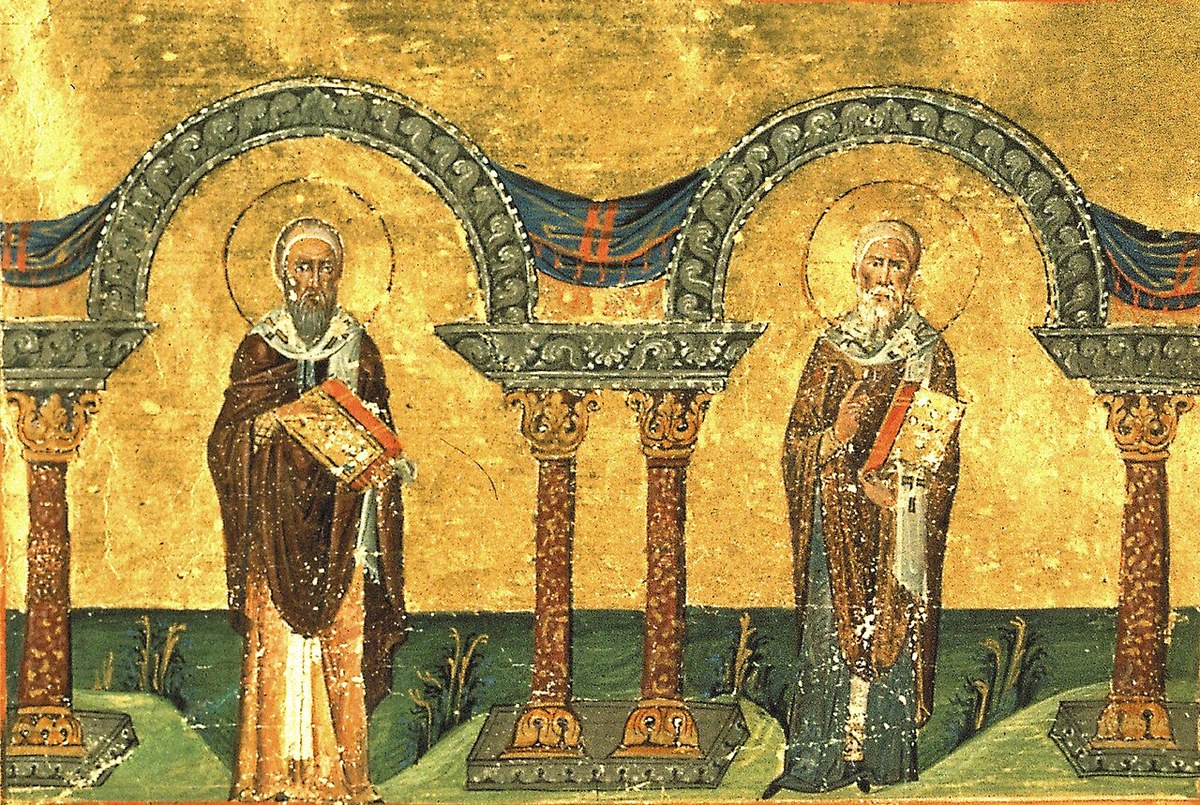
Athanasius is depicted as an archbishop of venerable age — high forehead, a full rounded (often greying) beard, vested as a hierarch in the phelonion or the cross-figured polystavrion with the omophorion, holding the Gospel-book or a scroll and raising his hand in blessing. In the paired image of the two hierarchs of Alexandria he stands beside Cyril, the elder Athanasius commonly balanced against the younger patriarch, the two together forming the visual type of the January 18 feast. Where a scroll is inscribed it often bears a line of his teaching on the Incarnation or the homoousion.
The stored image is the miniature for January 18 from the Menologion of Basil II (Constantinople, c. 985; Vatican, Vat. gr. 1613), depicting Athanasius and Cyril of Alexandria together — the two hierarchs of Alexandria vested in the cross-marked omophorion, the visual form of their joint feast.
Disputed questions
- The "Athanasian Creed." The Latin creed Quicumque vult ("Whosoever will be saved…"), long called the "Athanasian Creed," is not the work of Athanasius: it is a later Western composition (probably fifth- or sixth-century, of Gallic origin), written in Latin, unknown to the Greek East in Athanasius's day, and bearing his name only as a token of its Nicene orthodoxy. The attribution is honoured as a tribute, not accepted as history.
- The year of his birth and the length of his life. The sources allow his birth anywhere from about 293 to 298; the entry follows the common "c. 296," giving him some seventy-seven years and about thirty-three at his consecration.
- Not to be confused with the several other saints named Athanasius: Athanasius I, Patriarch of Constantinople (†c. 1315, kept October 24); Athanasius of Athos, founder of the Great Lavra (†c. 1000, kept July 5); Athanasius of Medikion (kept April 26); Athanasius of Syandem (the Russian venerable kept on this same January 18, for whom see below); and others. "The Great," "the Apostolic," and "Father of Orthodoxy" belong to this Athanasius, the Alexandrian archbishop, alone.