
Evodus of Antioch
The Holy Apostle Evodus of the Seventy, First Bishop of Antioch after Peter
Apostle of the Seventy · Apostle · Hieromartyr · Bishop · d. c. 66
Commemorated 4 January — Synaxis of the Seventy Apostles, 7 September — With the Apostle Onesiphorus of the Seventy
Evodus (†c. 66) was one of the Seventy Apostles and the first bishop of Antioch after the Apostle Peter, the predecessor of Ignatius the God-bearer in the see from which the Patriarchate of Antioch descends. Eusebius names him first in the Antiochian succession, and a later tradition credits him with coining the name "Christians," first given to the disciples at Antioch. He is said to have shepherded the Antiochian church for some twenty-seven years and to have died a martyr, under Nero by the most common account. His writings, among them a book called The Star, are lost. He is commemorated on September 7 with the Apostle Onesiphorus, and with all the Seventy on January 4.

Place in the apostolic church
Evodus (in Greek Εὔοδος, "good way" or "prospering"; the forms Evodius, Euodius and Euodias are all found in English) is counted among the Seventy Apostles sent out by Christ (Luke 10), though like most of that company he is not named in the New Testament. His fame rests on the See of Antioch: the unanimous witness of the early episcopal lists makes him the first bishop of Antioch after the Apostle Peter, and the immediate predecessor of Ignatius the God-bearer. Eusebius of Caesarea records the succession twice, noting that Evodus was "the first" appointed over Antioch and that Ignatius was "famous as the second." Jerome and the later chroniclers repeat the same order. The Church of Antioch — "where the disciples were first called Christians" (Acts 11:26) — thus traces its unbroken line from Peter through Evodus, and the Patriarchate of Antioch has always numbered him at the head of its diptychs after the Apostle himself.
The tradition assigns his episcopate a length of about twenty-seven years, beginning in the 40s of the first century, spanning the very decades in which Antioch was the great missionary base of Paul and Barnabas and the scene of the dispute over the Gentile converts.
The name "Christians"
The chronicler John Malalas, himself an Antiochian, preserves the tradition that it was under Evodus — indeed by his mouth — that the disciples at Antioch first received the name "Christians," the name the Acts of the Apostles attaches to that city. The claim cannot be tested against the New Testament, which does not say who coined the word, but it was cherished at Antioch as binding the see's first hierarch to the very name of the Christian people, and it remains part of his memory in the Antiochian tradition.
The two-successions tradition
A distinct early tradition, found in the Apostolic Constitutions (VII.46), records that Evodus was ordained bishop for Antioch by Peter, and Ignatius by Paul — which some ancient and modern readers have understood to mean that the two men served concurrently, one for the church of the circumcision and one for the Gentile converts, the two lines uniting after Evodus' death. The more common reading, and the one followed by the synaxaria, keeps the simple sequence Peter–Evodus–Ignatius. The double-ordination notice is best taken as a witness to the mixed character of the apostolic community at Antioch rather than as a rival chronology.
Writings
None of Evodus' writings survives. The fourteenth-century church historian Nikephoros Kallistos Xanthopoulos knew of a book of his entitled The Star (Φῶς or Φωστήρ in the Greek reports), and later tradition drawing on the same source attributes to him the statement that the Most Holy Virgin gave birth to the Saviour in her fifteenth year. These notices are late and cannot be checked; they are recorded here as the tradition transmits them.
A frequently repeated modern claim makes Evodus the "blessed Evodus" remembered in a letter of Ignatius to the Antiochians ("remember your blessed father Evodus, who was made your first pastor by the Apostles"). The letter in question belongs to the spurious, later expansion of the Ignatian corpus, not to the seven genuine epistles; the notice therefore witnesses to the strength of Evodus' memory at Antioch in the patristic period, not to a first-hand mention by Ignatius.
Martyrdom
The Byzantine tradition holds that Evodus ended his episcopate as a martyr. The Slavic synaxaria and the OCA give the year 66, under Nero; other strands of the tradition place his death under Vespasian (whose reign began in 69), which would fit a twenty-seven-year episcopate begun in the early 40s; and some Western scholars, noting that no early source describes the manner of his death, have doubted the martyrdom altogether and supposed he died in peace. The Church commemorates him as a hieromartyr — an apostle-bishop who sealed his ministry with his blood — while the uncertainty of the record is acknowledged below.
Feast and commemoration
September 7 (church date; Old Calendar civil September 20), together with the Apostle Onesiphorus of the Seventy, within the forefeast of the Nativity of the Theotokos; and January 4 with the Synaxis of the Seventy Apostles. The September commemoration is kept across the Byzantine-rite calendars (Antiochian, Greek, Slavic). For the Church of Antioch he holds particular honour as the first of her hierarchs after Peter.
Hymns
Troparion — Tone 3
Holy Apostle Evodus, intercede with the merciful God, that he grant to our souls the forgiveness of offences.
Original translation from the Greek
Iconography
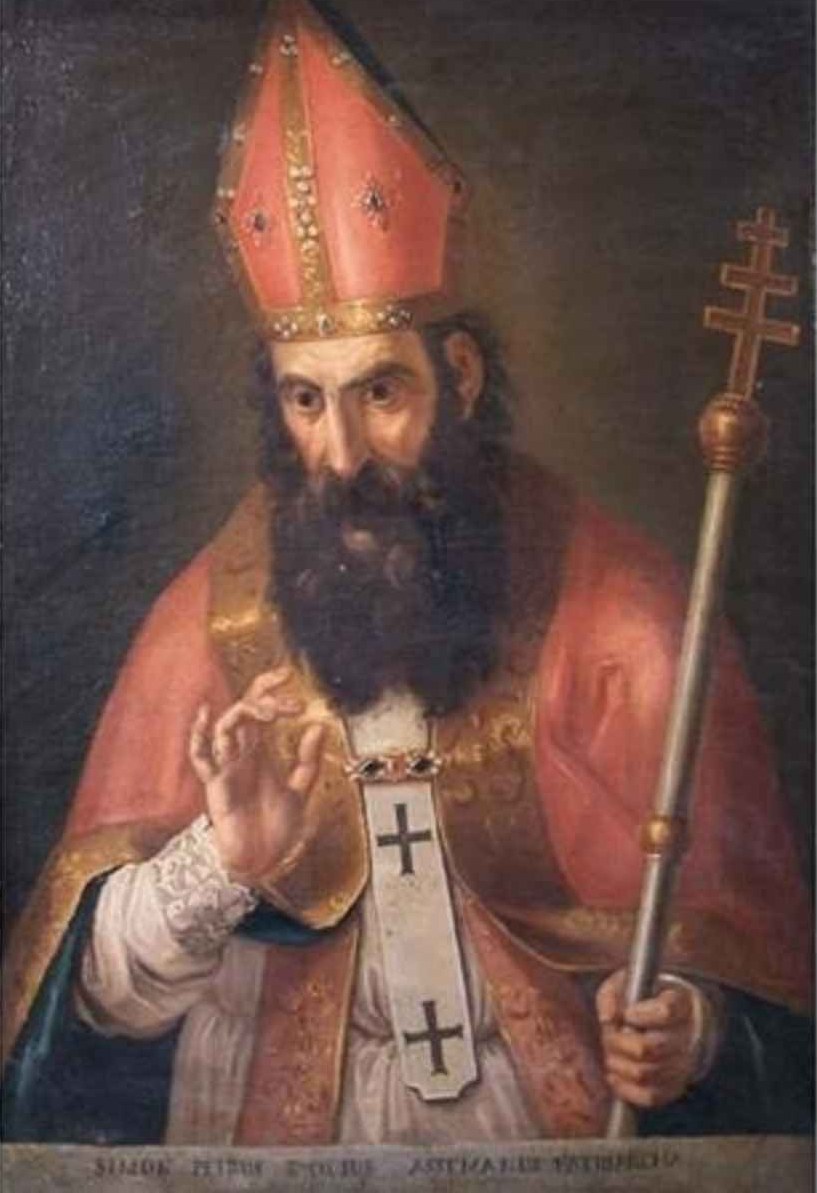
Evodus is painted as an apostle-bishop of the earliest type: an aged man in phelonion and omophorion, holding the Gospel book, often paired with Onesiphorus on icons for September 7, and appearing among the Seventy in synaxis icons for January 4. The stored image is a seventeenth-century Italian painting of the saint as bishop of Antioch — a Western, baroque image (mitre and crozier rather than Byzantine vestments), inscribed with his name and see, kept here until a pre-modern Byzantine image of verified identity can be found.
Disputed questions
- Manner and date of death. Martyrdom under Nero c. 66 (so the Slavic tradition and the OCA); martyrdom under Vespasian (part of the Greek tradition); death in peace (a minority scholarly view arguing from the silence of Eusebius, who records no martyrdom). The commemoration as hieromartyr follows the received tradition; the divergence is real and is recorded here rather than resolved.
- Chronology of the episcopate. The dates assigned to his accession range over the 40s (Eusebius' Chronicle places it in the reign of Claudius); the length of twenty-seven years is traditional and cannot be verified.
- Style of the see. Antioch's first-century bishops are not styled "patriarch" — the patriarchal dignity of the see is a later development — so Evodus is classified here as bishop, head of the see from which the Patriarchate descends.
- Not to be confused with Evodus of Nicomedia, the martyr commemorated September 1 with his sister Callista and brother Hermogenes (†c. 309) — a different person entirely, three centuries later — nor with Euodia (Euodias) of Philippi, the woman greeted by Paul in Philippians 4:2, with whom the variant spelling "Euodias" invites confusion.