
Ignatius of Antioch
The Holy Hieromartyr Ignatius the God-bearer, Bishop of Antioch
Hieromartyr · Bishop · b. c. 35 — d. c. 107, at Rome
Commemorated 29 January — Translation of his relics — the return from Rome to Antioch, 20 December — Martyrdom at Rome in the amphitheatre
Ignatius the God-bearer (c. 35 – c. 107) was bishop of Antioch — the third to hold the see, after the Apostle Peter and Evodus — and, with Polycarp of Smyrna, a disciple of the Apostle and Evangelist John the Theologian. Tradition identifies him with the child whom Christ set in the midst of the disciples, and reads his name "Theophoros," God-bearer, in both its senses: one borne in the arms of God, and one who bore God in his heart. Arrested under the emperor Trajan and condemned to the beasts, he was sent under military guard across Asia Minor to Rome — a journey on which, chained to "ten leopards," he wrote the seven letters that are his enduring monument: a foundational witness to the bishop's office, to the Eucharist as "the medicine of immortality," and to a martyrdom he embraced with longing — "I am the wheat of God, and I am ground by the teeth of the wild beasts, that I may be found the pure bread of Christ." He was devoured by beasts in the amphitheatre at Rome about the year 107. His relics were carried back to Antioch — the first stage of their journey — and later translated to Rome, to the Basilica of San Clemente, where they rest. He is kept on December 20, and on January 29 for the translation of his relics.

Origins and the See of Antioch
Ignatius belongs to the sub-apostolic generation, the men who had known the Apostles and carried their teaching into the second century. He was bishop of Antioch on the Orontes — the great metropolis of the Roman East, third city of the empire, "where the disciples were first called Christians" (Acts 11:26), and the see from which the Patriarchate of Antioch descends. The episcopal lists of Antioch place him after the Apostle Peter, who founded the church there, and after Evodus, the first bishop after Peter and one of the Seventy; Ignatius is thus reckoned the church's third hierarch, and — the phrase runs through the tradition — the first of purely apostolic-age memory to leave a body of writing of his own.
A note on the counting is owed, for the sources differ in appearance rather than substance. Eusebius of Caesarea, the earliest to set the succession in order, styles Ignatius "the second to hold the episcopate of Antioch in succession from the Apostles" — that is, second in the line of bishops after Peter (Evodus first, Ignatius second), Peter himself being reckoned the apostolic founder rather than numbered among the bishops. Where Peter is counted as the first bishop, Ignatius becomes the third. The two reckonings name the same three men in the same order — Peter, Evodus, Ignatius — and the OCA and several Greek sources accordingly call him "second bishop of Antioch" while the Antiochian tradition, counting from Peter, keeps him third. The difference is one of bookkeeping, not of history.
Of his birth and youth nothing is securely recorded. A persistent later tradition makes him a Syrian by origin and gives his birth about the year 35; the same tradition, and the hymnography of his feast, hold that he was a disciple of the Apostle John the Theologian, in whose circle at Ephesus he was formed together with Polycarp, the future bishop of Smyrna and martyr — a discipleship the whole of Ignatius's later theology, saturated in the Johannine language of life, flesh, and unity, makes entirely credible even where the biographical link cannot be proved. Some accounts add that he was consecrated bishop of Antioch by the Apostles themselves (Peter, or Paul, or both), and the tradition of the church of Antioch honoured him as one who received his charge from apostolic hands.
The child in the midst, and the name "God-bearer"
Two cherished traditions attach to his person and his name, and the tradition holds them together.
The first identifies Ignatius with the child whom Christ set in the midst of the disciples. When the Twelve disputed which of them was the greatest, the Lord "took a child, and set him in the midst of them: and when he had taken him in his arms, he said unto them, Whosoever shall receive one of such children in my name, receiveth me" (Mark 9:36–37; cf. Matthew 18:2–4, "Except ye be converted, and become as little children, ye shall not enter into the kingdom of heaven"). The tradition of the Church — repeated in the synaxaria and in the OCA life — sees in that child the young Ignatius, taken up in the arms of the incarnate God. The identification is a pious tradition, not a datum of the Gospels, which do not name the child; but it has shaped his memory and his iconography for centuries, and it gives his surname its most vivid reading.
For the surname is Theophoros — "God-bearer" — and it too is read in two senses which the Greek itself distinguishes by accent. Read Θεόφορος (Theophoros, proparoxytone), it is passive: "borne by God," one carried in the arms of God — the sense that fits the child in Christ's embrace. Read Θεοφόρος (Theophóros, paroxytone), it is active: "God-bearing," one who bears God within — and this is the sense Ignatius himself gives it, for he signs every one of his letters "Ignatius, who is also Theophoros." When, according to the martyrdom-account, Trajan asked him what "Theophoros" meant, he answered that it is "he who has Christ within his breast," and that all who bear God in a holy life may be so called. The Church keeps both senses at once: the child once held in the arms of God became the bishop who carried God in his heart to the very jaws of the beasts, and — the legend of his martyrdom adds — whose heart was found at the last to bear the Holy Name.
Bishop of Antioch
Of his episcopate at Antioch the record is thin in fact and rich in memory. He governed the church of the Syrian capital for many years — the tradition speaks of some four decades, from about the year 68 or 70 to his death — through the last quarter of the first century and into the second, the very decades in which the apostolic generation was passing and the shape of the Church's ministry was settling into the threefold order of bishop, presbyters, and deacons that his own letters are the first to describe with full clarity. The historian Socrates Scholasticus transmits a tradition that Ignatius introduced antiphonal singing — the chanting of the psalms and hymns by two choirs in alternation — into the worship of Antioch, having seen in a vision the angels hymning the Holy Trinity in alternating choirs; from Antioch, the account says, the practice spread through the churches. Whatever its precise origin, the tradition binds the God-bearer to the Church's sung worship, and it is echoed in his own letters, which call the united voice of a congregation a choir singing to God the Father through Jesus Christ.
Arrest under Trajan and the journey to Rome
Under the emperor Trajan (98–117) the profession of Christianity was a capital matter — as Trajan's own rescript to Pliny, governor of Bithynia, shows: Christians were not to be sought out, but if accused and convicted, and persisting, were to be punished. The tradition of Ignatius's arrest sets it in the aftermath of Trajan's eastern campaigns, about the years 106–107, when the emperor is said to have passed through Antioch; there Ignatius was denounced, or came forward, as the bishop who openly confessed Christ, and — refusing to sacrifice to the gods — was condemned to be sent to Rome and thrown to the wild beasts in the amphitheatre for the people's holiday. He accepted the sentence with joy, seeing in it the crown he had longed for; and the same tradition holds that he offered himself in part to draw the persecution onto himself and away from his flock.
He was not, however, martyred at Antioch. Under the guard of a detachment of soldiers he was taken the long way to Rome — overland across Asia Minor and by sea — and this journey under sentence, lasting some weeks or months, is the setting of everything for which the Church remembers him best. He describes the soldiers who conducted him with a phrase that has never been forgotten: they were "ten leopards" — "a company of soldiers, who only grow worse when they are kindly treated" (Romans 5) — chained to him day and night, so that from Syria to Rome he "fought with beasts" long before the arena. Along the way the churches of Asia sent bishops, presbyters, and deacons to meet and console him; and out of these meetings, and the enforced leisure of the road, came his letters.
The seven epistles
At Smyrna, received by its bishop Polycarp and by delegations from the neighbouring churches, Ignatius wrote four letters — to the Ephesians, the Magnesians, the Trallians, and, sent ahead of him, to the Romans. From Troas, where he learned the welcome news that the persecution at Antioch had ceased, he wrote three more — to the Philadelphians, to the Smyrnaeans, and to Polycarp himself. These seven epistles are among the most precious documents of the early Church, the fullest window we possess onto Christian faith and order in the generation immediately after the Apostles.
Their witness is threefold and unmistakable. First, to the ministry: Ignatius is the earliest writer to set out, with insistent clarity, the threefold order and the monarchical episcopate — one bishop in each church, surrounded by the presbytery and served by the deacons, the bishop standing as the visible centre of the church's unity. "Let no one do anything pertaining to the Church without the bishop… Wherever the bishop appears, there let the congregation be; even as where Jesus Christ is, there is the catholic Church" (Smyrnaeans 8 — the first surviving use of the phrase "the catholic Church"). "Do nothing without the bishop," he tells the Trallians and the Philadelphians; be "united with the bishop as the Church is with Jesus Christ, and Jesus Christ with the Father." Second, to the Eucharist: against those who "abstain from the Eucharist and from prayer, because they confess not that the Eucharist is the flesh of our Saviour Jesus Christ" (Smyrnaeans 7), he affirms the reality of the Lord's Body and Blood, and famously calls the one bread broken in the one assembly "the medicine of immortality, the antidote that we should not die but live for ever in Jesus Christ" (Ephesians 20). Third, against Docetism — the denial that Christ truly took flesh — he insists on the full reality of the Incarnation, the Passion, and the Resurrection: Christ was "truly born, truly ate and drank, truly persecuted under Pontius Pilate, truly crucified… truly raised from the dead" (Trallians 9); if his suffering was only in appearance, Ignatius asks, why then is he himself in chains?
Above all, the Letter to the Romans — written to a church he was hastening toward not as its teacher but as its victim — is the most personal of the seven, a cry of longing for martyrdom that begs the Roman Christians not to use their influence to save him: "Suffer me to be the food of the beasts, through whom I can attain to God. I am the wheat of God, and I am ground by the teeth of the wild beasts, that I may be found the pure bread of Christ." "It is good for me to die for Jesus Christ rather than to reign over the ends of the earth… Him I seek, who died for our sake; him I desire, who rose again for us. The pangs of a new birth are upon me… Suffer me to receive the pure light; when I have come thither, I shall be a man of God." No other document of the early Church so fuses theology and biography: a bishop teaching the Church her own doctrine of Christ, the Eucharist, and the ministry in the very act of walking to his death.
Martyrdom at Rome
Ignatius reached Rome and, according to the Martyrium composed by companions who claim to have accompanied him, was led into the amphitheatre on December 20, a day of public games, and given to the beasts before the assembled people. The account has him address the crowd — that he was condemned not for any crime but for the love of God, and that he longed to be with him — and then the beasts were loosed and devoured him, leaving, the tradition says, only his heart and the larger and harder of his bones. His companions gathered these remains as a treasure. To the martyrdom the tradition adds two enduring details: that on the road he never ceased repeating the Name of Jesus Christ, and, asked why, answered that the Name was written on his heart; and that when after his death his heart was cut open, the pagans found within it, in letters of gold, the words "Jesus Christ" — the God-bearer's own confession made visible in his flesh. The legend is late and is honoured as legend, but it crystallises the whole meaning of his name.
The year is not certain. The tradition, following Eusebius's Chronicle, places the martyrdom about 107 (some reckonings 108), in the reign of Trajan; other strands, and much modern scholarship, allow a range across the later part of Trajan's reign, to about 110–117, or even into that of Hadrian. The day, December 20, is the fixed liturgical anchor; the year is given with "c."
Relics and translations
The companions carried the martyr's remains back to Antioch — the first stage of the relics' long journey, and the reason the Church keeps a translation-feast on January 29 commemorating their return to his own city, where they were received with honour and laid to rest outside the gates, near the cemetery, and afterwards (the tradition holds) brought within the city. The relics remained the treasure of Antioch for centuries. When, in the reign of the emperor Heraclius, the Persian and then the Arab wars overwhelmed Syria, the relics were removed to safety, and about the year 637 they were translated to Rome and enshrined in the Basilica of San Clemente, where they rest today beneath the high altar — a homecoming of a kind, to the city of his crown. (Some accounts assign the Roman translation to a somewhat different date; the enshrinement at San Clemente is constant.) The two feasts of the calendar thus frame the arc: December 20, the martyrdom at Rome; January 29, the first translation, the carrying of the relics home to Antioch.
Veneration and later cultus
Ignatius was venerated from the moment of his death. Within a generation Polycarp of Smyrna, gathering the martyr's letters, wrote to the Philippians that he was sending them the epistles of Ignatius "which were sent to us by him, and others as many as we had by us," and commended the example of Ignatius and his fellow-martyrs who had run "not in vain, but in faith and righteousness" (Philippians 13, 9). Irenaeus of Lyons, himself a hearer of Polycarp, quotes the Letter to the Romans — "I am the wheat of God…" — as the words of "one of our own" who was condemned to the beasts (Against Heresies V.28). From these near-contemporary witnesses the memory of Ignatius passes unbroken into the calendars of East and West. For the Church of Antioch he is, with Babylas and the great preachers who came after, the cornerstone of the see's own sanctity — the God-bearing hieromartyr who set the pattern of the bishop as the living centre of the Church's unity, a pattern the Antiochian tradition has never ceased to teach from his letters. The West keeps him too — the Roman calendar commemorates him (long on February 1, the Roman translation-day, and since 1969 on October 17), and San Clemente guards his relics.
Feast and commemoration
Ignatius is kept universally on December 20 (church date; Old Calendar civil January 2), the day of his martyrdom at Rome, within the forefeast of the Nativity — the day, in the Byzantine reckoning, on which the forefeast of the Nativity of Christ begins, so that the God-bearer's feast opens the Church's approach to the Cave of Bethlehem. His office in the Menaion is sung together with the forefeast hymns, and the coincidence is dwelt on by the hymnographers: the martyr who longed to be "the pure bread of Christ" is honoured as the Church sets out toward the birth of the Bread of Life. The Antiochian, Greek, and Slavic calendars agree on the day. January 29 (Old Calendar civil February 11) commemorates the translation of his relics — their carrying back from Rome to Antioch — kept as its own feast, the Translation of the Relics of Ignatius the God-bearer. The Roman calendar keeps him as a martyr, formerly on February 1 (the day of the later translation to Rome) and now on October 17; the East knows the February date as well from the Roman connection, but the Byzantine feasts are December 20 and January 29.
Hymns
Troparion — Tone 4
As one who shared in the ways of the Apostles and succeeded to their thrones, thou didst find in thy labours, O God-inspired one, an ascent to divine vision; wherefore, rightly dividing the word of truth, thou didst contend for the faith even unto blood, O Hieromartyr Ignatius. Intercede with Christ our God that our souls may be saved.
Original translation from the Greek
Kontakion — Tone 3
The radiant day of thy shining contests proclaims to all men Him who was born of the Virgin; for thirsting to delight in him out of love, thou didst hasten to be devoured by the wild beasts. Therefore wast thou called God-bearer, O glorious Ignatius.
Original translation from the Greek
Sticheron
A living pillar and a breathing icon — thy yearly feast is come, O God-bearer Ignatius, proclaiming thy hidden mysteries and thy noble deeds, thy standing for the faith even unto blood, and that blessed and famous cry of thine, which said: **"I am the wheat of God, and I am ground by the teeth of the wild beasts."** Wherefore, having become an imitator of Christ, intercede that our souls may be saved.
Appointed readings
Epistle — Hebrews 4:14–5:6
14Seeing then that we have a great high priest, that is passed into the heavens, Jesus the Son of God, let us hold fast our profession. 15For we have not an high priest which cannot be touched with the feeling of our infirmities; but was in all points tempted like as we are, yet without sin. 16Let us therefore come boldly unto the throne of grace, that we may obtain mercy, and find grace to help in time of need. 1For every high priest taken from among men is ordained for men in things pertaining to God, that he may offer both gifts and sacrifices for sins: 2Who can have compassion on the ignorant, and on them that are out of the way; for that he himself also is compassed with infirmity. 3And by reason hereof he ought, as for the people, so also for himself, to offer for sins. 4And no man taketh this honour unto himself, but he that is called of God, as was Aaron. 5So also Christ glorified not himself to be made an high priest; but he that said unto him, Thou art my Son, to day have I begotten thee. 6As he saith also in another place, Thou art a priest for ever after the order of Melchisedec.
Gospel — Mark 9:33–41
33And he came to Capernaum: and being in the house he asked them, What was it that ye disputed among yourselves by the way? 34But they held their peace: for by the way they had disputed among themselves, who should be the greatest. 35And he sat down, and called the twelve, and saith unto them, If any man desire to be first, the same shall be last of all, and servant of all. 36And he took a child, and set him in the midst of them: and when he had taken him in his arms, he said unto them, 37Whosoever shall receive one of such children in my name, receiveth me: and whosoever shall receive me, receiveth not me, but him that sent me. 38And John answered him, saying, Master, we saw one casting out devils in thy name, and he followeth not us: and we forbad him, because he followeth not us. 39But Jesus said, Forbid him not: for there is no man which shall do a miracle in my name, that can lightly speak evil of me. 40For he that is not against us is on our part. 41For whosoever shall give you a cup of water to drink in my name, because ye belong to Christ, verily I say unto you, he shall not lose his reward.
Iconography
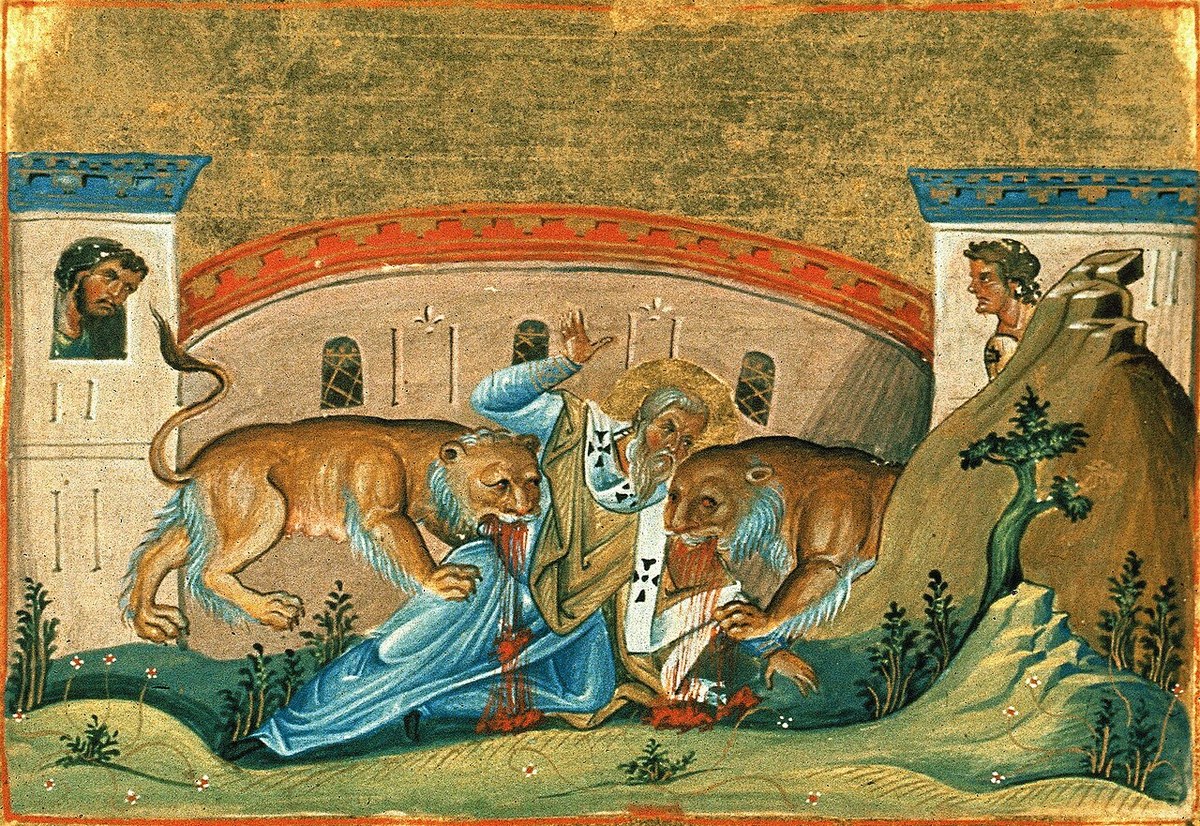
Ignatius is depicted as an aged bishop — grey-haired and bearded, vested in the phelonion or the cross-figured polystavrion, wearing the omophorion and holding or blessing over the Gospel-book — in the settled type of the apostolic-age hierarch. But his most characteristic image is not the portrait but the martyrdom: the bishop in the arena, in the midst of two lions (or of the beasts) that seize upon him, his hands raised in prayer, the spectators of the amphitheatre looking on from above — the visual form of his own words, "I am the wheat of God, ground by the teeth of the wild beasts." The scene of the translation of his relics — the coffin borne in procession toward a church — is the second narrative type, illustrating the January 29 feast.
The stored primary image is a Byzantine menologion miniature of the martyrdom: Ignatius, vested as a bishop in the cross-marked omophorion, set upon by two lions within the walls of the arena while onlookers watch from the towers — the God-bearer between the beasts (source, public domain, pd-old-work).
A second stored image is the miniature for December 20 from the Menologion of Basil II (Constantinople, c. 985; Vatican, Vat. gr. 1613) depicting the translation of the relics of Ignatius — the reliquary-coffin carried in procession by deacons, with candle-bearers and a bishop bearing the Gospel, toward the church that will receive it — the visual form of the January 29 feast (source, public domain, pd-old-work).
Disputed questions
- The three recensions, and the authenticity of the letters. The Ignatian correspondence survives in three forms, and disentangling them is one of the classic problems of patristic scholarship. A long recension transmits thirteen letters — the seven, heavily interpolated, together with six that are spurious (among them a Letter to the Antiochians invoking "the blessed Evodus," and correspondence with the Virgin and with the Apostle John); a short recension, surviving in Syriac, gives only three letters in abridged form; and a middle recension gives the seven letters named by Eusebius (Hist. eccl. III.36) in their fuller, uninterpolated text. From the seventeenth century the labour of James Ussher, Isaac Voss, and above all J. B. Lightfoot and Theodor Zahn established the scholarly consensus that has held ever since: the middle recension of the seven letters is genuine, the work of Ignatius on his road to Rome; the long recension is a later (probably fourth-century, Arian-tending) expansion, and the six added letters are forgeries; the short Syriac recension is an abridgement, not the original core. This is the position followed throughout the entry above. It is right to record, in candour, that a minority of scholars has always dissented — some (in the nineteenth century, the Tübingen critics; more recently R. Hübner, T. Lechner, and others) dating even the seven letters to the middle of the second century and doubting their authenticity, others proposing that the corpus was edited later than Ignatius's own hand. The great weight of scholarship, and the constant use of the Church, hold the seven genuine; the entry notes the dissent without adopting it.
- The two disciples, Evodus and Ignatius. A distinct early tradition (the Apostolic Constitutions VII.46) has Evodus ordained for Antioch by Peter and Ignatius by Paul, which some have read as concurrent episcopates — one for the Jewish, one for the Gentile Christians — uniting after Evodus's death. The common tradition, followed here, keeps the simple sequence Peter–Evodus–Ignatius; the double-ordination notice witnesses to the mixed apostolic community at Antioch rather than to a rival chronology.
- "The blessed Evodus." The frequently quoted line in which "Ignatius" bids the Antiochians "remember your blessed father Evodus" belongs to the spurious Letter to the Antiochians of the long recension, not to the seven genuine epistles; it witnesses to the strength of Evodus's memory at Antioch, not to a first-hand mention by Ignatius.
- Not to be confused with Ignatius, Patriarch of Constantinople (†877, kept October 23), the son of the emperor Michael I and the antagonist of Photius — a wholly different saint of a wholly different age; nor with the several later Ignatii of the calendar. "The God-bearer" belongs to this Ignatius alone.