
Ezekiel the Prophet
The Holy Prophet Ezekiel
Prophet · b. c. 622 BC, at Sarira in the land of Judah, of a priestly family — d. c. 570 BC (the traditional account: killed in Babylonia by a prince of the exiles)
Commemorated 21 July — The principal commemoration of the prophet, carrying the day's service
Ezekiel, son of Buzi, priest and prophet, is the prophet of the exile: carried away to Babylonia with King Jehoiachin in 597 BC and settled with the deportees at Tel-Abib by the river Chebar, he was called there in his thirtieth year by the overwhelming vision of the fiery chariot — the four living creatures, the wheels full of eyes, and above the crystal firmament the sapphire throne with the likeness of a man upon it. For some twenty-two years he preached to a broken people, first that Jerusalem must fall and then that the dry bones would live; and the Church has read him ever since as the seer of two mysteries above all — the valley of dry bones, chanted over the tomb of Christ at the Matins of Great and Holy Saturday, and the closed gate through which the Lord alone has passed, read at the Vespers of every feast of the Theotokos. Tradition holds that he was put to death in Babylonia by a prince of his own people whose idolatry he had rebuked.
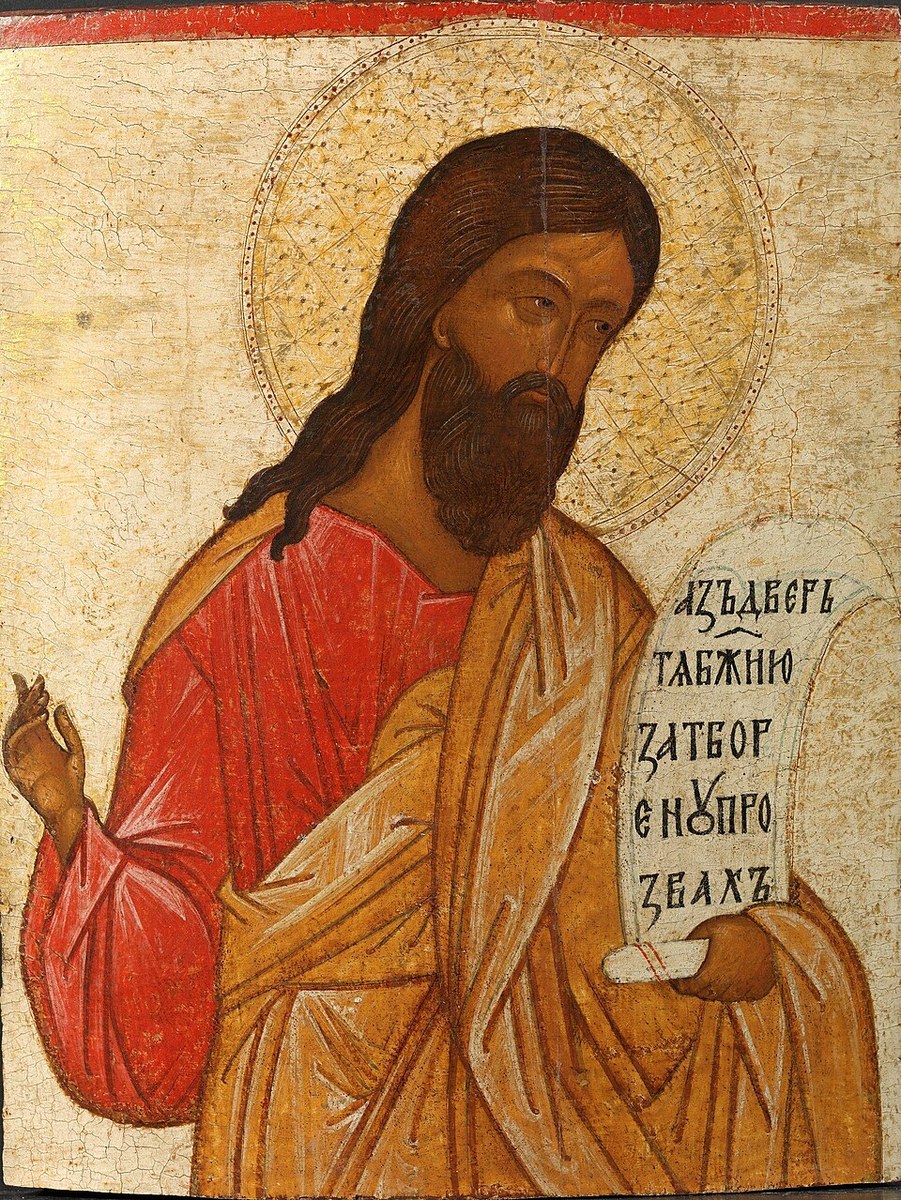

The priest carried into exile
Ezekiel was of a priestly family — "Ezekiel the priest, the son of Buzi" (Ezek. 1:3) — and the synaxarion tradition gives his birthplace as Sarira in the land of Judah. He belonged, therefore, to the class whose whole life was the Temple, and this shows on every page of his book: no prophet is so preoccupied with the sanctuary, its measurements, its defilement, its glory and its restoration.
In 597 BC Nebuchadnezzar took Jerusalem for the first time and deported the young king Jehoiachin (Jechoniah) with the court, the craftsmen and the leading families. Ezekiel went with them, a man of about twenty-five. The exiles were settled in Babylonia at Tel-Abib, on the river Chebar — one of the great irrigation canals of the Euphrates system — and there, among a defeated and bewildered community that still expected a quick return, he was called.
The vision by the Chebar
"In the thirtieth year, in the fourth month, in the fifth day of the month, as I was among the captives by the river of Chebar, the heavens were opened, and I saw visions of God" (Ezek. 1:1). It is the most elaborate theophany in the prophets. A storm-wind came out of the north with a great cloud and fire flashing continually, and in the midst of it four living creatures, each with four faces — of a man, a lion, an ox and an eagle — and four wings, moving straight forward and not turning as they went. Beside each creature was a wheel, and a wheel within the wheel, and their rims were full of eyes. Over their heads was a firmament like terrible crystal, and above the firmament the likeness of a throne of sapphire, and upon it "the likeness as the appearance of a man," girt about with fire and with the rainbow in the cloud. "This was the appearance of the likeness of the glory of the Lord: and when I saw it, I fell upon my face."
He was then given a scroll written within and without with lamentations and mourning and woe, and told to eat it; and it was in his mouth sweet as honey (Ezek. 2:8–3:3). He was set as a watchman over the house of Israel, answerable for the blood of any whom he failed to warn (Ezek. 3:17; 33:1–9) — the charge that the Church has always applied to the office of the bishop.
Prophet to the exiles
The first half of his ministry, down to the fall of the city in 587 BC, was spent convincing his fellow exiles of what they refused to believe: that Jerusalem would not be spared. He did it as much by sign-acts as by speech, and they are among the strangest in Scripture. He drew the siege of the city on a clay brick and laid siege to it with an iron pan for a wall. He lay bound upon his left side three hundred and ninety days and on his right forty, bearing the iniquity of Israel and of Judah. He shaved his head and beard with a sword and divided the hair into three parts, burnt, struck and scattered. He dug through the wall of his house at evening and carried out his baggage in the sight of the people, as an exile going into exile. And when his wife, "the desire of thine eyes," died at a stroke, he was forbidden to mourn her — because Jerusalem, the desire of their eyes, would fall and there would be no mourning left in them (Ezek. 24:15–24).
He was carried in vision to Jerusalem and shown the abominations in the Temple — the image of jealousy, the elders censing the creeping things painted on the wall, the women weeping for Tammuz, the men with their backs to the sanctuary worshipping the sun (Ezek. 8). Then he watched the glory of the Lord depart: from the cherub to the threshold, from the threshold to the east gate, and at last out of the city to the mountain on its east side (Ezek. 10–11) — the most terrible sentence in the prophets, because it says that the Temple's fall was only the visible end of a departure that had already happened.
The dry bones and the restored temple
After the city fell his message reversed. He turned from judgement to promise: the gathering of the scattered flock and the one Shepherd who would feed them (Ezek. 34); the new heart of flesh in place of the heart of stone and the new spirit put within them (Ezek. 36:26); the two sticks made one in his hand for the reuniting of Israel and Judah (Ezek. 37:15–28).
Between these stands the vision that has gone furthest into the Church's worship. The hand of the Lord set him down in the midst of a valley full of bones, very many and very dry, and asked him: Son of man, can these bones live? — and he answered, O Lord God, Thou knowest. He prophesied as he was commanded, and there was a noise and a shaking, and the bones came together, bone to his bone; and the sinews and the flesh came up upon them and the skin covered them above, but there was no breath in them. Then he prophesied to the wind, and the breath came into them, and they lived, and stood up upon their feet, an exceeding great army (Ezek. 37:1–14).
The last nine chapters are the vision of the new temple, measured gate by gate and court by court by a man with a line of flax and a measuring reed; the glory of the Lord returning by the east gate by which it had gone out; the river issuing from under the threshold, ankle-deep, knee-deep, loin-deep, and at last a river that could not be passed over, with trees on both banks whose leaf does not wither and whose fruit is for meat and whose leaf is for medicine (Ezek. 47). The book closes on the name of the city: "The Lord is there."
Repose
Scripture does not record his death. The Lives of the Prophets and the synaxaria, which the Church's liturgical notice follows, relate that he was murdered in Babylonia by a prince of the exiled Israelites whom he had rebuked for idolatry, being dragged to death behind horses; and that the people buried him honourably in the field of Maur, in the tomb reputed to be that of Shem and Arphaxad, a place shown to this day. The traditional accounts also credit him with wonders during the exile — that he divided the waters of the Chebar so that his people could pass over from their pursuers, and that he obtained food for them in a famine. The site venerated as his tomb is at al-Kifl in southern Iraq, honoured through the Middle Ages by Jews, Christians and Muslims alike (Muslim tradition names him Dhu al-Kifl), and it remained a place of pilgrimage within the historic territory of the Church of the East and, more distantly, of Antioch.
Ezekiel in the Church's reading
Four passages carry most of the weight the Church has given him.
- The closed gate. "This gate shall be shut, it shall not be opened, and no man shall enter in by it; because the Lord, the God of Israel, hath entered in by it, therefore it shall be shut" (Ezek. 44:2). From at least the fourth century this is read of the ever-virginity of the Theotokos, and it is appointed as one of the three Vespers readings at every great feast of the Mother of God — the ladder of Jacob, the closed gate, and the house of Wisdom. No text of the Old Testament is more constantly heard in Marian services.
- The dry bones. Ezekiel 37:1–14 is read at the Matins of Great and Holy Saturday, after the burial procession and the Lamentations, over the tomb of Christ — the Church's own commentary on the passage, which it hears not as a metaphor of national restoration only but as the prophecy of the general resurrection accomplished in Christ's descent into hell.
- The chariot and the throne. The Fathers read the likeness of a man enthroned above the firmament as a foreshadowing of the Incarnation, and the throne itself of the Theotokos, "the living throne of God"; while the four living creatures were identified from Irenaeus onwards with the four Evangelists, and passed in that sense into Christian art through the same imagery in the Apocalypse (Rev. 4:6–8), which draws directly on this chapter.
- Individual responsibility. "The soul that sinneth, it shall die… the son shall not bear the iniquity of the father" (Ezek. 18) is the classic scriptural statement that guilt is not inherited by descent, and it is regularly cited in Orthodox moral and penitential theology.
Feast and commemoration
July 21 (church date; New Calendar civil July 21, Old Calendar civil August 3). The prophet's memory carries the greater part of the day's service in the Greek and Slavonic books alike, and is shared with Symeon the Fool-for-Christ of Emesa and John his fellow-ascetic. In the Latin calendar Ezekiel is kept on April 10. He is also commemorated with the whole company of the righteous of the old covenant on the Sunday of the Holy Forefathers and the Sunday before the Nativity, which are movable and belong to their own rules.
Hymns
Apolytikion — Tone 2
As we keep the memory of Thy Prophet Ezekiel, O Lord, through him we entreat Thee: save our souls.
Kontakion — Tone 4
Thou didst behold the throne of fire borne upon the wheels of many eyes, O seer of God, and the closed gate through which the Lord alone hath passed; and prophesying over the bones of the dead thou didst raise up an exceeding great army: wherefore, O Ezekiel, we honour thee as a herald of the resurrection.
Original translation from the Greek
Iconography
Ezekiel is painted as a prophet in the prime of life or a little beyond it: long dark hair falling to the shoulders, a full pointed beard, a tunic and a mantle thrown across the body, one hand raised in speech and the other holding an unrolled scroll. He has a fixed place in the prophet tier of the developed Russian iconostasis, where the ranks of the prophets stand to either side of the Theotokos of the Sign, each holding the text by which he foretold the Incarnation; the text given to Ezekiel is almost invariably that of the closed gate, because it is on that verse that his place in the Marian tier rests.
Two great compositions belong to him rather than to any other prophet. The first is the chariot-vision, painted in Byzantine and post-Byzantine art as the prophet on a mountain before a mandorla of many-eyed wheels and the four winged creatures, sometimes titled the Vision of Ezekiel and sometimes absorbed into images of the Theotokos as the throne. The second is the valley of dry bones, painted with the prophet standing over a field of scattered skulls and limbs which rise reassembled at his word — an image found in the frescoed narthexes and, notably, in the third-century synagogue of Dura-Europos on the Syrian Euphrates, the earliest surviving pictorial cycle of the subject and one made within the same Syrian world in which the Church of Antioch grew.
The stored image is a fifteenth-century panel of the Novgorod school (Nasjonalmuseet, Oslo, NG.M.01772), from a prophet tier: the prophet half-length, three-quarters turned, in a red tunic and ochre mantle, the right hand raised, the left holding a large white scroll whose Church Slavonic text was read on the image itself before storing — азъ дверь та Божїю затворену прозрѣахъ, "I beheld that door of God shut," the closed gate of Ezekiel 44:2, which confirms the identification beyond doubt.
Disputed questions
- "The thirtieth year." Ezekiel 1:1 dates the call to "the thirtieth year" without saying of what, and immediately afterwards (1:2) to the fifth year of Jehoiachin's captivity, i.e. 593 BC. The oldest and simplest reading, followed by the synaxaria, takes the thirtieth year as the prophet's own age — which is also the age at which a priest entered his service. Other explanations (an era of Nabopolassar; a reckoning from Josiah's reform) have been proposed and none is certain.
- Where he prophesied. Because chapters 8–11 are set in Jerusalem, some have argued for a Palestinian ministry, or for a divided one. The book itself resolves this: the prophet is at all times physically among the exiles by the Chebar, and is carried to Jerusalem "in the visions of God" (Ezek. 8:3).
- The manner of his death. No scriptural warrant exists for it. The tradition of the murder by a prince of the exiles comes from the Lives of the Prophets, a Jewish work of the turn of the era received into Christian use, and from there into the synaxaria; the detail of the horses is not constant in the manuscripts, some notices saying only that he was killed. It is recorded here as tradition, not as history.
- The place of the tomb. The synaxarion places the burial in the field of Maur near Baghdad, in the tomb of Shem and Arphaxad; local tradition has fixed on al-Kifl on the Euphrates south of Babylon. These are not the same place, and the identification cannot be pressed.