
Symeon the Fool-for-Christ of Emesa
Our Venerable Fathers Symeon of Emesa, the Fool-for-Christ, and John his Fellow-ascetic
Fool for Christ · Venerable · d. c. 570–590, at Emesa in Syria (John shortly afterwards, in the desert by the Dead Sea)
Commemorated 21 July — Repose of Symeon at Emesa and of John his fellow-ascetic
Symeon of Emesa — the Syrian city of Homs, in the patriarchal territory of Antioch — is the archetype of the whole Eastern vocation of folly for Christ's sake. With his lifelong friend John he abandoned the world on a pilgrimage to Jerusalem, was tonsured near the Jordan, and spent twenty-nine years with him in the desert by the Dead Sea; then, having attained dispassion in secret, he came down into the crowded provincial city "to mock the world," dragging a dead dog behind him through the gate. For the rest of his life he played the lunatic — overturning tables, feigning gluttony and lechery, beaten and insulted daily — while in hiding he healed the sick, cast out demons, converted prostitutes and unbelievers, and foretold plague and earthquake. His Life, written about 641–649 by Leontius, bishop of Neapolis in Cyprus, is the foundational text of the fool-for-Christ tradition, and Symeon is the pattern to whom Andrew of Constantinople and the whole later Russian lineage of iurodivye look back.

Origins and early life
The Life presents Symeon and John as young men of Syria, of prosperous families — Symeon of Edessa by the tradition followed in the Slavonic and OCA notices — who had been friends from boyhood. In about their thirtieth and twenty-fourth years respectively they travelled south with a company of pilgrims to Jerusalem, for the feast of the Exaltation of the Holy Cross. Symeon was unmarried and had an aged mother living; John had a young wife and parents of his own. On the road back from the Holy City, riding past the monasteries that lay along the Jordan valley, the two fell into the conversation that decided their lives: they spoke of the monks whose cells they were passing, of the shortness of the world, and of what it would be to leave everything at once. Leontius does not soften what this cost. He records their fear, their hesitation, the anguish of the mother and the wife they were about to abandon without a word, and the long night in which each waited to see whether the other would go back on it.
They turned aside from the road, resolving to enter whichever monastery they should find with its gates standing open — and found the gates of Abba Nikon's house open, the abbot having been forewarned of them in a vision. There they were tonsured together.
Ascetic struggle in the desert
Almost at once Symeon pressed for something more severe, and the two withdrew into the wilderness by the Dead Sea, where they lived — the Life is precise about the number — twenty-nine years, at first in great affliction of body and mind. Leontius gives an unusually candid account of this period: hunger, thirst, the heat, the terror of the demons, and above all the temptation of memory, John being tormented by thoughts of the wife he had left and Symeon by thoughts of his mother, until word reached them at last that both women had died. The two supported one another through it, and after long years came into the calm the ascetic literature calls ἀπάθεια, dispassion — the state in which the passions no longer move, and in which alone, on the Life's own reasoning, the vocation that followed becomes possible without ruin.
"To mock the world": the fool at Emesa
Then Symeon told John that he could no longer remain hidden in the desert: he would go out "to mock the world." John begged him not to go and, failing, wept and let him go; they never met again in this life, though each knew of the other by revelation. Symeon travelled to Emesa, a busy Syrian city on the Orontes, where nobody knew him.
He entered it as he meant to go on. Finding a dead dog on a dunghill outside the walls, he untied the rope girdle from his waist, tied it to the animal's leg, and ran into the city by the gate near the schoolhouse, hauling the carcass after him, while the children ran behind shouting that a crazy abba had come. The next day, a Sunday, he went into the church with a bag of nuts, threw them at the women during the Liturgy, and put out the lamps; when they chased him out he climbed into the pulpit and pelted them from there. He overturned the tables of the pastry-sellers in the market and was beaten half to death for it. He ate meat in public on Great Friday. He walked into the women's bath-house, and when John the deacon afterwards asked him in horror how he could bear it, answered that it had been to him exactly like a man walking into a stack of firewood — he had felt nothing at all, and had not known where he was. He worked for a time for a phouskarios, a seller of hot spiced drink, and was dismissed for giving away the stock. He limped, he danced, he babbled; he was struck, dragged, mocked and driven out of shops; and Leontius insists that he not only endured this but courted it, since the whole art of his life was to make certain that no one should ever honour him.
The hidden work
Beneath the performance the Life shows the work going on. Symeon healed the sick and cast out demons, always in such a way that the cure could be credited to something else — a slap, a joke, an absurdity — and the healed person went away insulted rather than grateful. He knew the hidden sins of those he met and named them under cover of nonsense, so that the conscience was struck without the reputation being touched. He converted a Jewish glass-blower who had seen him make the sign of the Cross over the furnace. He sought out the city's prostitutes, called them his girlfriends in the hearing of everyone, and gave them money on the secret condition that they stop selling themselves; several he brought to repentance, and the scandal of the arrangement he simply accepted as part of the price. When a servant girl was got with child and, to shield her lover, named Symeon as the father, he took the blame publicly and went about saying that he would have a fine little Symeon of his own — and she could not be delivered until she confessed the truth. He foretold an earthquake and a plague, and by the Life's account went about the city beforehand kissing or striking as he passed, so that afterwards it was seen which he had marked. To one man only, the deacon John of Emesa, did he at length open himself, binding him to say nothing while he lived; and it is from this deacon that Leontius says the account descends.
Repose
Symeon died alone. He had shut himself away for three days; his body was found in his hut under a heap of brushwood that served him for a bed, and two poor men carried it out without candles, without psalmody, without a priest, to the burial place of the strangers where the friendless and the disgraced of Emesa were laid. As the corpse was carried past a house, a Jew inside heard a great choir singing psalms over it and ran out to find nobody there but two labourers with a dead beggar. When the deacon John, released now from his oath, came a few days later with clergy and candles to take up the body and bury it with honour, the grave was found empty. His repose is placed about 570–590; John, in the desert, had already seen him in a vision crowned, and followed him not long after.
Veneration and later cultus
Symeon's memory was kept from an early date and passed into the Byzantine synaxaria on July 21, always with John beside him. The importance of the cultus, however, is out of all proportion to its size, because the Life became the charter of a whole way of sanctity. Every later holy fool of the East is read in its light: Thomas the Fool-for-Christ of Syria, who played the madman at Antioch and Daphne within a generation of Symeon and in the same Syrian province; Andrew of Constantinople, whose tenth-century Life borrows Symeon's conventions wholesale; and, when the type was transplanted to Rus', Procopius of Ustyug, the first fool of the Russian land, and John the Fool-for-Christ of Ustyug after him. The Slavonic books call the type iurodivy, translating the Greek σαλός; the Greek and Antiochian books keep the Greek word. That the fountainhead of the tradition is a Syrian saint of a Syrian city, in the territory of the Church of Antioch, is a fact of some weight for the Antiochian tradition, and it is not an isolated one: Syria produced Thomas the Salos as well, and the Syrian Lives are the earliest sustained literature of the vocation.
The theology of folly
The vocation rests on a text: "We are fools for Christ's sake" (1 Cor. 4:10), with "if any man among you seemeth to be wise in this world, let him become a fool, that he may be wise" (1 Cor. 3:18). What Symeon's Life adds is a discipline. Folly is not a beginner's exercise but the last stage of a long ascesis: the twenty-nine desert years are not preface but prerequisite, and Leontius is careful to say that Symeon undertook the city only after he was no longer at risk from it. Its purpose is twofold — to destroy in the saint himself the last root of vainglory, which almsgiving and fasting and even martyrdom can feed, by making praise structurally impossible; and to serve the neighbour invisibly, since a man whom nobody respects can go anywhere, say anything, and take any blame. The Church's caution about the type is as old as the type itself: the fool is honoured and never recommended.
Feast and commemoration
July 21 (church date; New Calendar civil July 21, Old Calendar civil August 3). The day is kept by the Greek, Antiochian, Slavonic and OCA calendars alike, always of the two saints together — "Symeon the Fool-for-Christ and John his fellow-ascetic" — and it shares the date with the Prophet Ezekiel, whose memory carries the greater part of the service in most books. Symeon is styled ὅσιος in Greek usage and blazhenny — blessed — in Slavonic, the customary title of the fools. Emesa, the city of his labours, is the modern Homs in Syria, a see of the Patriarchate of Antioch.
Hymns
Apolytikion — Tone 8 (common of a venerable father)
In thee, O Fathers, was that which is according to the image preserved with exactness; for taking up the Cross ye followed Christ, and by your deeds ye taught us to despise the flesh, for it passeth away, but to care for the soul, a thing immortal. Therefore do your spirits, O venerable Symeon and John, rejoice together with the Angels.
Kontakion — Tone 2
Thou didst hide the treasure of dispassion beneath the rags of madness, and being wise in God wast counted a fool among men; wherefore, O Symeon, thou wast crowned with John thy fellow-struggler, and thou dost pray without ceasing for us all.
Original translation from the Greek
Iconography
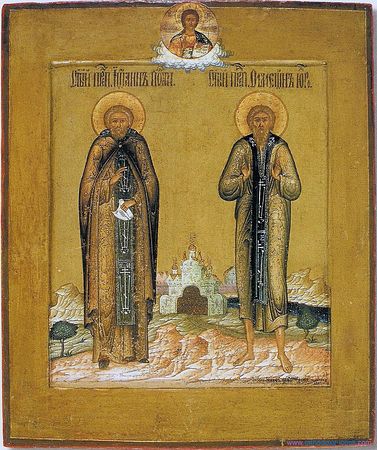
Symeon belongs to the iconography of the holy fool, which the painters approached with a certain reserve, since the image had to show a man in contempt without inviting the viewer to despise him. He is shown lean and weathered, bare-headed and bare-footed, his hair and beard disordered, wearing not the monastic habit but a short, ragged or patched tunic that leaves the legs bare — poorer than the poorest monk, because his calling was to look like nothing. The face carries the whole paradox: the eyes are steady, lucid and entirely sane above the beggar's dress. His inscription in the Greek books is Ὁ ΑΓΙΟΣ ΣΥΜΕΩΝ Ὁ ΣΑΛΟΣ; in the Slavonic, СТЫЙ ПРЕПОДОБНЫЙ СИМЕѠНЪ ЮРОДИВЫЙ. Where the narrative scenes are painted, the fixed ones are the dead dog dragged through the city gate, the nuts thrown in church, and the burial among the strangers.
Because the two are commemorated together, the commonest surviving type is a paired panel: Symeon in his rags on one side and John in the full monastic mantiya and schema on the other, the city of Emesa or a church between them and Christ blessing from a cloud above — the composition stating the two halves of the vocation, the hidden monk and the public fool, at a single glance.
The stored image is a nineteenth-century Russian panel of exactly this type, read on the image itself before storing: the inscriptions name СТЫЙ ПРЕП[ОДОБНЫЙ] ІѠАННЪ ПОСТНИКЪ — John the Faster, that is the fellow-faster — on the left, in the dark monastic mantle with a scroll in his hand, and СТЫЙ ПРЕП[ОДОБНЫЙ] СИМЕѠНЪ ЮР[ОДИВЫЙ] — Symeon the Fool — on the right, barefoot in a ragged ochre garment, both standing on the rocky ground with a white church between them and Christ in a glory of cloud above.
Disputed questions
- The independent witness. Symeon is not known from Leontius alone. Evagrius Scholasticus, a Syrian of Epiphaneia writing his Ecclesiastical History about 593 — therefore within living memory — reports at the end of his fourth book a certain Symeon who so ordered his life as to conceal his virtue, playing the madman in the streets, entering the women's bath, and working wonders in secret. Evagrius places him under Justinian (527–565). This is unusual for a holy fool: Andrew of Constantinople has no witness outside his own Life, whereas Symeon has a near-contemporary historian independent of the hagiographer. The existence of the man is therefore about as secure as anything in sixth-century Syrian hagiography.
- The date of the repose. Evagrius's placement under Justinian and Leontius's narrative do not fix a year. The commonly given range is c. 570–590; older Western handbooks say c. 590, some Greek notices reckon earlier, and the entry keeps the range rather than choose.
- How much of the Life is Leontius's own. Leontius of Neapolis wrote in Cyprus about 641–649, some seventy years after the events, and by his own statement at second or third hand through the deacon John of Emesa. Modern study — chiefly Lennart Rydén's critical edition and Derek Krueger's monograph — reads the Life as a deliberately literary work whose picture of the late antique city (the market, the bath, the tavern, the school, the burial ground of strangers) is drawn with real topographical knowledge, but whose individual anecdotes are shaped by the author's purpose and partly by Cynic and philosophical models of the sage who insults convention. The narrative core is early; the telling is Leontius's.
- "John and Symeon of Cyprus." Some English calendar lists for July 21 style the pair of Cyprus. There is no separate Cypriot pair: the epithet has migrated from Leontius of Neapolis, the Cypriot bishop who wrote the Life, to his subjects. Symeon is of Emesa in Syria and John his fellow-ascetic of the Judaean desert, and no other saints stand behind the July 21 notice.
- John's own veneration. John is never commemorated apart from Symeon, has no separate synaxarion notice and no proper office, and for that reason is treated in this entry rather than in one of his own. He is styled in the Slavonic books sopostnik — the fellow-faster — and appears with Symeon in the icons.
- Not to be confused with Symeon the Stylite, Symeon the Stylite of the Wonderful Mountain, or Symeon the New Theologian; nor with the many Johns of the Syrian and Palestinian deserts.