
Florus of Amisus
Our Father among the Saints Florus, Bishop of Amisus
Bishop · d. early 7th century
Commemorated 18 December — Repose
Florus (d. early 7th century) was a Byzantine nobleman who became bishop of Amisus on the Black Sea coast of Asia Minor. Named for his father, and given a fine education, he served at the imperial court and was raised to the rank of patrician; he married and had children. When his wife and children died of an epidemic, he renounced the world, withdrew to the neighbourhood of Constantinople to live in solitude and prayer, and was afterwards chosen bishop of Amisus, where he shepherded his flock wisely and reposed in peace. He is commemorated on December 18.

Florus was the son of Christian parents, Florus and Euphemia, who saw to his thorough education. He entered the service of the Byzantine court and rose to the dignity of patrikios (patrician), one of the senior ranks of the empire; he was also a married man with a family. The turning-point of his life came with bereavement: his wife and children were carried off by an epidemic — the sources name smallpox — and in his grief he left the world altogether. Withdrawing to the outskirts of Constantinople, he took up a solitary and devout manner of life.
From this hidden life he was drawn out to the episcopate, being chosen bishop of Amisus (Amisos, the modern Samsun), a port and see on the southern shore of the Black Sea in the province of Helenopontus. He governed his church with wisdom and died peacefully at the beginning of the seventh century. His is a quiet life of the kind the synaxaria preserve without elaboration: a man of rank who, stripped of family by sorrow, gave what remained of his life to the Church.
Feast and commemoration
December 18 (church date; Old Calendar civil December 31). Florus is a minor commemoration of the day, kept in both the Greek and the Slavonic menaia alongside the martyr Sebastian and the hierarch Modestus of Jerusalem. No proper service survives; he is honoured with the common office of a bishop.
Hymns
Troparion
A rule of faith and an image of meekness, a teacher of temperance, hast thou been shown to thy flock by the truth of thy deeds; therefore by humility thou didst gain the things on high, and by poverty the things of wealth. O father and hierarch Florus, intercede with Christ God that our souls may be saved.
Original translation from the Greek
Iconography
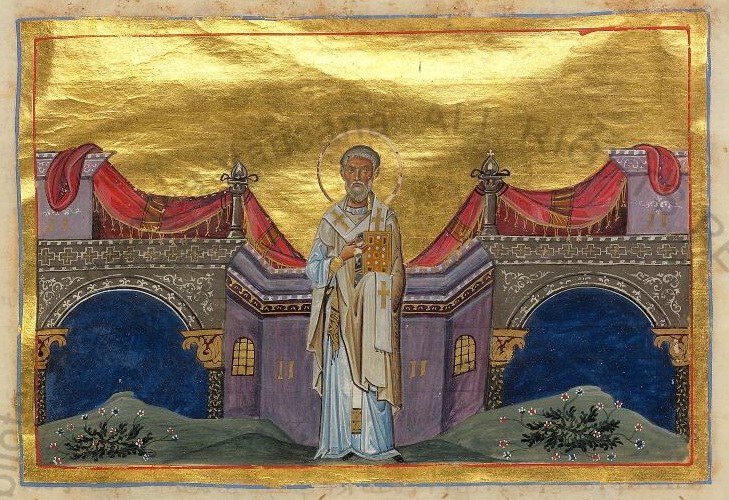
The stored image is the miniature of the Menologion of Basil II (Constantinople, 985): the bishop stands before the arcades of his church in phelonion and omophorion, the Gospel-book on his arm and his right hand raised in blessing — precisely the hierarch type the tradition appoints.
Disputed questions
- See. "Amisus" (Amisos) is the Black Sea city of Samsun; the form "Amasea" sometimes attached to his name confuses it with the inland Pontic metropolis of Amaseia, a different see.
- Not to be confused with the martyr Florus who, with his brother Laurus, is commemorated on August 18 — see Florus and Laurus, the stone-masons of Illyria buried alive in a well at Ulpiana in the second century: an unrelated and earlier pair, laymen and not hierarchs, with whom this bishop shares only the name and the coincidence of an eighteenth-day feast.