
Florus and Laurus
The Holy Martyrs Florus and Laurus, the stone-masons of Illyria
Martyr · d. 2nd century, at Ulpiana in Dardania
Commemorated 18 August — Martyrdom in the dry well at Ulpiana
Florus and Laurus were twin brothers and stone-masons, born at Byzantium and taught their craft — and their faith — by two Christian masters, Proclus and Maximus. Sent into Illyricum to build a pagan temple at Ulpiana in Dardania, they gave their wages to the poor, healed the eye of the son of the idol-priest Mamertinus and converted father and son, and when the building was finished they filled it instead with Christians, threw down the idols and set up a cross in its eastern end. Some three hundred of that company were burnt; the two brothers were thrown into a dry well and buried alive under earth, in the second century. Their relics were afterwards found incorrupt and carried to Constantinople. In the Slavic lands they became, by a devotion of the countryside rather than of the service-books, the patrons of horses, and they are painted in one of the most distinctive icon types of the Russian north.
_-_Icon,_The_Archangel_Michael_Blessing_the_Martyred_Saints_Florus_and_Laurus_of_Dalmatia_-_75.62_-_Minneapolis_Institute_of_Arts.jpg)
Two brothers of Byzantium
The passion makes Florus and Laurus brothers by birth — the Slavonic tradition and most retellings call them twins — natives of Byzantium, the city that had not yet become Constantinople. They were stone-masons (λιθοξόοι), trained in the craft by two Christian craftsmen named Proclus and Maximus, who taught them at the same time the manner of life that pleases God. When their masters were themselves put to death for the faith, the brothers left the capital and went into Illyricum, settling at Ulpiana in Dardania — the Roman town under the modern Lipljan, south of Priština, where a church of Sts Florus and Laurus stands to this day.
They were poor men and remained so deliberately. What the synaxarion says of their working life is very plain and very concrete: they took the wages of their trade and gave them away to the poor, keeping strict fast and praying while they worked. It is the detail that has made them, in the popular mind of Orthodox peoples, saints of manual labour before they were ever saints of the stable.
The temple at Ulpiana and the healing of Mamertinus' son
The governor of the province — the passion names him Lykaion (Λυκίων), a name the manuscripts also give as Lykon and Licinius — commissioned the brothers to raise a temple to the idols in a nearby district. They took the work.
While the building was going up, the son of the local pagan priest Mamertinus came carelessly near the works, and a chip of stone flew into his eye, wounding him grievously. The father's grief turned to rage. Florus and Laurus promised him that the boy would be made whole; they brought him round, instructed him, and told him to believe in Christ. When the youth confessed Jesus Christ as the true God, the brothers prayed over him and the eye was healed. Mamertinus, seeing it, believed with his son — a priest of the idols converted by the workmen he had hired.
The temple made a church
When the fabric was complete, Florus and Laurus did not deliver it up. They gathered the Christians of the district, went in procession through the finished building, shattered the statues, and in the eastern part — the place where an altar would stand — set up the Holy Cross. Then they kept the whole night there in prayer, and the tradition says the place was filled with a heavenly light.
The reprisal was immediate and total. The head of the district condemned to the fire the former priest Mamertinus, his son, and some three hundred Christians with them — the "three hundred burnt for casting down the idols" whom the Greek synaxarion still keeps on this day beside the two brothers. Florus and Laurus themselves were sent back under guard to the governor Lykaion, who ordered them thrown down an empty well and the well filled in over them with earth. So they died, buried alive in the shaft of their own quarrying, and the Church numbers them among the martyrs of the second century.
Relics, and the road to Constantinople
"After many years" — the passion is vague, and honestly so — the well was opened and the relics were found undecayed. They were taken up and translated to Constantinople. There they were seen by Russian pilgrims whose travel-accounts happen to survive and give us our firmest fixed points for the cult: Anthony of Novgorod, who visited the city in 1200 and records the relics among the treasures of the capital; and Stephen of Novgorod, who about 1350 saw the heads of the two martyrs in the monastery of the Pantokrator — the "Almighty monastery" of the old Slavonic itineraries. It was by that Constantinopolitan cult, and by those Novgorod pilgrims, that Florus and Laurus passed into the devotion of the Russian lands, where their fame in the end outran their fame among the Greeks.
The horses: what the sources actually say
Florus and Laurus are known throughout the Slavic world as the patrons of horses, and honesty requires that the growth of that patronage be described as what it is: a devotion of the folk calendar and the countryside, not a datum of the passion. The passion knows nothing of horses. Two things fed the association.
The first is a notice attached to the uncovering of the relics: that on the day the bodies were raised from the well, a severe murrain among the horses came to an end. It is the single hinge on which the whole later devotion turns.
The second is the Russian agricultural year. August 18 falls at the close of harvest, and in Rus' and Ukraine the day became the лошадиный праздник, the "horse-feast." Peasants did no work with horses on it; the beasts were groomed, fed to satiety, driven in procession round the village church, and sprinkled with holy water, and in many places the priest blessed them by name. In the Russian countryside the brothers' names were inseparable from the stable — "Frol and Lavr" in colloquial speech — and the day is still so called in the old almanacs.
The Church never legislated any of this, and the service-books do not mention horses. But it would be false to the record to file the patronage away as mere superstition: it is a real and ancient popular veneration, grown out of the relic-notice, and it produced one of the great icon types of the Russian north (below). Where it shaded into charm and weather-lore, Russian pastors said so at the time.
Feast and commemoration
August 18 (church date; Old Calendar civil August 31), within the afterfeast of the Dormition of the Theotokos. The brothers are the principal saints of the day in both Greek and Slavic usage, and their service is printed in the Menaion of August. In the Greek books they are commemorated together with the three hundred martyrs burnt for the casting down of the idols, who belong to their own passion.
Their veneration is universal, but it is in the Russian, Ukrainian and Belarusian Churches that it took its most vivid form, and in Serbia and Kosovo, where the church at Lipljan stands on the traditional site of their martyrdom, that it is oldest on the ground. Countless village churches of the Russian north and of Moscow itself bear the dedication "of Sts Flor and Lavr."
Hymns
Troparion — Tone 4 (common of martyrs)
Thy martyrs, O Lord, in their contest received incorruptible crowns from Thee our God; for possessing Thy strength, they cast down the tyrants and shattered the feeble insolence of the demons. By their intercessions, O Christ our God, save our souls.
Original translation from the Greek
Kontakion — Tone 2 (common of martyrs)
As firm and God-bearing stones of the Church, ye were hewn by the chisel of suffering and laid in the foundation of the faith; and being cast into the pit of the earth, ye rose as unfading crowns. O Florus and Laurus, entreat Christ God for us who honour your memory.
Original translation from the Greek
Iconography
Florus and Laurus are painted as young laymen, beardless or lightly bearded, in tunic and mantle, holding the cross of martyrdom — and, in the Balkan and Greek tradition, sometimes with the tools of the mason, hammer and chisel, at their belts. The scene of their passion shows the two let down into the well and the earth thrown in.
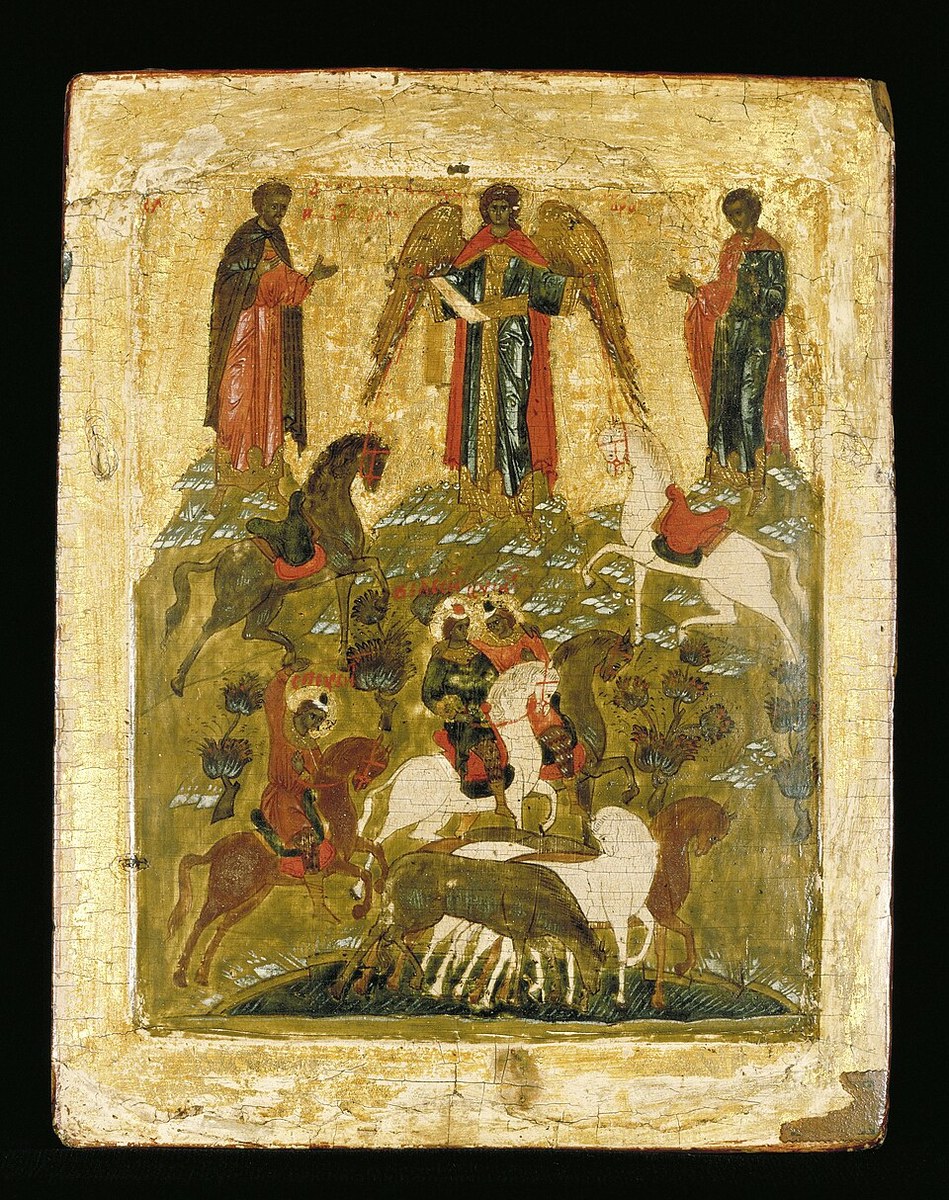
The Slavic tradition produced a wholly distinctive composition, one of the most easily recognised of all Russian icon types: "The Miracle of Florus and Laurus," in which the Archangel Michael stands between the two saints on a hill and hands them the reins of two horses, one dark and one white, while below, in a green landscape, a herd of horses is driven by the three martyr-brothers Speusippus, Eleusippus and Meleusippus (the Cappadocian triplets of January 16), who serve here as the herdsmen. The type is Novgorodian in origin and spread through the north from the fifteenth century.
The stored image is a Novgorod panel of 1450–1500 (tempera and gold on wood, Minneapolis Institute of Art, 75.62) of exactly this type: Michael in the centre with outspread golden wings, holding out the bridles; Florus at the left and Laurus at the right on their hillocks with hands raised; the black and the white horse rearing beneath the Archangel's hands; and at the foot the three herdsmen and the drove of horses at the watering-place.
Disputed questions
- The date and the persecutor. The synaxaria place the martyrdom in the second century, and this collection follows them; but the passion (BHG 661–663) is a late and strongly hagiographic text, and it names the governor variously — Lykaion / Lykon / Likinios — which has led some to pull the martyrdom down into the persecutions of the early fourth century, when a Licinius would be plausible. No independent evidence settles it. The second-century date is the calendar's, not an historian's.
- "Of Dalmatia" or "of Illyria." Russian and museum captioning frequently styles them Florus and Laurus of Dalmatia; the passion places them in Dardania, within the prefecture of Illyricum, at Ulpiana — the modern Lipljan in Kosovo. Both epithets point to the same place under different administrative names; "of Illyria" is the more exact.
- Twins. The twinship is universal in Slavic usage and in the iconography, which paints them as a matched pair, but the Greek passion says only ἀδελφοί, "brothers."
- Not to be confused with Florus of Amisus, the bishop of Amisus (Amaseia) commemorated on December 18 — a seventh-century hierarch, wholly distinct from the Illyrian martyr, with whom he shares nothing but a name and a coincidence of the numeral eighteen in his feast.