
George of Vladimir
The Holy Right-believing Great Prince George (Yuri) Vsevolodovich of Vladimir
Prince · Righteous · b. 1189, Suzdal — d. 1238, at the Sit River
Commemorated 4 February — Commemoration of the Great Prince, slain by the Mongols
George (Yuri) Vsevolodovich (1189–1238) was Great Prince of Vladimir and the central figure of the Russian resistance to the Mongol invasion of 1237–1238. Son of Vsevolod "Big Nest," he governed the leading principality of northern Rus, founded the city of Nizhny Novgorod, and was renowned, the chronicles say, for both his valour and his piety. When the Horde of Batu Khan overran the land, George gathered an army on the Sit River to meet it; there, on the fourth of March 1238, his forces were destroyed and the prince himself was slain. The tradition holds that his severed head was afterward reunited with his body, found incorrupt, and that his relics, enshrined in the Dormition Cathedral of Vladimir, worked wonders. The Church honours him as a right-believing prince who gave his life for the Christian land; he is commemorated on February 4.
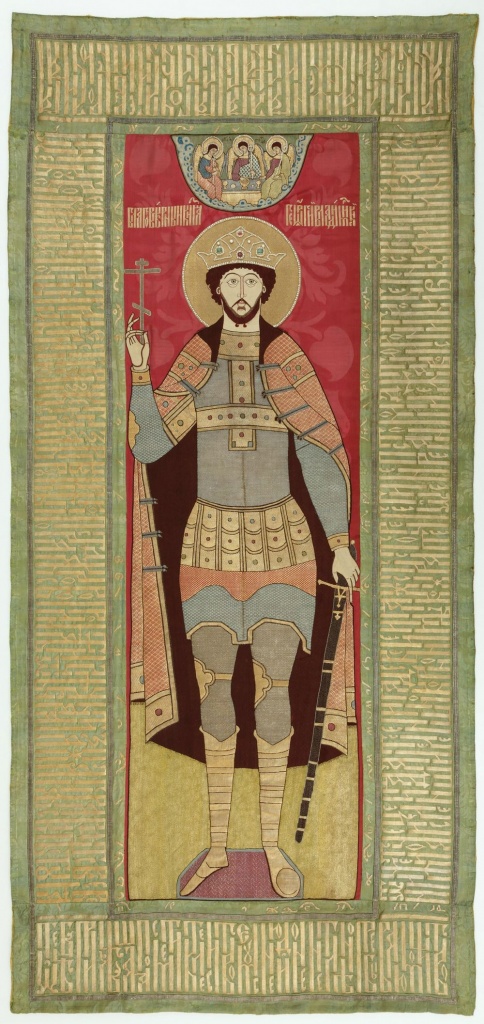

The house of Vsevolod
George was born in 1189, a son of the Great Prince Vsevolod III Yurievich, called "Big Nest" (Bolshoe Gnezdo) for his many children, and grandson of Yuri Dolgoruky, founder of Moscow. He belonged to the senior line of the princes of Vladimir-Suzdal, the dominant power of north-eastern Rus in the generation before the Mongol storm. On his father's death the succession was disputed between George and his elder brother Constantine, and for a time Constantine, with allied princes, prevailed against him; but after Constantine's death George became Great Prince of Vladimir in 1218 and held the throne for twenty years.
Prince of Vladimir
The chronicles remember George as a ruler distinguished for military valour and for piety. He built and adorned churches, and in 1221 he founded, at the confluence of the Oka and the Volga, the city of Nizhny Novgorod, raising there a cathedral and a monastery — a foundation that would grow into one of the great cities of Russia. He campaigned to secure the eastern frontier against the Volga Bulgars and the Mordvins, and stood at the head of the princes of the north-east. It was a settled and, by the measure of the age, a prosperous reign — until, out of the eastern steppe, came a power against which the divided principalities of Rus could not stand.
The Mongol invasion and the Sit River
In the winter of 1237 the Mongol Horde of Batu Khan, grandson of Genghis Khan, fell upon Rus. Ryazan was stormed and put to the sword; then the Horde turned on the Vladimir lands. George, unable to hold the capital with the force at hand, left his sons and his family in Vladimir and withdrew northward to gather an army from the other principalities, encamping on the Sit River (the Sit', a tributary in the Yaroslavl country). While he mustered his forces the Mongols took Vladimir by storm (February 1238): the city was sacked, and the prince's wife, sons, and household — who had taken refuge with the clergy in the Dormition Cathedral — perished there, many burned or cut down as the cathedral was overrun.
The news reached George on the Sit. On the fourth of March 1238 the Mongol army found and surrounded his host, and in the battle that followed the Russian force was annihilated and the Great Prince was killed. His body was left on the field of the slaughter.
Repose, relics, and the reunited head
After the Horde withdrew, Cyril, bishop of Rostov, passing over the field of the Sit, found and recognised the headless body of the Great Prince and carried it to Rostov for burial; later the severed head was discovered and, the tradition holds, was reunited with the body, the two joining so that no mark of the wound remained. The relics were afterward translated to Vladimir and enshrined in the rebuilt Dormition Cathedral, where in the seventeenth century they were found incorrupt and glorified; miracles were reported, and George was numbered among the saints as a right-believing prince who had fallen defending the Orthodox land against the pagan invader. He is remembered together with the whole company of the princes, clergy, and people who perished in the ruin of Vladimir-Suzdal in that terrible year.
Feast and commemoration
George of Vladimir is commemorated in the Russian calendar on February 4 (church date; Old Calendar civil February 17), within the afterfeast of the Meeting, together with Isidore of Pelusium who leads the day. Though he was slain on the field of the Sit on the fourth of March, the Church keeps his memory on the fourth of February. He is not to be confused with his kinsman and contemporary Alexander Nevsky, nor with the Great-Martyr George; "of Vladimir" and the epithet "right-believing Great Prince" mark this saint, the prince who fell before the Horde.
Iconography
George is depicted as a Russian prince-saint: a bearded man in the robes and fur-trimmed cap of a Great Prince, or in armour with a cross or a sword, often with the halo of sanctity and sometimes shown holding a model of a church (for his foundations) or against the burning of Vladimir. In the icons of the assembly of Russian saints he stands among the holy princes.
The stored image is a detail of an embroidered funeral pokrov (shroud) of 1626, worked in the Tsaritsa's workshop of the Moscow Kremlin, depicting the Great Prince George Vsevolodovich full-length in princely robes — the kind of figured cloth laid over a saint's shrine (source, a pre-1900 work; pd-old-work).