
Isidore of Pelusium
Our Venerable Father Isidore of Pelusium
Venerable · Priest · b. c. 360, Alexandria — d. c. 449, near Pelusium in Egypt
Commemorated 4 February — Repose near Pelusium; within the afterfeast of the Meeting
Isidore of Pelusium (c. 360 – c. 449) was an Egyptian ascetic, priest, and abbot of a monastery on the mountain near Pelusium, at the eastern mouth of the Nile, and one of the most learned spiritual fathers of the fifth century. Formed in the exegetical and moral spirit of John Chrysostom, whose memory he revered and defended, he governed his community by word and example and poured out his teaching in an immense correspondence: some two thousand letters survive, brief and pointed answers on Scripture, doctrine, and the moral life, addressed to bishops, clergy, monks, officials, and laymen high and low. A fearless rebuker of laxity and ambition in the hierarchy — not sparing the powerful — he was also a clear voice against the Nestorian denial of the one Christ, and pressed Cyril of Alexandria, his own kinsman, to hold the faith without the vindictiveness that had wronged Chrysostom. His letters remain a treasury of patristic exegesis. He is kept universally on February 4.
.jpg)
Origins and formation
Isidore was born about the year 360, of a prominent Alexandrian family; the tradition makes him a kinsman of two successive archbishops of Alexandria, Theophilus and his nephew Cyril — a connection that runs, sometimes painfully, through his later correspondence. Alexandria in his youth was the intellectual capital of the Christian East, and Isidore received there the full Hellenic education of the age: he writes with an easy command of the classical poets, orators, and philosophers, and turns that learning wholly to the service of the Scriptures. Yet the world of the schools did not hold him. Drawn to the ascetic life that had already covered the Egyptian desert with monks, he withdrew — the sources say, refusing every prospect of advancement in the world or the Church — to the mountain near Pelusium, the frontier city at the easternmost mouth of the Nile, and there became a monk.
The decisive influence on his mind was not any Alexandrian master but the preaching of John Chrysostom. Whether Isidore ever heard Chrysostom in person is uncertain and probably not to be pressed, but he knew and loved his homilies, styled him "the eye of the Church of Byzantium" and "the wise interpreter," and modelled on him both his manner of reading Scripture — sober, literal-historical, morally applied, in the sober key later called Antiochene — and his fearless application of the Gospel to the lives of bishops and rulers. In an age when Alexandria and the memory of Chrysostom were at odds, Isidore, an Alexandrian by birth and kin, stands out as a wholehearted disciple of the Antiochene teacher; the paradox is the key to his whole career.
Ascetic life and the abbacy near Pelusium
On his mountain Isidore embraced the strictest discipline. The later tradition, and the tenor of his own letters, present him as the model of what a monk should be: rigorous with himself, sparing in food and sleep, unwearied in prayer and in the study of the Scriptures, and utterly free of the love of money and place that he saw corroding the clergy of his day. He was ordained priest, and in time was set at the head of the community as its abbot (hegumen), governing not by weight of office but, as he insisted a shepherd must, by the example of his own life — "teaching by doing," in the phrase his hymnography borrows. He compared the monastic life to a philosophy truer than the philosophers', and the monastery to a school of the virtues; but he had no patience for asceticism worn as a costume, and rebuked monks who made a show of fasting while nursing pride, anger, or avarice within.
His fame as a spiritual physician spread far beyond his mountain, and he became, through his pen, a counsellor to the whole Church of Egypt and beyond. He seems never to have sought or held any higher office, refusing — the tradition says — even the thought of the great sees; his authority was entirely that of holiness and learning, freely acknowledged by those who wrote to him for judgement.
The letters
Isidore's monument is his correspondence. The manuscript tradition preserves about two thousand letters (the Greek collections number roughly 2,000, gathered into five books; further letters survive in Syriac), and the ancient historians report that many more once existed. They are almost all short — often a few lines — each a pointed answer to a single question: the meaning of a difficult verse, a knot of doctrine, a rule of conduct, a rebuke, a word of consolation. Taken together they are one of the richest bodies of practical exegesis and moral theology to survive from the patristic age, and a vivid window onto the life of the fifth-century Church, its clergy, its controversies, and its faults.
Three notes sound through them. First, Scripture: Isidore is above all an interpreter of the Bible, and his method is the Antiochene one he learned from Chrysostom — attentive to the letter, the history, and the grammar of the text before its higher senses, wary of allegory spun loose from the words, and always bending the interpretation toward the amendment of life. Second, the moral reform of the clergy: he is merciless toward simony, luxury, ambition, and negligence among bishops and priests, and he says so to their faces. He wrote repeatedly and sharply to Eusebius, bishop of Pelusium, and to Eusebius's favourites (the deacon-treasurers Zosimus and Maron), denouncing their greed and misrule of the local church; and he did not spare the great, reproving officials and even, in guarded terms, the conduct of the mighty when it wronged the poor. Third, doctrine: he defends the full divinity of the Son and the Spirit against the residue of Arianism, and — in the crisis of his last years — the unity of the one Christ against Nestorius.
Chrysostom, Cyril, and Nestorius
Isidore's public interventions cluster around two great causes, and in both the figure of Chrysostom stands behind him.
He never accepted the deposition and exile of Chrysostom, engineered in 403 by his own kinsman Theophilus at the Synod of the Oak, as anything but a scandal and an injustice; he honoured the exiled archbishop as a saint and a martyr of jealousy, and he pressed — with the whole party of the "Johannites" — for his rehabilitation and the restoration of his name to the diptychs. When Theophilus died and was succeeded by his nephew Cyril, who at first shared his uncle's hostility to Chrysostom's memory, Isidore wrote to the young archbishop with startling frankness, warning him not to carry a family feud into the sanctuary, not to let "private grudges" masquerade as the Church's judgement, and to restore Chrysostom to honour. It is a rare and telling thing: a monk of no office rebuking the patriarch of Alexandria, his own relative, in the name of justice and the memory of the Antiochene saint.
Yet when the greater storm broke — the preaching of Nestorius, patriarch of Constantinople, that the Virgin should be called "Mother of Christ" (Christotokos) rather than "Mother of God" (Theotokos), a formula the Church heard as a splitting of the one Christ into two — Isidore stood with Cyril and against Nestorius. He grasped the true stake: that the Son of God and the son of Mary are one and the same person, and that to deny the Theotokos is to deny the Incarnation. The tradition, following the ancient historians, holds that it was in part through Isidore's urging that the matter was brought to a general council, and the Third Ecumenical Council met at Ephesus in 431 and condemned Nestorius. But Isidore's support of Cyril was neither factional nor uncritical. He wrote to Cyril at Ephesus a letter that has never been forgotten, warning him that partisanship and vindictiveness could ruin even a just cause: that many were saying Cyril pursued Nestorius not for the truth's sake but out of the same jealous temper his uncle had shown toward Chrysostom, and that the Council's president must be seen to judge for God and not for himself. The convictions cohere: Isidore defended the Theotokos with all his heart, but he would not let the defence of the true faith become a licence for the very sin — ecclesiastical vendetta — that had crucified his beloved Chrysostom.
Repose
Isidore lived to a great age and reposed on his mountain in the first half of the fifth century, having spent, the tradition says, some six or seven decades in the ascetic life. The year is not fixed: the common reckoning places his repose about 449–450, but other authorities give c. 435–436, and the sources agree only that he died after the Council of Ephesus (431) with which his last years were bound up. He left no disciples to rival his own fame, but he left his letters, and through them he became a teacher of the whole Church. The day of his commemoration, February 4, is the fixed anchor; the year is given with "c.".
Literary legacy
The Greek collection of Isidore's letters was gathered early — the labour is associated with the monks of the Akoimetoi ("the Sleepless") at Constantinople — into five books, and it is edited among the works of the Fathers (in Migne's Patrologia Graeca, volume 78). A treatise Against the Greeks and other works mentioned by the ancients are lost or survive only within the letters. Because so many of the letters are miniature commentaries on single verses, later exegetes and the compilers of the biblical catenae mined them heavily, and phrases of Isidore pass, often unnamed, into the standard Greek interpretation of Scripture. What survives is therefore both a personal archive and a quarry of patristic exegesis — the reason the tradition calls him, simply, one of the wisest teachers of his century.
Feast and commemoration
Isidore is kept universally on February 4 (church date; Old Calendar civil February 17), within the afterfeast of the Meeting of the Lord — his office in the Menaion is sung together with the afterfeast hymns of the Presentation. The Greek, Antiochian, and Slavic calendars agree on the day, and the Coptic and other Oriental Churches also honour him. The Roman Martyrology commemorates him on the same day. On February 4 the Church keeps with him Nicholas the Studite, confessor and abbot; the Persian hieromartyr Abramius of Arbela; and, in the Russian calendar, Cyril of Novoezersk and the holy Great Prince George of Vladimir.
Hymns
Troparion — Tone 8
In thee, O Father, was the divine image kept secure; for taking up the cross thou didst follow after Christ, and by thy deeds thou didst teach us to despise the flesh, for it passeth away, but to care for the soul, a thing immortal. Wherefore, O venerable Isidore, thy spirit rejoiceth together with the Angels.
Original translation from the Greek
Iconography
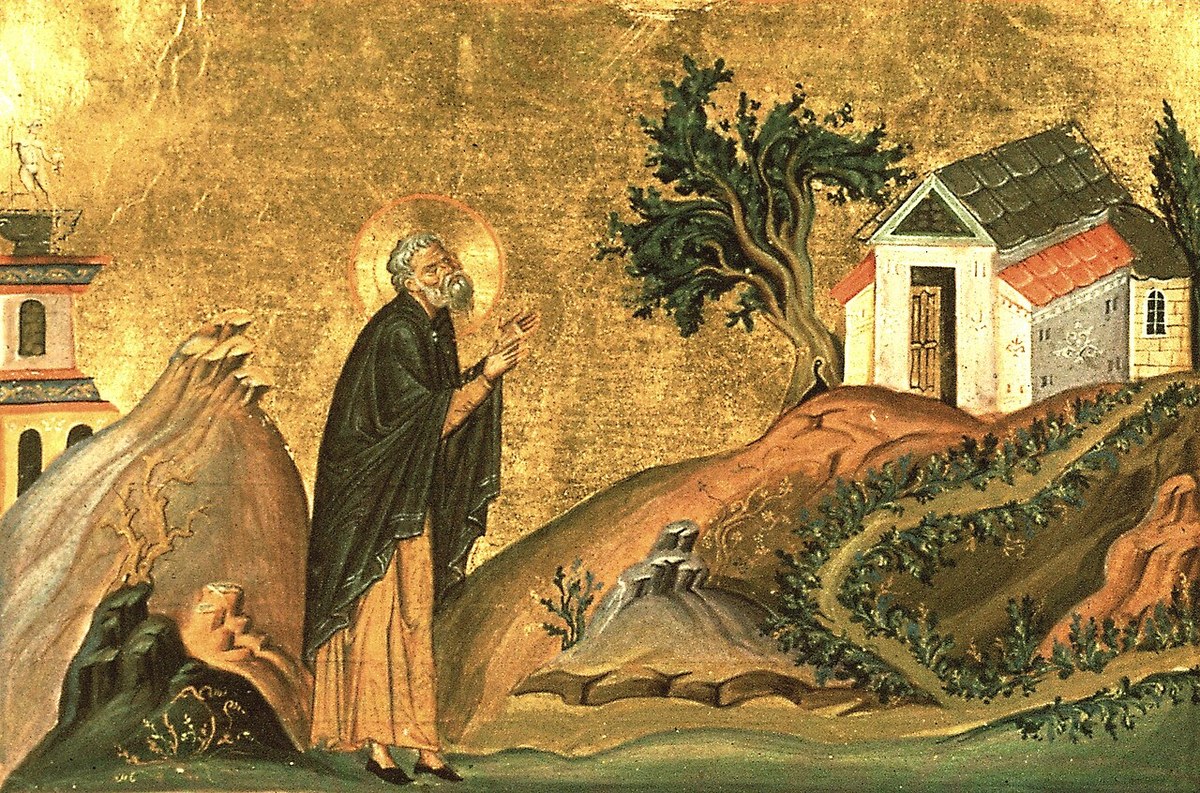
Isidore is depicted as an aged monk-priest: a long grey beard, the monastic schema or the priest's phelonion, holding a Gospel-book or a scroll — the image of the learned ascetic and teacher. Because his monument is his writing, he is often shown with a scroll unrolled, as the interpreter of the Word.
The stored image is the miniature for February 4 from the Menologion of Basil II (Constantinople, c. 985; Vatican, Vat. gr. 1613): Isidore standing as an aged monastic father, in the compact narrative style of that great menologion (source, public domain, pd-old-work).
Disputed questions
- Not to be confused with the other saints of this very common Egyptian name: the soldier-martyr Isidore of Chios (†251, May 14), an Alexandrian like himself but a sailor of the imperial fleet; Isidore of Rostov (†1474, also May 14), the German-born fool-for-Christ of the Russian north; Isidora of Tabenna (May 1), the first woman fool-for-Christ; Isidore of Yuriev (Dorpat) and the seventy-two martyrs with him (January 8); and the Western fathers Isidore of Seville and Isidore the Ploughman. Isidore of Pelusium is the letter-writer and abbot of February 4.