
Gerasim of Vologda
Our Venerable Father Gerasim of Vologda, Wonderworker
Venerable · Wonderworker · b. early 12th century, near Kiev — d. March 4, 1178, at Vologda
Commemorated 4 March — Repose (1178); the day is also that of his monastic tonsure
Gerasim of Vologda (early 12th century – 1178) is honoured as the first monastic founder and wonderworker of the Vologda land in the Russian north. A monk of the Gnilets (Dormition) Monastery near Kiev, he came north about the middle of the twelfth century to the small riverside settlement that would become the city of Vologda, and there, in the forest by the Kaisarov brook, built a church and monastery of the Holy Trinity — the earliest religious house of that whole region. Tradition remembers his prophecy that the obscure settlement would grow into a great city, and honours him as its heavenly founder. He reposed on March 4, 1178, the same day of the year on which, long before, he had received the monastic tonsure. He is not to be confused with the desert father Gerasimus of the Jordan, who is commemorated on this very same day.

Gerasim was born, the tradition holds, in the country near Kiev in the early twelfth century, and received the monastic tonsure — on March 4, the day that would afterward be his feast — at the Gnilets (Gniloe) Dormition Monastery, one of the cave-monasteries in the neighbourhood of Kiev. Ordained in time to the priesthood, he was moved by the desire to carry the Gospel and the monastic life into the still half-pagan forests of the Russian north.
About the year 1147 he made the long journey north and came to a small trading settlement on the Vologda river, at the place then called Lenivy Torzhok (the "Lazy Marketplace"), where a few dwellings stood among the woods. Withdrawing a little from the settlement, into the forest by the Kaisarov brook, Gerasim built himself a cell, and then a church and monastery of the Holy Trinity — the first monastery of the whole Vologda region, and the seed of its Christian life. There he laboured in prayer, in the instruction of the people, and in works of mercy, and God granted him the gift of wonders, so that he became known through the north country. The tradition preserves his prophecy that the poor settlement by the river would one day become a great and populous city — a word fulfilled in the rise of Vologda.
Gerasim reposed at his monastery on March 4, 1178. His grave in the Holy Trinity church became a place of healing, and his cultus grew as the local memory of the land's first monk and founder; the Russian Church honours him as the "first wonderworker of Vologda." His feast is kept on the day of his repose, March 4.
Feast and commemoration
Gerasim is commemorated on March 4 (church date; Old Calendar civil March 17), the day both of his repose (1178) and, by the tradition, of his monastic tonsure. His is a local Russian commemoration — proper to Vologda and its region, and kept in the wider Russian and OCA calendars among the northern saints — and it falls almost always within the Great Fast. On this same day the universal calendar keeps the great desert father Gerasimus of the Jordan (†475), with whom the Russian Gerasim, sharing both name and day, is very easily confused; the two are wholly distinct — the one a fifth-century anchorite of the Palestinian desert, the other a twelfth-century founder of the Russian north.
Iconography
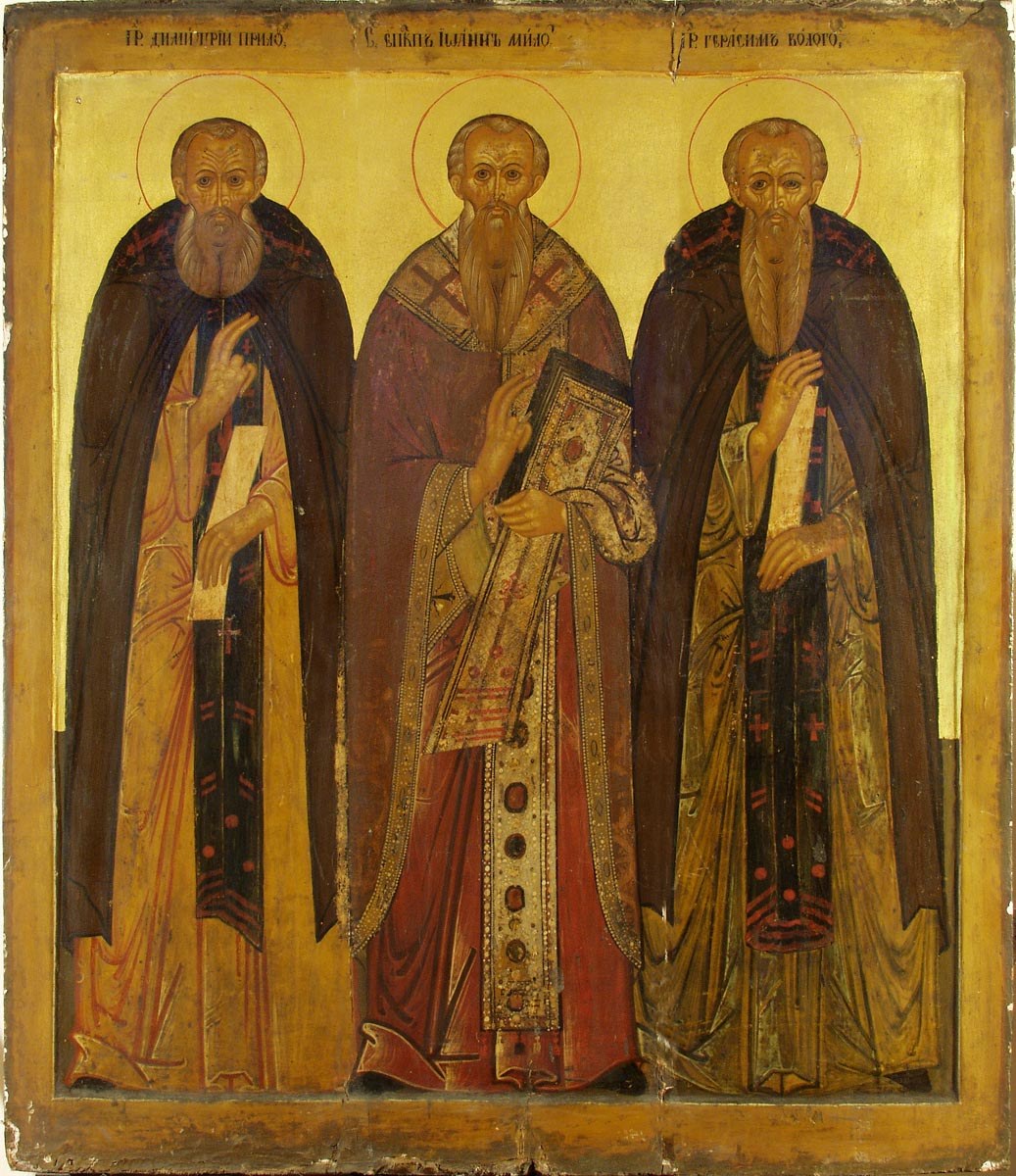
Gerasim is depicted as a Russian monastic saint and hieromonk: in the habit and mantle, with a moderate dark or greying beard, blessing and holding a scroll, and often shown with his Holy Trinity church or the city of Vologda behind him as its founder. The stored image is a 17th-century Russian icon of three named saints — "Пр. Гераси́м Воло́го[дский]" stands at the right, in mantle and schema with a scroll, beside Dimitri of Priluki and John the Merciful — each identified by the inscription above his halo.