
Gerasimus of the Jordan
Our Venerable and God-bearing Father Gerasimus of the Jordan
Venerable · b. early 5th century, in Lycia (Asia Minor) — d. 475, at his lavra by the Jordan
Commemorated 4 March — Repose at his lavra in the wilderness of the Jordan
Gerasimus of the Jordan (early 5th century – 475) is one of the great fathers of the Palestinian desert, the founder of a celebrated lavra in the wilderness by the River Jordan and a contemporary and associate of Euthymius the Great. A native of Lycia in Asia Minor, he was formed as a monk in Egypt and the Thebaid before settling near the Jordan about the middle of the fifth century. Briefly drawn, in the turmoil that followed the Council of Chalcedon, into the Eutychian (Monophysite) error, he was recovered to the orthodox faith by Euthymius, whom he thereafter revered as his father in the desert. His lavra combined a coenobium for beginners with cells for the more advanced, under a rule of extreme austerity — five days a week in silent solitude on bread, dates and water, without fire or cooked food. He is loved above all for the lion he healed of a thorn and tamed, which served the monastery, was falsely suspected of theft and did penance, recovered the stolen donkey, and at last, finding its master dead, mourned and died upon his grave. He reposed in 475, shortly after Euthymius.

The memory of Gerasimus rests on two streams of witness that meet in his person: the Life of Euthymius and companion Lives of Cyril of Scythopolis (c. 555), who names Gerasimus among the fathers of the desert in Euthymius's circle; and the tale of the lion, transmitted in the Spiritual Meadow (Pratum Spirituale) of John Moschus (early 7th century) and in the Life that grew around it. From these the Church has its portrait of the man and his beast.
Origins and formation
Gerasimus was born in the province of Lycia, on the southern coast of Asia Minor, in the early years of the fifth century, of well-to-do parents. Drawn from his youth to the ascetic life, he renounced the world and its wealth and became a monk; and, as many of the age's most fervent did, he went down into Egypt — into the deserts of the Thebaid, the school of the first and greatest anchorites — where he was schooled in the discipline of solitude and the warfare of the passions. Only after this long apprenticeship, about the year 450, did he come to Palestine and settle in the desert of the Jordan, where he would spend the rest of his life and win his fame.
The Chalcedonian crisis and Euthymius the Great
Gerasimus arrived in Palestine at the moment of its gravest doctrinal storm. The Fourth Ecumenical Council at Chalcedon (451) had confessed Christ in two natures, divine and human; and in Palestine the definition was met by a violent Monophysite reaction, as a monk named Theodosius seized the throne of Jerusalem and carried a great part of the desert's monks into schism against the Council. Gerasimus, newly come and not yet proof against the confusion, was for a time drawn into the error of Eutyches and Dioscorus — the teaching that in Christ after the union there was but one nature, the divine, and not the human.
His deliverance came through the greatest of the desert's fathers. Withdrawing, like the other waverers, to lay his trouble before Euthymius the Great, who alone of the elders had stood immovable for the Council, Gerasimus was instructed by him in the deep desert of Rouba and restored to the orthodox faith — to the confession of the one Christ in two natures — which he held unshaken to the end. From that day he attached himself to Euthymius as to a father and teacher; the tradition counts him among Euthymius's associates and disciples, and it was in Euthymius's company, the sources say, that Gerasimus was refined into the great ascetic the Church remembers. The bond between the two is one of the constant notes of the Palestinian desert's memory: the recovered penitent who became himself a father of monks.
The lavra by the Jordan
In the wilderness some distance from the River Jordan, toward the Dead Sea and not far from Jericho, Gerasimus founded the monastery for which he is chiefly remembered — a lavra on the Palestinian pattern, but ordered with a wisdom of his own. At its centre he set a coenobium, a communal house where the younger and the untried were received and trained in obedience and the common life; and around it, in the wilderness, he set the cells (the lavra proper) of the solitaries — some seventy in number — where those already advanced in the ascetic life dwelt apart. As with Euthymius, the principle was that no one might pass to the solitude of a cell until he had first been proved in the coenobium: the common life was the school of the solitary life, and stillness the reward of obedience. The site is remembered in the monastery of Deir Hajla — the Monastery of Saint Gerasimus — which keeps his name in the Jordan valley to this day.
The rule of life
The discipline Gerasimus laid on his lavriotes was among the most austere of the desert. Through the five days of the working week the solitaries kept to their cells in unbroken silence, giving themselves to prayer and to the plaiting of reeds and mats, and taking no cooked food and kindling no fire — their whole sustenance in that time was dry bread, dates or roots, and water. The cell doors were left unlocked, so that any brother might enter another's cell and take what he had need of, for none possessed anything of his own — not so much as to call the water in his jar or the mat under him his own. On Saturday and Sunday the whole brotherhood gathered at the central monastery for the Divine Liturgy and Communion, and only then took a little cooked food and a measure of wine, and carried back to their cells the reeds for the week's work. Gerasimus himself outdid all his monks: through the whole of Great Lent he took, the tradition says, no food at all but the Holy Communion of Saturdays and Sundays, sustaining his body on the Body and Blood of Christ alone; and he would go out into the deeper desert for the Forty Days, returning to his lavra for Palm Sunday and Pascha.
The lion Jordanes
The story that has carried the name of Gerasimus into every corner of Christendom is that of his lion — a parable in fact, of the peace between man and beast that the saints recover from Paradise.
One day, as Gerasimus walked by the banks of the Jordan, he met a lion roaring in pain, holding up one paw into which a great thorn (a reed-splinter) had run, so that the foot was swollen and festering. The beast, instead of falling on him, seemed to plead for help; and the old man, taking the paw, drew out the thorn, pressed out the corruption, cleansed the wound and bound it up. Healed, the lion would not leave him, but followed him back to the lavra like a disciple, and lived there thenceforward, fed by the monks, gentle as a lamb.
Gerasimus set the lion a charge: to guard the donkey that carried the monastery's water up from the Jordan, leading it out to graze along the river. So things went for a season. But one day, while the lion drowsed apart, Arabian camel-drivers passing that way found the donkey grazing alone and drove it off with them. The lion, waking and searching in vain, came back to the monastery crestfallen and alone; and Gerasimus, supposing that his lion had grown hungry and devoured the donkey, laid on the beast the donkey's own penance — from then on the lion must carry the great water-vessels up from the river on its back, and do the work of the animal it was thought to have eaten. The lion bore the sentence meekly, in silence.
But the lion had not sinned. Some while later the same merchant came again by that road with his string of camels, and the stolen donkey with them, on his way to sell corn in Jerusalem. The lion knew the donkey at once, roared, and rushed upon them; the terrified merchant fled, and the lion, seizing the donkey's halter in its mouth as it had been taught, drove the whole train — the donkey and the three camels roped together with their loads — straight back to the monastery and to the feet of Gerasimus. So the old man learned that the lion had been wronged, and, marvelling, gave it back its honour and named it Jordanes, after the river by which it had been found. From that day the lion stayed by its master, and was given its bread from his hand.
Five years the lion lived at the lavra. Then, while Gerasimus was away, the old man reposed, and was buried by the brethren; and the lion, coming back and not finding him, went roaring and grieving through the monastery, seeking its master everywhere. The disciple Sabbatius tried to comfort it, offering it food, and at last said, "Our elder is gone to the Lord and has left us" — but the beast would not be comforted, and only grieved the more. Then Sabbatius led it to the grave of Gerasimus, and said, "Here our elder is buried." The lion beat its head upon the ground over the tomb, roaring mightily, and there, upon the grave of Gerasimus, it gave up its life and died. "Not that the lion had a reasonable soul," John Moschus is careful to add, "but that God willed to glorify Gerasimus, and to show us how the beasts were subject to Adam before he disobeyed and fell from the delight of Paradise." The lion was buried near the saint; and it is for this that the icons of Gerasimus set the lion at his feet.
Repose
Gerasimus reposed at his lavra in the year 475, having outlived by two years his father and teacher Euthymius the Great (†473). His lavra continued after him as one of the notable houses of the Jordan desert, and his memory was kept there and throughout Palestine; the monastery of Deir Hajla still bears his name and shows the traditional site. His feast is kept on March 4.
Feast and commemoration
Gerasimus is kept universally on March 4 (church date; Old Calendar civil March 17), the day of his repose. The Antiochian, Greek and Slavic calendars agree on the day. His feast falls almost always within the Great Fast, and often on a weekday of Lent when no full Divine Liturgy is served, so that his office is sung at the Lenten hours and Vespers rather than at a festal Liturgy; where it falls on a Saturday or Sunday of Lent his commemoration is kept with the day's own service. In the Jordan valley his feast is the festival of the monastery of Deir Hajla, and pilgrims to the Holy Land keep his memory at the traditional site of his lavra.
Hymns
Troparion — Tone 1
A citizen of the wilderness and an angel in the body wast thou shown to be, and a wonderworker, O our God-bearing father Gerasimus. By fasting and vigil and prayer thou didst receive gifts from heaven, and thou healest the sick and the souls of them that run to thee in faith. Glory to Him that gave thee strength; glory to Him that crowned thee; glory to Him that worketh healings for all through thee.
Original translation from the Greek
Kontakion — Tone 4
Having caught fire with love for the things on high, thou didst prefer the harshness of the Jordan wilderness above all the sweet things of the world; wherefore the wild beast was made subject to thee even unto death, O father, and in obedience and grief gave up its life upon thy grave — for so had God glorified thee. Praying to Him, remember us also, O father Gerasimus.
Original translation from the Slavonic
Iconography
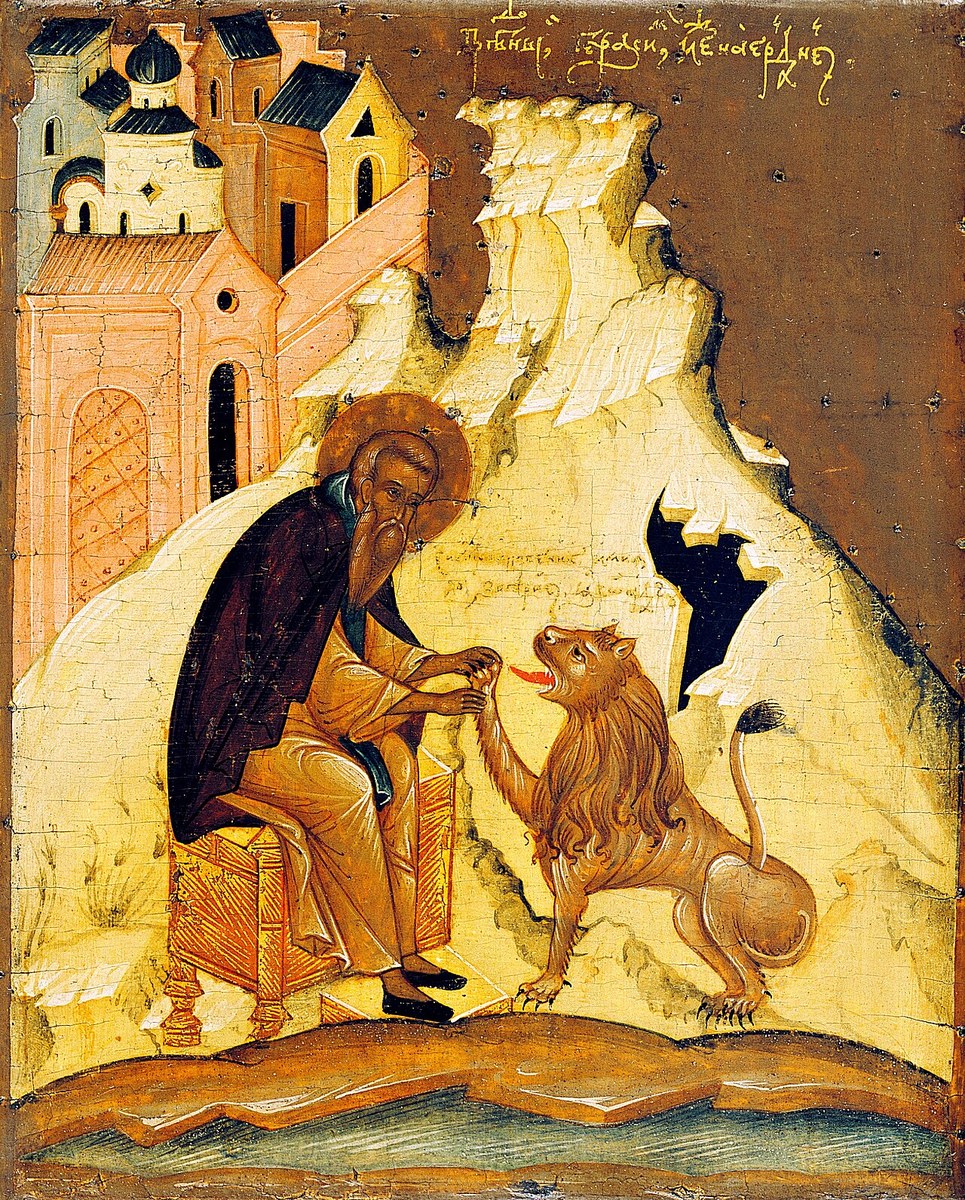
Gerasimus is depicted as an aged desert father in the monastic schema and mantle, with a long grey or white beard, blessing or holding a scroll — and, most characteristically, with the lion at his feet, or standing beside him, which identifies him at a glance and sets him apart from every other saint of his name. The fuller narrative icons show the scenes of the lion's tale: the drawing of the thorn from the paw, the lion leading or guarding the donkey, and — most movingly — the lion stretched dead upon the saint's grave. In some icons the River Jordan and his lavra are indicated behind him.
The stored image is a sixteenth-century Russian icon of the saint with his lion: Gerasimus as a schema-clad elder, the tamed beast at his side — the visual form of the story the whole Church knows (source, public domain, pd-old-work).
Disputed questions
- Chronology. Gerasimus's coming to Palestine is placed about 450 and his repose in 475 (aged, by the common reckoning, in his seventies). A minority of sources give an earlier death-year (451), confusing the date of his recovery from the Eutychian error at the time of Chalcedon with the date of his death; the received tradition, and Cyril of Scythopolis's placing of him in Euthymius's living circle, fix the repose in 475.
- The lion. The tale of the lion is transmitted by John Moschus (Spiritual Meadow 107) as a thing told him in the desert, and the Church has always received it as edifying tradition rather than as bare chronicle — Moschus himself frames it as a sign of God's glorifying of the saint and of the lost peace of Paradise, not as a proof that the beast reasoned. The same story is told in some Western transmissions of Saint Jerome (Hieronymus), whose name in Greek, Hieronymos, was early confused with Gerasimos; the desert tradition, and the Byzantine calendars, keep the lion firmly with Gerasimus of the Jordan, and the Jerome-and-the-lion of Western art is generally held to be a borrowing of this Palestinian story onto the great translator of the Vulgate.
- Not to be confused with Gerasim of Vologda (†1178), the Russian ascetic and "first wonderworker of Vologda," who is commemorated on this same day, March 4, and with whom Gerasimus of the Jordan is easily conflated; nor with Gerasimus of Cephalonia (†1579), the Greek "New Ascetic" and patron of the Ionian island, who is kept on August 16 and October 20. The lion, the Jordan, and the association with Euthymius belong to this Gerasimus alone.