
Gregory of Agrigentum
Our Father among the Saints Gregory, Bishop of Agrigentum
Bishop · Wonderworker · b. c. 559 — d. c. 592
Commemorated 23 November — Repose
Gregory of Agrigentum (Akragas) was a Sicilian-born bishop and biblical exegete of the sixth century, venerated as a hierarch and wonderworker. Born near Agrigentum of pious parents, he was drawn as a youth to Jerusalem, was tonsured a monk, and after years in Palestine, Constantinople and Rome was appointed by the Pope to the vacant see of his native city. There malicious clergy conspired against him, bribing a woman to accuse him of fornication; imprisoned and tried at Rome, he was vindicated when his prayer cast the demon out of his accuser, who confessed the plot. He governed his flock in peace to a serene old age and is commemorated on November 23.
_-_Photo_by_Giovanni_Dall%27Orto_-_April_5_2025.jpg)
Origins and early life
Gregory was born, according to his Life, in a village near the Sicilian city of Agrigentum (Akragas), the son of pious parents named Chariton and Theodota, and was baptised by the local bishop. A studious child, he mastered his letters and church chant early, and at about twelve was given over to the clergy under the guidance of the archdeacon Donatus, spending some ten years in the service of the Agrigentine church. Seized with a longing to venerate the holy places, he departed secretly for Jerusalem, where the patriarch received him kindly, ordained him deacon, and, at his request, blessed him to enter a monastery on the Mount of Olives.
Monastic and conciliar years
From the Mount of Olives Gregory passed to the discipleship of a desert elder, who for some four years formed him in humility and the monastic life before sending him back into the world as one destined to be a light to the Church. He dwelt for a time again at Jerusalem, then came to Constantinople, where he was received into the monastery of the Holy Martyrs Sergius and Bacchus. His gifts drew the notice of the patriarch, and the Life relates that he took part in the Fifth Ecumenical Council (Constantinople, 553) — one of several chronological difficulties in his biography (see below). He then journeyed to Rome to venerate the tombs of the Apostles Peter and Paul.
Bishop of Agrigentum, trial and vindication
While Gregory was at Rome the see of Agrigentum fell vacant, and a delegation of its elder clergy and leading citizens came to the Pope with a list of candidates. The Pope set their list aside and, by divine inspiration, chose Gregory himself, consecrating him bishop of his native city. For a few years he shepherded his people ably — a defender of the poor and the wronged, a wise preacher, and a healer of the sick — while living as strictly as a monk. But envious men resolved to destroy him. While the bishop was serving in church they smuggled a bribed prostitute into his private chambers, and then, before the crowd escorting him home, led her out and accused him of the deadly sin of fornication. He was placed under guard; at the trial the woman gave false witness — and in the very act of her slander fell into a fit of demonic frenzy, whereupon the judges charged him instead with sorcery. He was sent for judgment to Rome and shut up in prison.
There he bore his humiliation in constant prayer, and his gifts of healing became so renowned that pious Romans gathered at the prison to be taught and cured. After about two years a clairvoyant elder named Mark, who had known Gregory from his youth and disbelieved the charges, persuaded the Pope to convene a council. Clergy of Agrigentum came, with all the accusers and the woman; from Constantinople came three bishops and the dignitary Marcian, who fell mortally ill on the road and was carried, dying, to Gregory's prison, where the saint's prayer healed him. At the council, when the slanderers again produced the deranged woman as their proof, Gregory prayed over her and cast out the demon; restored to her senses, she told the whole truth. The plotters were put to shame and condemned — Marcian would have had them executed, but Gregory begged their pardon. Restored in honour to his cathedral and surrounded by the love of his flock, he guided the church of Agrigentum until his peaceful repose.
Hymnographic and literary legacy
Gregory is remembered as an exegete: a lengthy Greek commentary on Ecclesiastes, in ten books, is transmitted under his name and enjoyed wide circulation in Byzantium. His anonymous Greek Life, ascribed to a "Leontius, abbot of the monastery of Saint Sabas in Rome," is the source of the whole narrative above.
Feast and commemoration
November 23 (church date; Old Calendar civil December 6), within the Nativity Fast and the afterfeast of the Entry. In the Menaion his service is joined with that of Amphilochius of Iconium, the two hierarchs sharing the day; Gregory has his own proper kontakion and canon within that office.
Hymns
Troparion — Tone 4
O God of our Fathers, who dealest with us ever according to Thy gentleness: take not Thy mercy from us, but by their supplications govern our life in peace.
Original translation from the Greek
Kontakion — Tone 3
Like a great sun, with the dawning rays of thy wonders thou dost illumine the whole Church of God; by thine intercessions thou hast saved many people, and hast driven the evil-believing from thy flock. Therefore we honour thee, O God-minded father, wise Gregory.
Original translation from the Greek
Appointed readings
Epistle — Hebrews 7:26–8:2
26For such an high priest became us, who is holy, harmless, undefiled, separate from sinners, and made higher than the heavens; 27Who needeth not daily, as those high priests, to offer up sacrifice, first for his own sins, and then for the people’s: for this he did once, when he offered up himself. 28For the law maketh men high priests which have infirmity; but the word of the oath, which was since the law, maketh the Son, who is consecrated for evermore. 1Now of the things which we have spoken this is the sum: We have such an high priest, who is set on the right hand of the throne of the Majesty in the heavens; 2A minister of the sanctuary, and of the true tabernacle, which the Lord pitched, and not man.
Gospel — John 10:9–16
9I am the door: by me if any man enter in, he shall be saved, and shall go in and out, and find pasture. 10The thief cometh not, but for to steal, and to kill, and to destroy: I am come that they might have life, and that they might have it more abundantly. 11I am the good shepherd: the good shepherd giveth his life for the sheep. 12But he that is an hireling, and not the shepherd, whose own the sheep are not, seeth the wolf coming, and leaveth the sheep, and fleeth: and the wolf catcheth them, and scattereth the sheep. 13The hireling fleeth, because he is an hireling, and careth not for the sheep. 14I am the good shepherd, and know my sheep, and am known of mine. 15As the Father knoweth me, even so know I the Father: and I lay down my life for the sheep. 16And other sheep I have, which are not of this fold: them also I must bring, and they shall hear my voice; and there shall be one fold, and one shepherd.
Iconography
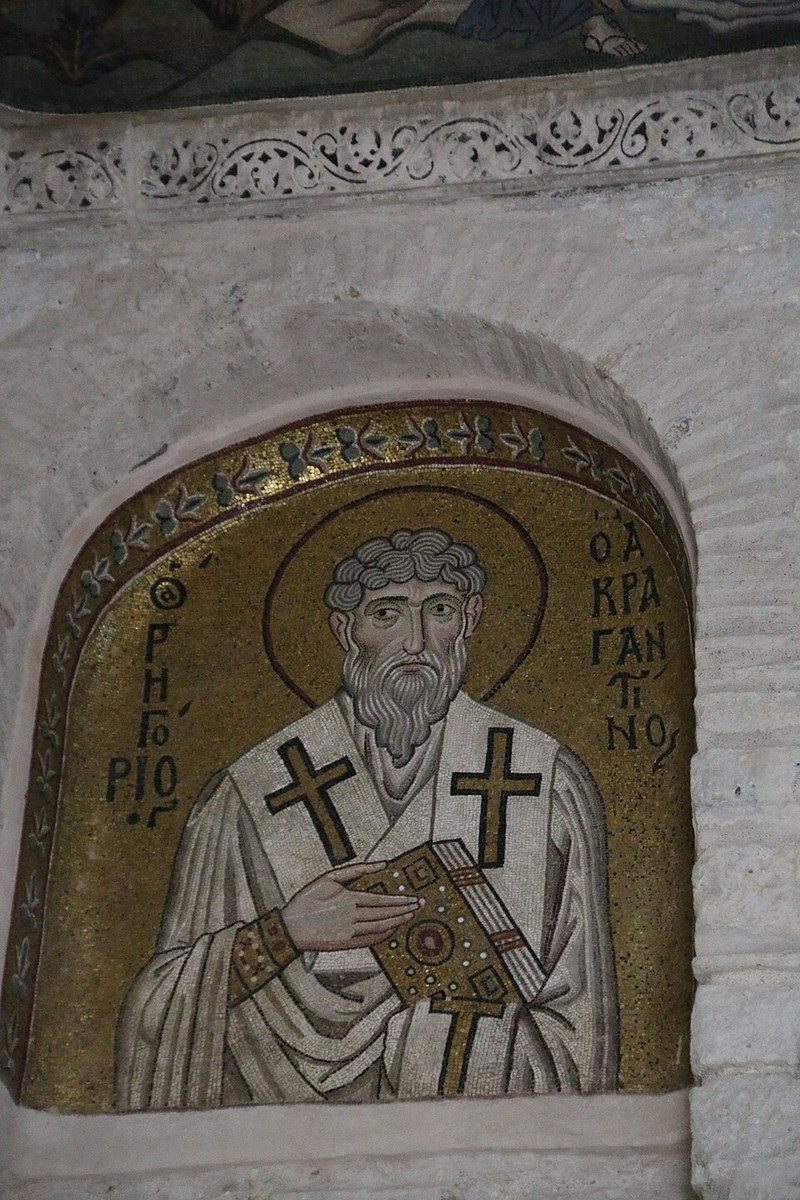
Gregory is shown as a bishop in phelonion and omophorion, holding the Gospel and blessing, with a dark, moderately long beard; his notices pair him with Amphilochius. The stored image is his portrait from the celebrated mosaic programme of the Daphni Monastery near Athens (c. 1100), where he stands in the company of the other holy Gregories — his identity fixed by the mosaic's inscription.
Disputed questions
- Dating. The Life entangles reigns and councils that cannot all be reconciled — it names the Jerusalem patriarch Macarius (563–574), the Constantinopolitan patriarch Eutychius (552–565) and the Fifth Council (553), yet also seems to presuppose later circumstances. Scholars accordingly place Gregory's floruit variously in the later sixth century (the dating followed here, with repose about 592) or as late as the seventh; the chronology of his biography is frankly legendary in parts.
- Not to be confused with the other bishop-saints named Gregory — Gregory the Theologian (Nazianzus), Gregory of Nyssa, Gregory the Wonderworker of Neocaesarea (November 17), and Gregory of Decapolis. In Byzantine monumental art Gregory of Agrigentum is regularly ranged among these Gregories (as in the Daphni mosaics), which makes secure identification of his portraits a matter of reading the inscriptions.