
Gregory Palamas
Our Father among the Saints Gregory Palamas, Archbishop of Thessalonica
Bishop · Wonderworker · b. c. 1296, Constantinople — d. November 14, 1359, at Thessalonica
Commemorated 14 November — Repose at Thessalonica, Second Sunday of Great Lent — the Sunday of Saint Gregory Palamas, a second Sunday of Orthodoxy
Gregory Palamas (c. 1296–1359), Archbishop of Thessalonica, is the great theologian of the Orthodox spiritual tradition and the defender of the hesychasts — the monks of Mount Athos who, in stillness and unceasing prayer, were granted to behold the uncreated light of God. When the Calabrian philosopher Barlaam derided their experience and denied that the divine light was anything but a created symbol, Gregory answered with the distinction that would become dogma: God is utterly unknowable in his essence, yet truly known and truly partaken in his uncreated energies — the same grace and glory that shone from Christ on Tabor and dwells in the saints. His theology was vindicated by a succession of councils at Constantinople, definitively in 1351, and the Church honours him twice: on November 14, the day of his repose, and on the Second Sunday of Great Lent, where his triumph stands as a "second Sunday of Orthodoxy." He is one of several saints named Gregory, to be distinguished from Gregory the Illuminator of Armenia (September 30), and from the Theologian, the Dialogist, and Gregory of Nyssa.
.jpg)
Origins and early life
Gregory was born about the year 1296 at Constantinople, into a noble family of the imperial service; his father Constantine was a senator and confidant of the emperor Andronikos II Palaiologos, who himself undertook the boy's education after the father's early death and entry into monasticism. Gregory was schooled in the imperial court and in the philosophy of the day — his mastery of Aristotle, displayed in a set exercise before the court, drew from his teacher, the Grand Logothete Theodore Metochites, the judgment that Aristotle himself, had he been present, would have praised him. But the honours of the world did not hold him. About the age of twenty, having persuaded his mother, his brothers, and his sisters to embrace the monastic life with him, he left the capital for Mount Athos.
Ascetic struggle on Athos
On the Holy Mountain Gregory placed himself under the elder Nicodemus at the monastery of Vatopedi, and after his death entered the Great Lavra of Saint Athanasius; later he withdrew to the more solitary skete of Glossia and, when Turkish raids made the coast unsafe, to Thessalonica, where he was ordained priest, and to a hermitage near Beroea, and back again to Athos. Through these years he gave himself wholly to hesychia — the sacred stillness of the heart in which the monk, gathering the mind within the body and calling ceaselessly on the name of Jesus, is purified and made ready to receive the illumination of grace. This was the ancient tradition of the desert renewed on Athos in his generation, and Gregory lived it before he ever defended it in writing: the hymns of his feast praise him first not as controversialist but as one who had himself become "a vessel of the light."
The controversy with Barlaam and the defence of the light
About 1330 there came from Calabria in the Byzantine south of Italy a learned monk, Barlaam, who won a name at Constantinople as a philosopher. Drawn into the disputes between the Greek and Latin churches, Barlaam argued that God is in principle unknowable, so that no theology can claim more than probability; and, coming to hear of the hesychasts' method of prayer and their claim to behold the divine light with the eyes of the purified, he ridiculed them as omphalopsychoi — "men with their souls in their navels" — and pronounced the light they saw a mere created phenomenon, a symbol at best, at worst a delusion.
Gregory answered in the great work known as the Triads — In Defence of the Holy Hesychasts — and in the Hagioritic Tome of 1340, which the elders of Athos signed as their common confession. His reply rested on a distinction already implicit in the Fathers, which he now drew out with full clarity: in God one must distinguish the essence (οὐσία), which is wholly transcendent and imparticipable, from the energies (ἐνέργειαι), the uncreated operations by which God goes forth, is known, and is truly shared. The light that shone from Christ on Mount Tabor, the glory that filled Moses and the prophets, the grace that deifies the saints — these are not created things standing between God and the creature, but God himself in his energies, truly God though not his essence. Thus the vision of the hesychasts is neither a created spectacle nor an impossible sight of the divine essence, but a real participation, granted to the pure, in the uncreated light of the Godhead. On this rests the whole Orthodox doctrine of theosis, that the human person is called to become "partaker of the divine nature" (2 Peter 1:4) by grace.
The Palamite councils
The dispute was tried before the Church in a series of councils at Constantinople. In June 1341 a council in Hagia Sophia condemned Barlaam, who submitted and soon returned to Italy and the Roman obedience. The controversy was carried on by others — Gregory Akindynos and later the historian and philosopher Nikephoros Gregoras — and it became fatally entangled in the civil war between the regency of the boy-emperor John V and the general John VI Kantakouzenos. In these years Gregory suffered for his teaching: the anti-Palamite patriarch John Kalekas excommunicated and imprisoned him. But the councils of 1347 and, decisively, of 1351 vindicated him in full, defining the essence–energies distinction as the faith of the Church and anathematizing its deniers — a definition afterwards written into the Synodikon of Orthodoxy read on the First Sunday of Lent.
Archbishop of Thessalonica; captivity among the Turks
In 1347 Gregory was consecrated Archbishop of Thessalonica. The city was then in the hands of the radical Zealot party and closed to him, so that he could not take up his see until about 1350; thereafter he shepherded it as a preacher of rare power, and a great body of his homilies survives. About 1354, sailing to Constantinople, he was captured by the Ottoman Turks and held for something near a year in Asia Minor, awaiting ransom. He turned even this to account: his letters from captivity record his conversations — courteous and unflinching — with Muslim scholars and with the sons of the emir, an early and remarkable Christian witness under Islam. Ransomed at last, he returned to Thessalonica.
Repose and glorification
Gregory reposed at Thessalonica on November 14 — the year given as 1359 in the common reckoning (some sources, including the Russian synaxaria, give 1357; the point is unsettled). His last recorded words, and the refrain of his dying, were "To the heights! To the heights!" Miracles of healing were soon reported at his tomb, and only nine years after his death, in 1368, the Church of Constantinople under his disciple Patriarch Philotheos Kokkinos proclaimed his sanctity, composed his Life and his service, and appointed his commemoration on the Second Sunday of Great Lent — so that the vindication of his theology might stand, week upon the Sunday of Orthodoxy, as a second triumph of the true faith.
Feast and commemoration
Gregory is commemorated on two days. His fixed feast is November 14 (church date; Old Calendar civil November 27), the day of his repose, kept with a full proper service. His great commemoration, however, is movable: on the Second Sunday of Great Lent — the rule 35 days before Pascha (thirty-five days before Pascha) — the whole Church keeps the "Sunday of Saint Gregory Palamas," placed by Patriarch Philotheos immediately after the Sunday of Orthodoxy as a continuation and confirmation of it, the Church's public thanksgiving for the vindication of the hesychast faith. The Lenten propers of that Sunday, in the Triodion, are the fuller service; the fixed November feast shares much of the same hymnography. Because his principal solemn celebration is the movable one, the fixed November 14 feast is here ranked primary only as the day of his repose, and the deviation is noted.
Hymns
Troparion — Tone 8
O luminary of Orthodoxy, support and teacher of the Church, adornment of monastics, invincible champion of theologians, O Gregory the Wonderworker, boast of Thessalonica, herald of grace: ever intercede that our souls be saved.
Original translation from the Greek
Kontakion — Tone 8
The holy and divine instrument of wisdom, the clear-sounding trumpet of theology, we hymn thee with one accord, O God-inspired Gregory. But as a mind that stands before the primal Mind, guide our mind unto Him, O father, that we may cry: Rejoice, O herald of grace.
Original translation from the Greek
Iconography
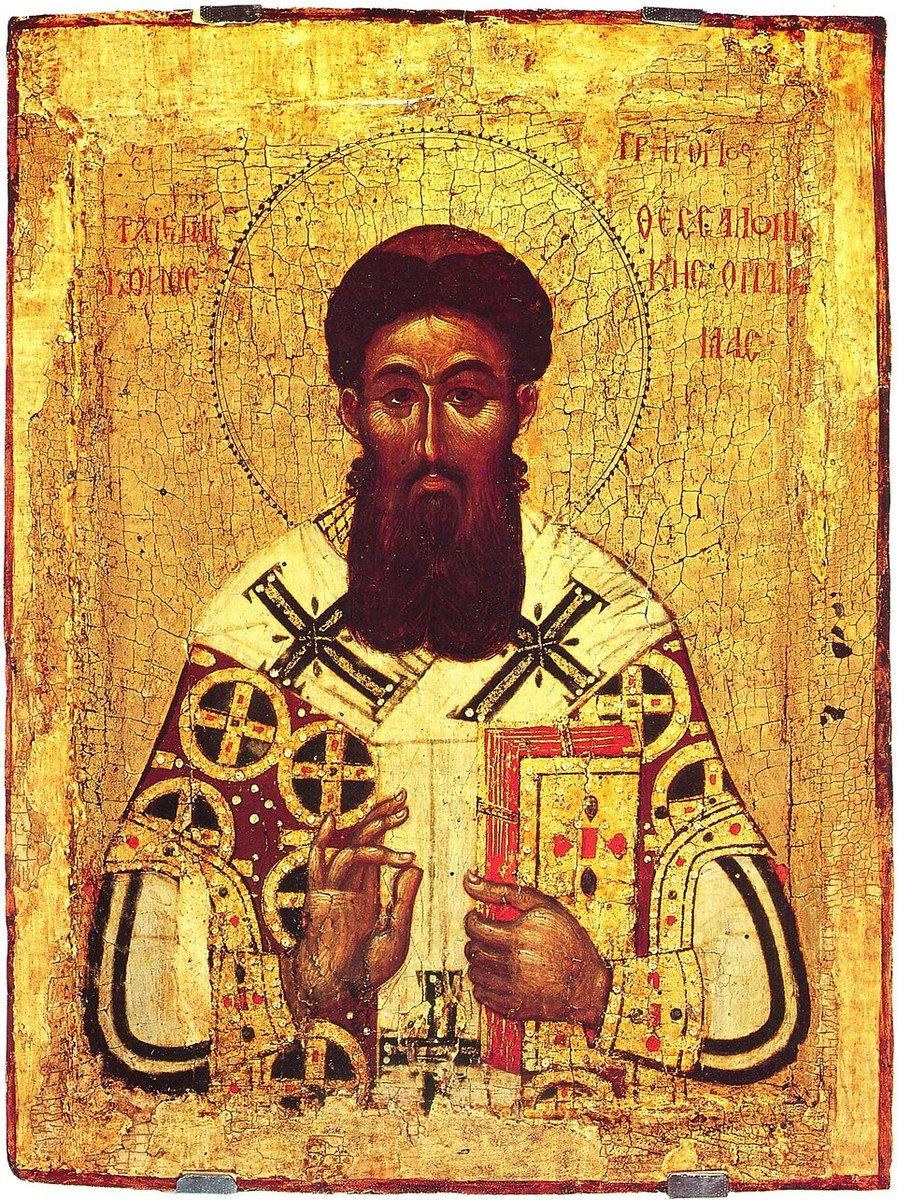
Gregory is depicted as an archbishop in the prime of maturity, vested in the sakkos and omophorion of a hierarch and often the domed mitre, blessing with the right hand and holding the Gospel book in the left; his beard is dark and rounded, his brow high. Where the icon means to name his theology, rays of uncreated light descend upon him or issue from a scroll bearing the words of his defence of the divine energies. The stored image is a North Greek icon of the fifteenth century, now in the Pushkin Museum in Moscow: the Archbishop half-length against an ochre ground, in cross-patterned polystavrion vestments, raising his hand in blessing over the book — one of the earliest surviving portrait icons of the saint, painted within a century of his glorification.