
Gregory the Illuminator
The Holy Hieromartyr Gregory, Bishop of Greater Armenia, Equal of the Apostles and Enlightener of Armenia
Equal to the Apostles · Confessor · Bishop · b. c. 257 — d. c. 331
Commemorated 30 September — Principal Byzantine commemoration
Gregory the Illuminator (c. 257 – c. 331) was the apostle of Armenia: a Parthian noble of the Arsacid line who, after enduring torture and some thirteen years' imprisonment in the pit of Khor Virap under King Tiridates III, healed the afflicted king, converted him, and led the Armenian nation to baptism around 301 — by the traditional reckoning the first kingdom on earth to embrace Christianity as a state. Consecrated bishop at Caesarea in Cappadocia, he became the first Catholicos of the Armenians, founded the cathedral of Etchmiadzin at the place of his celebrated vision of Christ descending, and ended his life as a hermit. The Byzantine calendar styles him hieromartyr for his sufferings, though he reposed in peace; he is commemorated on September 30.

Origins and the blood-feud
Gregory was born about 257, of the Parthian house of the Arsacids — the dynasty that then reigned, in separate branches, over both Persia and Armenia. His father Anak, a Parthian grandee, was induced (the Armenian tradition says by the new Sassanid masters of Persia, who had overthrown the Arsacids there and feared their Armenian kinsmen) to assassinate his own relative the king of Armenia — Khosrov I in the Armenian sources, "Kursar" in the Greek and Slavonic accounts. Anak struck the king down and fled, but was overtaken at a river crossing and killed with his brother; the dying king had ordered the extermination of the assassin's whole family. Two infant sons alone were saved: one was carried into Persia, and Gregory was rescued by kinsfolk — the tradition names his nurse, a Christian woman of Caesarea — and brought up in Caesarea of Cappadocia, where he was instructed in the Christian faith and baptised. The murdered king's son Tiridates (Trdat) was likewise carried to safety, into Roman territory: the two heirs of the blood-feud thus grew up, unknown to each other, in the same empire.
In Caesarea Gregory married Mariam, a Christian of Cappadocia, and had two sons; the marriage was dissolved by mutual consent for the ascetic life after the second son's birth. The elder, Vrtanes (the "Orthanes" of the Greek account), was ordained priest and would himself in time hold his father's see; the younger, Aristakes ("Arostanes"), became a monk and hermit, was later made bishop, and sat among the 318 fathers of the Council of Nicaea in 325.
Service to Tiridates and confession
Learning whose son he was, Gregory resolved to expiate his father's crime by serving the murdered man's heir. He attached himself, without disclosing his parentage, to Tiridates, then an officer in the Roman service, and served him faithfully. The Greek account relates that when the Goths pressed the empire, Tiridates took the emperor's place in single combat against their champion and carried him off captive, and that the grateful emperor — the Roman restoration of Tiridates to his father's throne is dated about 287 — established him as king of Armenia.
Restored to his kingdom, Tiridates offered sacrifice to the gods of Armenia — the national cult of the goddess Anahit above all — and required his faithful servant to join him. Gregory refused, confessing Christ. Enraged, and then further inflamed by the disclosure that his servant was the son of his father's murderer, Tiridates subjected him to a long series of tortures, which the Armenian tradition counts as twelve: he was hung head downward with a stone at his neck, choked with foul smoke, beaten, mocked, and made to walk in iron boots set with nails, and molten tin was poured over him; through all of it, the Lives relate, he sang the Psalms, and his wounds were healed in prison.
The pit of Khor Virap
When torture failed, Tiridates ordered Gregory thrown into the deep pit of the royal fortress-prison at Artashat — a dungeon for the condemned, filled, say the Lives, with serpents, scorpions and the bones of the dead. There he remained some thirteen years (the sources vary between thirteen, fourteen and fifteen), kept alive by a widow of the city who, bidden in a dream, lowered bread to him secretly, and strengthened, the tradition relates, by an angel of God. All this while he was believed dead. The place — Khor Virap, "the deep pit" — later became one of the great monastic shrines of Armenia, standing in the Ararat plain over the dungeon itself.
The virgin-martyrs and the king's affliction
Toward the year 300 the crisis came, through the martyrdom of Ripsimia, Gaiana and the virgin-martyrs of Armenia — consecrated virgins who had fled the emperor Diocletian's attentions to Vagharshapat, whom Tiridates in turn desired, and whom he put to death with atrocious tortures when Ripsimia resisted him. Days after the executions the king was struck with a degrading madness: the sources describe him and his companions in the crime as changed into the likeness of wild boars, after the pattern of Nebuchadnezzar, ranging the woods, tearing their clothing and devouring their own flesh. The king's sister Khosrovidukht saw in repeated dreams that only Gregory, forgotten in the pit, could heal him. Though it seemed impossible that he lived, a cord was let down into Khor Virap, and Gregory was drawn up alive — blackened, the Armenian account says, but whole.
Gregory's first act was to ask after the bodies of the martyred virgins, which had lain unburied for nine days; he buried them with honour, and over their graves the first martyria of Christian Armenia were raised. Then, after a long catechesis — the Armenian tradition tells of sixty-six days of preaching and fasting — he prayed over the king and his company, and Tiridates was healed, repenting before the relics of the women he had slain.
The conversion of Armenia
King, court and army embraced Christ, and the conversion of the nation followed with royal thoroughness: the temples of Anahit, Aramazd, Vahagn and Mihr were pulled down or converted, their estates given to the Church, and the people baptised — the tradition sets the baptism of the king and people in the waters of the Aratsani (Arsanias), the eastern Euphrates. The traditional date of the kingdom's conversion is 301, which Armenian tradition has always held to make Armenia the first Christian nation, preceding Constantine's Edict of Milan; a considerable body of modern scholarship, working back from the regnal years of Tiridates and the date of Gregory's consecration, argues instead for about 314, immediately after the peace of the Church in the Roman empire. Both datings are defended in the literature; the priority of Armenia's national conversion is not in serious dispute on either reckoning (see Disputed questions).
The vision of Etchmiadzin
At Vagharshapat Gregory beheld the vision from which the mother church of Armenia takes its name: Christ descending from heaven in light, striking the ground with a golden hammer at the place where the cathedral was to rise. The church there — Etchmiadzin, "the Only-Begotten descended" — was founded by Gregory and Tiridates together, and remains the see of the Catholicos of All Armenians. The vision, recounted at length in Agathangelos, fixed the sacred topography of the new Christian kingdom: the cathedral at the place of the descent, and the martyria of Ripsimia, Gaiana and their companions at the places of their deaths around it.
Consecration at Caesarea and the ordering of the Church
To receive episcopal orders Gregory travelled in state to Caesarea in Cappadocia, where he was consecrated bishop of Armenia by Archbishop Leontius with a synod of bishops — the mother-church relationship with Caesarea remained a mark of the Armenian hierarchy for generations, its chief bishops long travelling there for consecration. Returning, he baptised, built, ordained and organised on a national scale: the Lives credit him with ordaining bishops and priests throughout the land, founding schools for the children of the pagan priestly families so that the old cult's hereditary clergy became the seedbed of the new Church's, establishing monasteries, and carrying the mission beyond Armenia proper into the Caucasus — the enlightenment of Georgia by Nina and of Caucasian Albania belongs to the same generation, and the sources link the missions.
As first Catholicos of the Armenians Gregory also founded a line: the catholicate remained for several generations effectively hereditary in his family — his son Aristakes succeeded him, then Vrtanes, then Vrtanes's son Husik, and later his great-great-grandson Nerses the Great, down to Sahak the Great (†439), the last catholicos of the Illuminator's male line. This hereditary succession, without parallel in the Greek churches, the Armenian historians themselves record plainly.
Repose
His work established, Gregory consecrated his son Aristakes to the active government of the Church and withdrew from public life into ascetic solitude — the tradition places his last years in the cave of Mane on Mount Sepuh in the province of Daranali. There he reposed in peace about 331 (the sources range between about 325 and 337; the Russian calendar prints c. 335). The Lives relate that shepherds found the hermit's body, not knowing whose it was, and buried it; his relics were later recognised and enshrined at Thordan.
Relics and translations
The relics of the Illuminator were distributed widely and their history is long. The right hand, the most venerated relic, is kept at Holy Etchmiadzin, where the Catholicos of All Armenians uses it in the consecration of the holy myron (chrism) to this day; a left hand is kept by the Catholicosate of Cilicia at Antelias, so that both branches of the Armenian hierarchy trace their sanctification physically to the Illuminator's hand. Portions of the relics travelled to Constantinople, and a major portion — with a tradition of translation during the iconoclast troubles — came to rest at Naples, where it was kept for centuries in the convent of San Gregorio Armeno; in the year 2000 relics from Naples were solemnly given to the Armenian Church for the newly built cathedral of Saint Gregory the Illuminator in Yerevan. The Byzantine sources also record relics of the saint venerated in Constantinople.
Veneration and later cultus
Gregory's veneration is universal across the Christian East and West. The Armenian Apostolic Church, which honours him as its patron and "our Holy Father," keeps several feasts in his honour in its movable cycle — commemorating separately his entry into the pit, his deliverance from it, and the discovery of his relics. The Byzantine rite keeps September 30, with a full Menaion service; the canon of the day, ascribed to Joseph the Hymnographer, plays throughout on the saint's name (γρηγορέω, "to watch"): "the watchful shepherd" is its refrain. The Roman church commemorates him on October 1 in the older martyrologies. In Russia his veneration was early and his September feast entered the calendar with the Byzantine inheritance; the cathedral of the Intercession on Red Square (Saint Basil's) includes a chapel dedicated to him, since the capture of Kazan in 1552 fell on his feast.
Hymnographic and literary legacy
The primary account of Gregory is the History of the Armenians of Agathangelos, written in the fifth century in the name of a secretary of King Tiridates: it contains the narrative of the blood-feud, the tortures, the pit, the martyrdoms, the king's affliction and healing, the vision of Etchmiadzin, and the long catechetical discourse known as the Teaching of Saint Gregory. The work was translated early into Greek, and thence the saint's Life passed to the Byzantine synaxaria and the Greek Menaion; Symeon Metaphrastes included a redaction in his menologion. Movses Khorenatsi and the other classical Armenian historians supplement the record. A body of homilies (the Hachakhapatum) is transmitted under Gregory's name, though its attribution is debated; the Teaching embedded in Agathangelos is the foundational document of Armenian catechesis.
Feast and commemoration
September 30 (church date; Old Calendar civil October 13) is the saint's one feast in the Byzantine rite, kept universally; the Menaion service of the day is his, with the virgin-martyrs Ripsimia and Gaiana commemorated within it. The Greek books head the day "the holy Hieromartyr Gregory of Great Armenia"; the OCA adds "Equal of the Apostles and Enlightener of Armenia"; the Russian calendar styles him священномученик and dates his repose c. 335 (see Disputed questions on both points). The Armenian Apostolic Church honours its apostle on several days of its own movable cycle rather than on the Byzantine date. The Roman church keeps him on October 1 in the older martyrologies.
Hymns
Troparion — Tone 4
Sharer of the ways and successor to the throne of the apostles, divinely inspired one, thou didst find thy deeds a ladder to divine vision; wherefore, rightly dividing the word of truth, thou didst suffer for the faith even unto blood. O hieromartyr Gregory, entreat Christ God that our souls may be saved.
Original translation from the Greek
Kontakion — Tone 2
Come, ye faithful, let us all today with divine songs and hymns praise the glorious hierarch Gregory as a contender for the truth: the watchful shepherd and teacher, the luminary of the whole world; for he intercedes with Christ God that we may be saved.
Original translation from the Greek
Appointed readings
Epistle — 1 Corinthians 16:13–24
13Watch ye, stand fast in the faith, quit you like men, be strong. 14Let all your things be done with charity. 15I beseech you, brethren, (ye know the house of Stephanas, that it is the firstfruits of Achaia, and that they have addicted themselves to the ministry of the saints,) 16That ye submit yourselves unto such, and to every one that helpeth with us, and laboureth. 17I am glad of the coming of Stephanas and Fortunatus and Achaicus: for that which was lacking on your part they have supplied. 18For they have refreshed my spirit and yours: therefore acknowledge ye them that are such. 19The churches of Asia salute you. Aquila and Priscilla salute you much in the Lord, with the church that is in their house. 20All the brethren greet you. Greet ye one another with an holy kiss. 21The salutation of me Paul with mine own hand. 22If any man love not the Lord Jesus Christ, let him be Anathema Maranatha. 23The grace of our Lord Jesus Christ be with you. 24My love be with you all in Christ Jesus. Amen.
Gospel — Matthew 24:42–47
42Watch therefore: for ye know not what hour your Lord doth come. 43But know this, that if the goodman of the house had known in what watch the thief would come, he would have watched, and would not have suffered his house to be broken up. 44Therefore be ye also ready: for in such an hour as ye think not the Son of man cometh. 45Who then is a faithful and wise servant, whom his lord hath made ruler over his household, to give them meat in due season? 46Blessed is that servant, whom his lord when he cometh shall find so doing. 47Verily I say unto you, That he shall make him ruler over all his goods.
Iconography
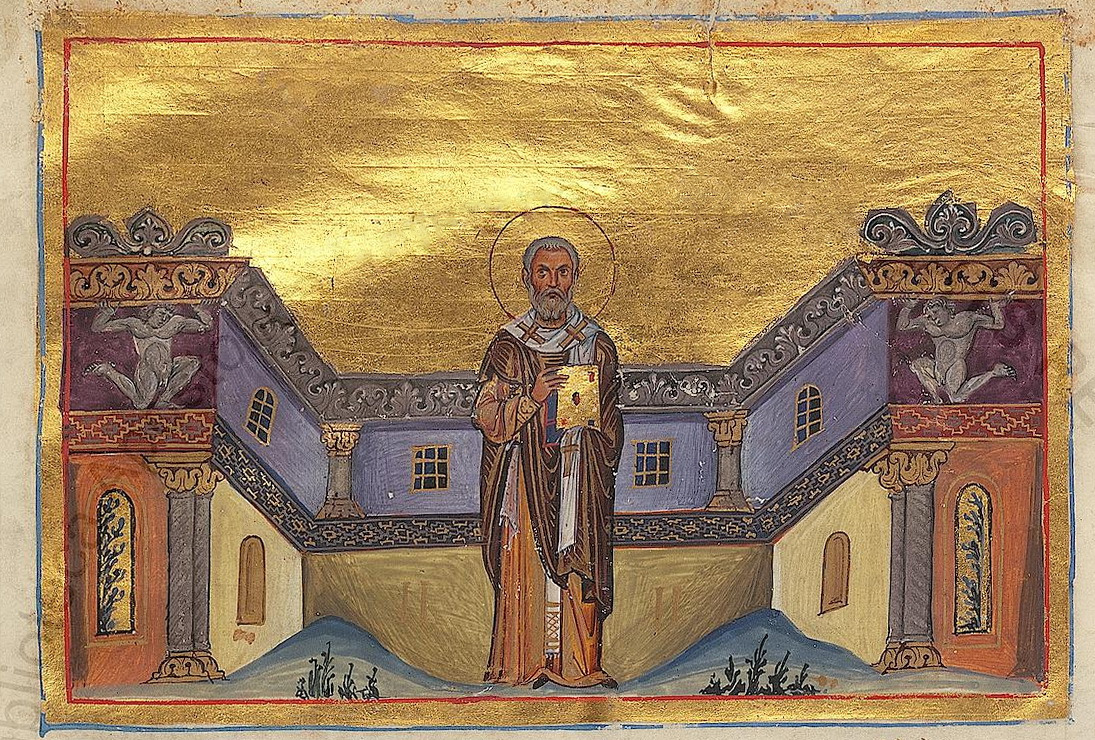
Gregory is depicted as a hierarch, in phelonion and omophorion, holding the Gospel book and blessing — iconographically the peer of the great bishop-saints, distinguished by inscription and often by the darker, ascetic cast of his features after the years in the pit. Armenian art adds narrative scenes without parallel in the Greek repertoire: the tortures, the pit of Khor Virap with the widow lowering bread, the baptism of Tiridates (sometimes shown boar-headed before his healing), and the vision of Etchmiadzin. The stored image is the miniature for September 30 from the Menologion of Basil II (Constantinople, c. 1000; Vat. gr. 1613, fol. 74), showing the saint standing in episcopal vestments before a golden architectural ground.
Disputed questions
- "Hieromartyr," though he did not die a martyr. The Greek Menaion, the Synaxarion of Constantinople, the Slavic books and the OCA all style Gregory hieromartyr (Ἱερομάρτυς, Сщмч.), and his troparion is the common hieromartyr text "thou didst suffer for the faith even unto blood." Yet every source of his Life — Agathangelos first — records that he survived his tortures and the pit, converted his persecutor, and reposed in peace as a hermit decades later. The styling rests on his sufferings and long imprisonment for the faith, which are precisely the definition of a confessor; the parallel case in this collection is Cornelius the Centurion (September 13), likewise styled hieromartyr by many calendars though the received Life ends in a peaceful repose. Following that precedent, this entry classifies Gregory as equal-to-the-apostles (the OCA's own title, and the plain sense of his work as the apostle of a nation), confessor, and bishop, and records the calendars' hieromartyr usage here rather than silently adopting or correcting it.
- 301 or 314. The traditional Armenian date of the conversion of Tiridates and the kingdom is 301 (some older reckonings 300 or 302). Much modern scholarship prefers c. 314, on the argument that Tiridates's restoration is to be dated c. 298–299 and that a royal conversion is most intelligible after Rome's peace with the Church in 313; the tercentenary tradition of 301 remains the Armenian Church's official chronology. Both dates are recorded here; the entry's narrative dates ("c. 300," "c. 301") follow the traditional chronology that the hagiographic sources presuppose.
- Chronology of the life. Birth c. 257 and repose c. 331 are the conventional dates (OCA gives 257 for the birth; the Russian calendar prints c. 335 for the repose; scholarly reconstructions of the consecration at Caesarea range from c. 302 to c. 314). The length of the imprisonment is given as thirteen years in Agathangelos, fourteen in the Greek and Slavonic accounts, and fifteen in parts of the Armenian tradition.
- The sources. Agathangelos's History is hagiography written some five generations after the events, and its miracles and speeches are shaped by its catechetical purpose; the underlying facts — the conversion of Tiridates through Gregory, the consecration at Caesarea, the destruction of the temples, the hereditary catholicate — are corroborated by the wider Armenian historical tradition and by the appearance of Aristakes at Nicaea in 325.
- Not to be confused with the many other great Gregories of the calendar: Gregory the Theologian (January 25), Gregory of Nyssa (January 10), Gregory Thaumaturgus of Neocaesarea (November 17), Gregory Palamas (November 14) — nor with his companion of this same day in the Russian books, the venerable Gregory of Pelshema (†1442).