
Habakkuk the Prophet
The Holy Prophet Habakkuk
Prophet · b. 7th century BC — d. 7th–6th century BC
Commemorated 2 December
Habakkuk is the eighth of the Twelve Minor Prophets, who prophesied in the kingdom of Judah in the last decades before the Babylonian captivity. His short book of three chapters wrestles, more openly than any other, with the problem of divine justice — why God should use the wicked Chaldeans to chastise his own people — and answers it with the words that Saint Paul would make a pillar of the Gospel: "the just shall live by his faith" (Habakkuk 2:4). His third chapter, the "prayer of Habakkuk" — "O Lord, I have heard thy report, and was afraid" — is the fourth of the Church's biblical canticles, sung as the fourth ode of every canon, and its vision of God coming forth "from the South" is read as a prophecy of the Incarnation. Tradition adds the marvel, from the Greek additions to Daniel, of the angel who carried him by the hair to feed Daniel in the lions' den. He is not to be confused with Habakkuk the New Martyr, who bore the same name in its Greek form (Ἀββακούμ) and suffered at Thessalonica in 1628 (August 6).
.jpg)
The prophet and his book
Habakkuk (in Greek Ἀμβακούμ, Ambakoum) stands eighth among the Minor Prophets in the reckoning of the Church. The ancient Lives of the Prophets attributed to Epiphanius makes him of the tribe of Simeon, from the district of Beth-zocher, and the calendars follow this. Unlike the other prophets, his book gives no date and names no king; but its whole burden — that God is raising up "the Chaldeans, that bitter and hasty nation" (Habakkuk 1:6) as the rod of his anger — places him in the last decades of the seventh century before Christ, in the years when Babylon had become the terror of the nations and Judah stood on the edge of the captivity that fell in 587. He is thus a younger contemporary of Jeremiah and Zephaniah, at the very close of the age of the writing prophets. The Orthodox service books, following the older synaxaria, place his activity "around 650 years before Christ."
The Book of Habakkuk is unlike the other prophetic books in form: it is not a collection of oracles addressed to the people but a dialogue between the prophet and God. In the first chapter Habakkuk lays before God the scandal of unpunished violence — "O Lord, how long shall I cry, and thou wilt not hear?… why dost thou show me iniquity?" — and receives the shattering answer that God is sending the Chaldeans. This only sharpens the question: how can the All-Holy use a nation "more righteous than they" only in appearance, and yet more wicked, to swallow up his own? In the second chapter the prophet takes his stand to wait for God's reply: "I will stand upon my watch, and set me upon the tower, and will watch to see what he will say unto me" (Habakkuk 2:1). The answer comes as a command to write the vision plainly, "that he may run that readeth it," and with it the distinction on which the whole book turns: the soul lifted up is not upright, "but the just shall live by his faith" (Habakkuk 2:4). There follow the five "woes" against the plunderer, the drunkard and the idolater, closing with the great silence: "the Lord is in his holy temple: let all the earth keep silence before him" (Habakkuk 2:20).
The prayer of Habakkuk (chapter 3)
The third chapter stands apart, marked in the Hebrew as "a prayer of Habakkuk the prophet, upon Shigionoth," with musical notes appended — evidence that it was sung in the Temple. It is a theophany: the prophet, having heard God's word, is seized with awe and beholds the Lord advancing to save his people and to break the head of the wicked. "O Lord, I have heard thy report, and was afraid: O Lord, consider thy works: in the midst of two living creatures shalt thou be known… God shall come from Teman, and the Holy One from the shady, thickly-wooded mountain" (Habakkuk 3:2–3, in the Septuagint the Church reads). The vision moves through the convulsions of the whole creation — the mountains scattered, the everlasting hills bowing, the sun and moon standing still — to the confession that even should the fig tree not blossom and the fields yield no food, "yet I will rejoice in the Lord, I will joy in the God of my salvation."
This canticle became the fourth of the nine biblical odes appointed at Matins, and so, like Jonah's prayer in the sixth ode, Habakkuk is carried within the daily prayer of the Church: the fourth ode of every canon ever composed is modelled on his cry, and the katavasiae of the great feasts for Ode 4 take up his imagery. The Fathers read his opening lines as prophecy fulfilled at Christ's birth. The phrase "in the midst of two living creatures shalt thou be known" was seen as the ox and the ass at the manger, or the two Testaments, or the two thieves; and "God shall come from Teman" — Teman, Θαιμάν, being the South — was read as the coming forth of God from the Virgin, so that the Nativity troparia and the very kontakion of the prophet name Habakkuk as one who foretold "the coming of God from the South, from the Virgin." His feast on December 2, within the Nativity Fast, is thus set among the forefeast prophets who prepare the Church for Christmas.
"The just shall live by his faith"
No single verse of the Minor Prophets has weighed more in Christian theology than Habakkuk 2:4. Saint Paul quotes it three times to establish that a man is justified before God not by the works of the Law but by faith — in the programmatic statement of Romans ("The just shall live by faith," Romans 1:17), in Galatians 3:11, and, with the following clause, in Hebrews 10:38. Through Paul the words of the Judean prophet became a foundation of the doctrine of justification, and in the sixteenth century the same verse stood at the centre of the Western Reformation's debates. The Orthodox tradition reads the phrase in its fuller sense — a faithfulness that is trust, endurance and fidelity, the righteous man's steadfast clinging to God through the long darkness before deliverance, which is exactly Habakkuk's own situation as he waits upon his watchtower.
Habakkuk and Daniel in the den
To the canonical book the tradition joins the episode preserved in the Greek additions to Daniel — the story of Bel and the Dragon, numbered as the fourteenth chapter of Daniel in the Septuagint and the Church's Bible (Daniel 14:33–39). While Daniel lay a second time in the lions' den in Babylon, Habakkuk was in Judea, carrying a bowl of pottage and bread to the reapers in the field. An angel of the Lord commanded him to take the meal to Daniel; and when the prophet said he knew neither Babylon nor the den, the angel took him by the crown of his head and, by the wind of his spirit, set him down over the den in Babylon. Habakkuk called out, "Daniel, Daniel, take the dinner which God hath sent thee," and Daniel ate and gave thanks, and the angel set Habakkuk back at once in his own place. This scene — the prophet lifted through the air by the angel, the bowl of food in his hands — is one of the most frequently depicted in Byzantine art, and the calendars regularly recall it in their notices of his day.
Repose and relics
Tradition has Habakkuk return home after the Babylonian danger had passed and die at a great old age, buried in his own country — the Lives of the Prophets names his native district. His relics, together with those of the Prophet Micah of Moresheth (August 14), were made known by revelation in the region of Eleutheropolis in Palestine: the older account, in the church historian Sozomen, places the finding in the episcopate of Zebennus toward the end of the fourth century, while the service books recall it under the emperor Theodosius the Younger (408–450) — the two datings are recorded here without harmonising them.
Feast and commemoration
Habakkuk is commemorated on December 2 (Old Calendar civil December 15), within the Nativity Fast, among the prophets whose Advent commemorations prepare the Church for the Nativity of Christ. His feast is universal to the Byzantine rite. His book supplies the third of the Old Testament prophecies read at the Royal Hours and Vespers of certain feasts, and above all his canticle grounds the fourth ode of the canon throughout the year.
Hymns
Troparion — Tone 2
Celebrating the memory of thy prophet Habakkuk, O Lord, through him we entreat thee: save our souls.
Original translation from the Greek
Kontakion — Tone 8
Having become an eloquent herald of God, O Habakkuk, thou didst foretell to the world the coming forth of God from the South, from the Virgin; and standing upon thy divine watchtower, thou didst receive from the radiant angel the tidings of the Resurrection of Christ. Therefore with gladness we cry to thee: Rejoice, O shining boast of the prophets.
Original translation from the Greek
Iconography
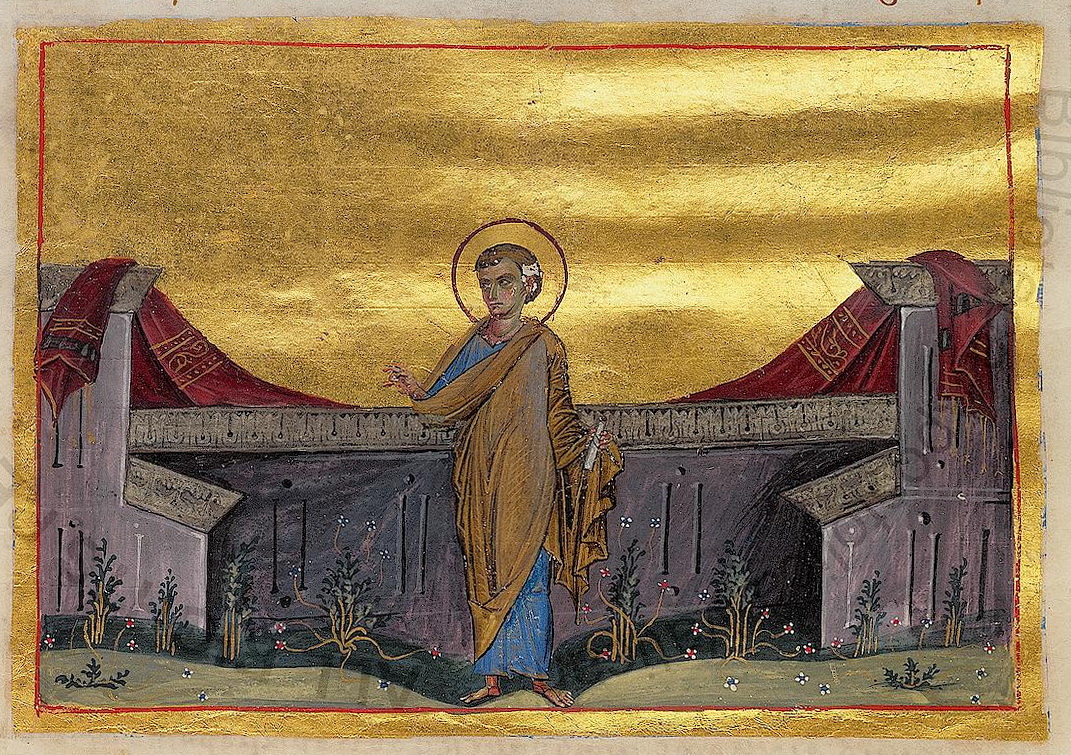
Habakkuk is depicted in two principal ways. In the prophet rows of the iconostasis and in Deesis compositions he stands as one of the Twelve, holding a scroll inscribed with a verse of his prophecy — often "God shall come from Teman" or "O Lord, I have heard thy report" — and is shown sometimes as a youthful, beardless figure (as in the earliest Byzantine art) and sometimes, in the later Slavic tradition, as a middle-aged man with a short dark beard. The second type is narrative: the angel carrying him aloft by the hair, the bowl of food in his hands, above Daniel among the lions. The stored image is the miniature of the Menologion of Basil II (Constantinople, c. 985), which shows the prophet as a young man standing before a walled enclosure hung with cloths, against a ground of gold.