
Micah of Moresheth
The Holy Prophet Micah the Morasthite
Prophet · b. 8th century BC, at Moresheth-Gath in Judah — d. late 8th or early 7th century BC
Commemorated 14 August — Memory of the prophet, kept on the last day of the Dormition fast and the Forefeast of the Dormition
Micah of Moresheth is the sixth of the Twelve Minor Prophets, a Judean countryman from the Shephelah who prophesied at Jerusalem in the last third of the eighth century before Christ, a contemporary of Isaiah, Hosea and Amos, under the kings Jotham, Ahaz and Hezekiah. His seven short chapters hold two sayings that the whole Church knows by heart: the demand that reduces all religion to its root — "He hath shewed thee, O man, what is good; and what doth the Lord require of thee, but to do justly, and to love mercy, and to walk humbly with thy God" (Micah 6:8) — and the prophecy that named the birthplace of the Messiah centuries before the event: "And thou, Bethlehem Ephratha… out of thee shall come forth unto me he that is to be ruler in Israel" (Micah 5:2), the verse the scribes quoted to Herod and the Church reads at the Nativity. His memory falls on August 14, the last day of the Dormition fast and the Forefeast of the Dormition. He is a different man from Micah, son of Imlah, the ninth-century prophet who withstood Ahab, with whom the synaxaria have long confused him.
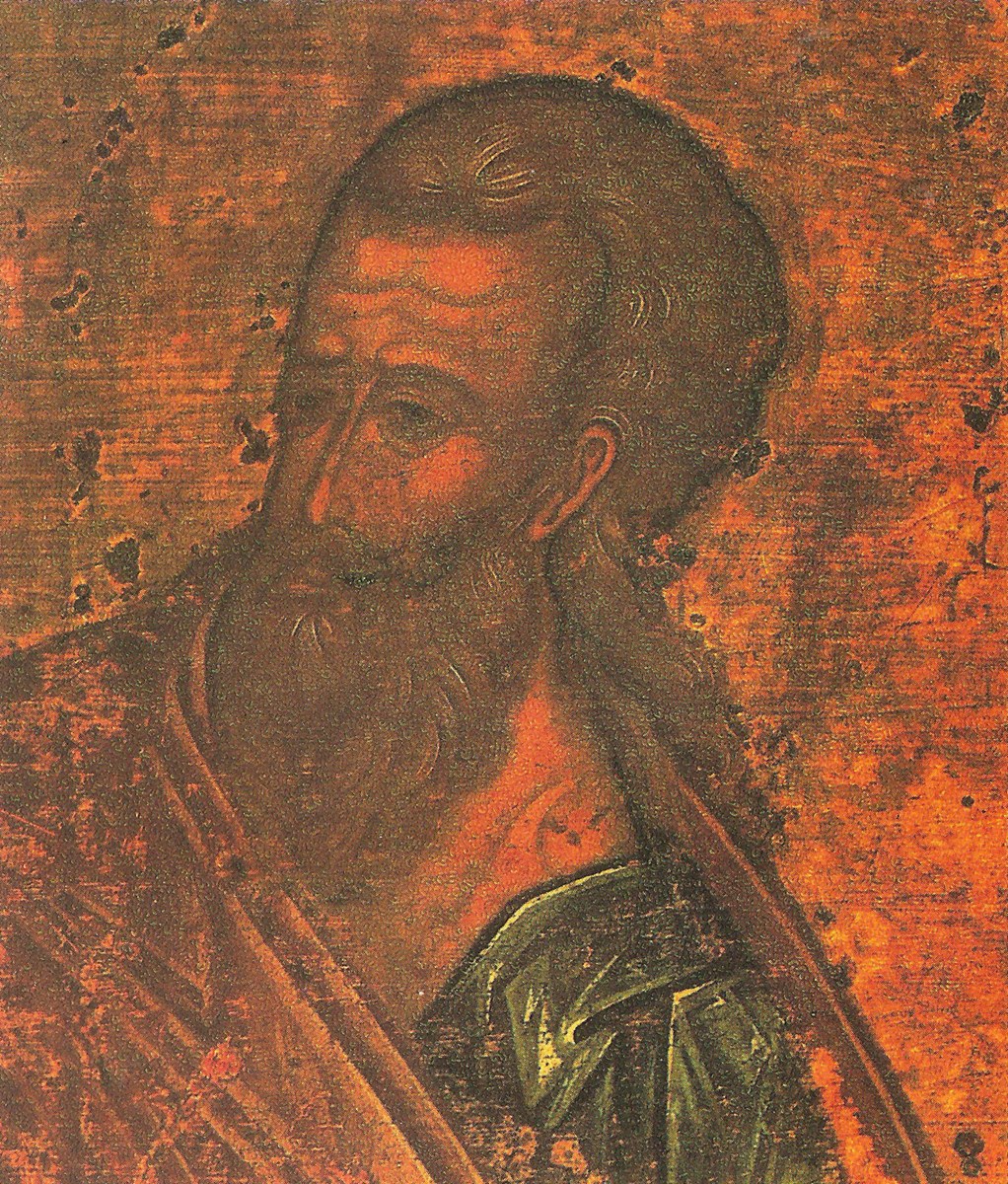
.jpg)
Origins and early life
The prophet's own book opens with all that is certainly known of his person: "The word of the Lord that came to Micah the Morasthite in the days of Jotham, Ahaz, and Hezekiah, kings of Judah, which he saw concerning Samaria and Jerusalem" (Micah 1:1). He is the Morasthite — the man of Moresheth, or Moresheth-Gath, a small town of the Shephelah, the low hill country between the Judean highlands and the Philistine plain, some twenty-five miles south-west of Jerusalem and within sight of the road along which the Assyrian armies would come. The Byzantine synaxaria assign him to the tribe of Judah; the ancient Lives of the Prophets, followed by part of the Greek tradition, makes him of Ephraim — a discrepancy that goes back to the same confusion of the two prophets named Micah discussed below.
The chronology given him in the service books and in the Slavic Lives is that his prophetic service began about 778 BC and lasted some fifty years; the Greek Μέγας Συναξαριστής states more compactly that he lived at Jerusalem between 748 and 696 BC. Both reckonings place him squarely within the reigns named in his own superscription, and make him the younger contemporary of Isaiah and Hosea and the near-contemporary of Amos. His public life therefore spans the most catastrophic generation of the divided kingdoms: the fall of Samaria to Assyria in 722–721, and the invasion of Judah by Sennacherib in 701, when the fortified towns of the Shephelah — Micah's own country — were taken one after another and Jerusalem alone was spared.
Unlike Isaiah, who moved among kings and counsellors in the capital, Micah speaks with the voice of the provinces. His indictments are of the men who "covet fields, and take them by violence" (2:2), who tear the skin from off the people and their flesh from off their bones (3:2–3), who build Zion with blood and Jerusalem with iniquity; and his lament in the first chapter runs through a roll-call of the little towns of the Shephelah — Gath, Beth-le-aphrah, Saphir, Zaanan, Lachish, Achzib, Mareshah, Adullam — in a chain of bitter puns on their names, the grief of a man watching his own countryside destroyed.
The book and its prophecy
The seven chapters of Micah are read by the Greek synaxarion in three movements. In the first three he announces the ruin of Samaria, which shall be made "an heap of the field, and as plantings of a vineyard," and turns the same judgement upon Jerusalem, closing with the most notorious sentence in the book: "Zion shall be plowed as a field, and Jerusalem shall become heaps, and the mountain of the house as the high places of the forest" (3:12). In the next two he turns to consolation and to the coming of the Messiah. In the last two he arraigns the people, who imagine that God can be appeased with sacrifice — with thousands of rams, with ten thousands of rivers of oil, with the firstborn for their transgression — and receives the answer that the whole prophetic tradition had been driving toward.
Three passages have carried his name through the Church's memory.
"He hath shewed thee, O man, what is good" (6:8). In the Septuagint the Church reads: Τί Κύριος ἐκζητεῖ παρὰ σοῦ ἀλλ' ἢ τοῦ ποιεῖν κρίμα καὶ ἀγαπᾶν ἔλεον καὶ ἕτοιμον εἶναι τοῦ πορεύεσθαι μετὰ Κυρίου Θεοῦ σου — "What does the Lord seek from thee, but to do judgement, and to love mercy, and to be ready to walk with the Lord thy God?" It is the summary of the prophetic protest against a cult without righteousness, and stands with Hosea's "I desired mercy, and not sacrifice" and Isaiah's first chapter as one of the three great texts of that protest. The Fathers read it as the Law reduced to its living principle, and the Byzantine commentators as the Old Testament's nearest approach to the two commandments on which hang the Law and the Prophets.
"But thou, Bethlehem Ephratha" (5:2). "And thou, Bethlehem, house of Ephratha, art little among the thousands of Judah; yet out of thee shall come forth unto me he that is to be ruler in Israel, whose goings forth have been from of old, from everlasting." This is the single Old Testament text that names the place of the Messiah's birth, and the Gospel itself records its use: when the magi came to Jerusalem, Herod gathered the chief priests and scribes and demanded where the Christ should be born, and "they said unto him, In Bethlehem of Judaea: for thus it is written by the prophet" — and quoted Micah (Matthew 2:5–6). The verse is appointed among the Old Testament lessons of the Nativity cycle and echoes through the forefeast hymns; the phrase "whose goings forth have been from everlasting" was read by the Fathers as a testimony to the eternal generation of the Son, so that the same verse witnesses both to the Incarnation in time and to the divinity of the one incarnate.
"Who is a God like unto thee?" (7:18). The book ends with a question that is also a play on the prophet's own name — Mikhah, a shortening of Mikhayahu, "Who is like the Lord?" — and answers it with the pardoning of iniquity and the casting of all sins into the depths of the sea. The great vision of 4:1–3, shared almost word for word with Isaiah 2:2–4 — the mountain of the house of the Lord established on the top of the mountains, the nations flowing to it, swords beaten into ploughshares and spears into pruning-hooks — is the passage the Church's hymnography for the prophet takes up when it sings of him foreseeing "the Church of Christ" as a mountain conspicuous and manifest.
Micah and Jeremiah: the prophet who was not killed
Micah is the only pre-exilic prophet whose preaching is quoted, by name and with his date, inside another prophetic book. A century after him, when Jeremiah stood on trial for his life at Jerusalem for prophesying against the Temple, the elders of the land rose in his defence and cited the precedent: "Micah the Morasthite prophesied in the days of Hezekiah king of Judah, and spake to all the people of Judah, saying, Zion shall be plowed like a field… Did Hezekiah king of Judah and all Judah put him at all to death? Did he not fear the Lord, and beseech the Lord, and the Lord repented him of the evil?" (Jeremiah 26:18–19). Jeremiah's life was spared on the strength of it.
The passage is doubly precious. It preserves an independent memory of Micah's preaching, dates it firmly to the reign of Hezekiah, and records that his word moved a king to repentance — the rarest outcome in the prophetic books. It also establishes, as the Slavic Lives of the Saints observe, that Micah of Moresheth was not put to death: the men of Judah feared to touch him. That plain scriptural statement is the chief reason for distinguishing him from the martyred Micah of the synaxarion notice.
Relics
Nothing is transmitted of the prophet's repose beyond the tradition that he was buried in his own country at Moresheth. In the fourth century his relics were made known, together with those of the prophet Habakkuk, in the region of Eleutheropolis in Palestine — at a place the sources call Berathsatia or Baraphsatia — by a revelation granted to the local bishop, named Zebennus (Zeuinos) in the Greek. The church historian Sozomen records the finding among the discoveries of holy bodies of his own age. The site, close to Micah's native Shephelah, became a place of pilgrimage, and the joint discovery is the reason the two prophets are so often named together in later notices.
Feast and commemoration
Micah is commemorated on August 14 (church date; New Calendar civil August 14, Old Calendar civil August 27). The day is the last day of the Dormition fast, which runs from August 1 to August 14, and the Forefeast of the Dormition of the Theotokos — so the prophet's memory is sung under the forefeast, and his office in the Menaion yields precedence to it. The placing is felicitous rather than accidental in the Church's reading: the prophet who named Bethlehem as the place from which the Ruler should come forth is remembered on the eve of the feast that celebrates the falling-asleep of the one from whom he came forth.
His feast is universal to the Byzantine rite and is kept alike in Antiochian, Greek and Slavic usage. The Latin Church commemorates him on January 15; the Armenian tradition keeps the Twelve Prophets together. The joint discovery of his relics with those of Habakkuk is noticed in the Greek synaxaria under both prophets' days.
Hymns
Apolytikion — Tone 4
As a mountain conspicuous and truly manifest to all, thou didst foresee in the Spirit the Church of Christ, O God-inspired Micah; wherefore they that have found salvation in her walk, as thou didst foretell, in the paths of the Lord, honouring, O Prophet, thine all-venerable memory.
Kontakion — Tone 4
Illumined by the flashing radiance of the Holy Spirit, thou didst write beforehand of the condescension of Christ, whereby we who honour thee, O God-inspired Micah, have been delivered from corruption.
Original translation from the Greek
Magnification
Having a tongue borne along by the Spirit, thou wast shown forth as the herald and expounder of things to come; wherefore thou wast glorified, O Micah who speakest of God, having sealed thy course after the manner of the martyrs.
Original translation from the Greek
Iconography
Micah is painted in the settled type of the Old Testament prophets: a bearded man of middle or advanced years in a tunic with a mantle thrown over it, holding an unrolled scroll. In the prophet tier of the Russian iconostasis — the row above the festal tier, where the prophets stand turned toward the Mother of God of the Sign at its centre — he takes his place among the Twelve, and his scroll regularly bears the Bethlehem prophecy, which is precisely why the prophet row is built around the image of the Incarnation. In Byzantine and Serbian wall painting he appears in the domes and drums among the prophets who ring the Pantocrator; the frescoes of Saint Sophia at Ohrid and of the dome of Gračanica both include him. He is normally shown with a full dark or greying beard, and is distinguished from his namesake of January 5 only by the inscription and by the text of the scroll.
The stored image is a detail of a mid-sixteenth-century Muscovite panel from the prophet tier of the iconostasis of the Cathedral of the Annunciation in the Moscow Kremlin, inscribed in the cathedral's records as Пророк Михей — the prophet in three-quarter view, the head lined and the beard long, against a scarlet ground worn to the gesso. The crop preserves no legible inscription, and the identification therefore rests on the cathedral's attribution of the panel within a prophet row, which by its nature contains the writing prophets and not the prophet of 1 Kings 22.
Disputed questions
Two prophets named Micah. The Byzantine synaxarion notice for August 14 — followed to this day by the Greek Μέγας Συναξαριστής — ends its account of Micah of Moresheth with a martyrdom: because he sharply reproved the lawlessness of Ahab, he was hunted by that king and escaped into the mountains; and when Ahab's son Joram reigned, the prophet was seized, hanged, and so put to death, his kinsmen recovering the body and burying it at Moresheth "near the cemetery of the Enakim." The ultimate source is the ancient Lives of the Prophets ascribed to Epiphanius, which tells the same story with the prophet thrown from a cliff.
This account belongs, by every internal test, to the other Micah: to Micah, son of Imlah, the ninth-century prophet of the northern kingdom who alone contradicted Ahab's four hundred prophets, foretold his death at Ramoth-Gilead, and was struck and imprisoned for it (1 Kings 22; 2 Chronicles 18) — a man who lived some hundred and fifty years before the Morasthite, wrote nothing, and is kept by the Church on January 5. Ahab and Joram are his kings, not Micah of Moresheth's; the Morasthite's kings are named in his own first verse, and Jeremiah 26 testifies that he died unharmed. The confusion is old, easy, and universal: in Greek both men are Μιχαίας, in Slavonic both are Михей, and the two commemorations were fixed on separate days long before the distinction was drawn clearly in the notices.
This entry therefore records the martyrdom tradition as the synaxarion transmits it, without adopting it, and keeps the two prophets in separate files. Readers should also note that neither is Micah of Radonezh (†1385, May 6), the Russian monastic disciple of Saint Sergius who bears the same name in its Slavonic form.
Tribe and dating. The synaxaria that assign Micah to Ephraim are following the Lives of the Prophets on the strength of the same conflation; the book's own superscription, its geography and its concern with Judah and Jerusalem place him in Judah. The two chronologies given above (a ministry begun c. 778 BC; a life of 748–696 BC) are recorded as the sources give them and are not harmonised here.