
Hermogenes of Moscow
The Holy Hieromartyr Hermogenes, Patriarch of Moscow and All Russia, Wonderworker
Hieromartyr · Patriarch · Bishop · Wonderworker · b. c. 1530 — d. 1612, at Moscow (by starvation in the Chudov Monastery)
Commemorated 17 February — Repose (martyrdom by starvation) in the Chudov Monastery, 12 May — Glorification (1913)
Hermogenes (c. 1530 – 1612) was Patriarch of Moscow and All Russia through the worst years of the Time of Troubles, and a hieromartyr whose steadfastness helped save the Russian state and Church. A priest of Kazan who witnessed and recorded the finding of the wonderworking Kazan Icon of the Mother of God, and afterwards its first metropolitan, he was raised to the patriarchal throne in 1606. When the Polish invaders and their partisans overran Moscow and pressed the Russians to accept a Catholic prince, Władysław, as tsar, Hermogenes refused to bless him unless he became Orthodox, and from his cathedral, and then from prison, sent out letters (gramoty) calling the people to rise in defence of the faith and the fatherland — the summons that kindled the national militia of Minin and Pozharsky. For this the Poles shut him up in the Chudov Monastery in the Kremlin and starved him; he died on February 17, 1612, months before Moscow was freed. He was glorified in 1913, and his relics rest in the Dormition Cathedral of the Kremlin. Not to be confused with the new hieromartyr Hermogenes (Dolganev), Bishop of Tobolsk (June 16, †1918), drowned in the river Tura by the Bolsheviks — a different man of a different century, with whom the patriarch is often confused because both bear the name and both died in the hands of an occupying power.

Priest of Kazan and the Kazan Icon
Hermogenes was born about the year 1530; the tradition connects his origins with Kazan and with the Don Cossacks, and he is first known as a married parish priest of the Church of Saint Nicholas in the merchants' quarter (Gostinodvorsky) at Kazan, the great Volga city newly won from the Tatars and newly Christian. In 1579, when a little girl, Matrona, was thrice shown in a dream the place where an icon of the Mother of God lay buried in the ashes of a burned house, it was the priest Hermogenes who, with the archbishop, took up the recovered image — the Kazan Icon, which was to become one of the most beloved and powerful of all Russian icons of the Theotokos. Hermogenes carried it in procession to the church, and afterwards, as an eyewitness, wrote the account of its finding and of the miracles that followed — a text that remains a chief source for the icon's history.
Widowed, he took monastic vows, and rose swiftly: archimandrite, then, when the see of Kazan was raised to a metropolitanate, its first Metropolitan of Kazan (1589). As metropolitan he laboured for the conversion and catechesis of the Tatar and Finnic peoples of the Volga, sought the honouring of the local martyrs, and showed the firmness that would mark his patriarchate.
Patriarch in the Time of Troubles
The turn of the seventeenth century plunged Muscovy into the Time of Troubles (Smuta) — dynastic collapse after the extinction of the old line, famine, pretenders, civil war, and foreign invasion. When the first False Dmitri, a pretender backed by Poland, took Moscow and married the Catholic Marina Mniszech, Hermogenes opposed him openly, demanding that Marina be received into Orthodoxy and refusing to countenance the Latinising of the court; for this he was banished from the capital. After the pretender's fall and the accession of Tsar Vasily Shuisky, Hermogenes was called to Moscow and, in 1606, consecrated Patriarch of Moscow and All Russia.
His patriarchate fell in the darkest passage of the Troubles. A second False Dmitri raised his standard; Shuisky was overthrown; a faction of boyars, seeking any peace, agreed to offer the Russian throne to Władysław, son of the Polish king Sigismund III, and admitted a Polish garrison into the Kremlin. Hermogenes gave a conditional and reluctant assent — that Władysław might be received only if he became Orthodox and the Poles withdrew — but when it became plain that Sigismund meant to take the Russian crown for himself, to keep the garrison, and to bring the Russian Church under Rome, the Patriarch turned wholly against the settlement and became the soul of the national resistance.
The letters, imprisonment, and martyrdom
From his cathedral, and by letters carried through the country, Hermogenes released the people from any oath to Władysław and called upon the towns and the Cossacks to gather in arms for the deliverance of Moscow and the defence of Orthodoxy. His gramoty — circular letters to Nizhny Novgorod and the other cities — were among the sparks that lit the great popular movement: the first militia, and then the second militia of Kuzma Minin and Prince Dmitri Pozharsky, which would at last retake the Kremlin.
The Poles and their partisans, understanding that this old man's voice was worth an army, seized him, deposed him in all but name, and shut him up in a cellar of the Chudov Monastery within the Kremlin. They demanded that he order the advancing militias to disperse; he answered that he would bless those who came to free Moscow and curse the traitors, and that they should do to him what they would. They left him without bread and water. Hermogenes died of starvation in his prison on February 17, 1612 — some seven or eight months before the militia entered the Kremlin in October and Moscow was freed, and a year before the election of the first Romanov tsar, whose house he had helped make possible. He was buried in the Chudov Monastery, and afterwards, in 1654, his incorrupt relics were translated with honour to the Dormition Cathedral of the Kremlin, where they rest.
Glorification
Long venerated as a martyr and patriot, Hermogenes was solemnly glorified by the Russian Orthodox Church in 1913, on the eve of the tercentenary of the Romanov dynasty, and the commemoration of his glorification is kept on May 12. His memory, already bound up with the Kazan Icon and with the deliverance of 1612, was invoked again through the trials of the twentieth century as the type of the shepherd who gives his life for his flock and his people.
Feast and commemoration
Hermogenes is commemorated on February 17 (church date; New Calendar civil February 17, Old Calendar civil March 2), the day of his martyrdom by starvation in 1612; and on May 12 (Old Calendar civil May 25) for his glorification of 1913. His feasts are kept by the Russian Orthodox Church, the Church Abroad, and the OCA; the OCA and azbyka calendars agree in placing his principal commemoration on February 17. He is honoured together with the other patriarchs and hierarchs of Moscow, and his name is linked in the Russian memory with the Kazan Icon of the Mother of God and with the national deliverance from the Time of Troubles.
Hymns
Troparion — Tone 4
First-enthroned hierarch of the Russian land and unsleeping intercessor for it before God: laying down your life for the faith of Christ and for your flock, you delivered our country from ungodliness. Therefore we cry to you: save us by your prayers, O Hieromartyr Hermogenes, our father.
Original translation from the Slavonic
Kontakion — Tone 6
Enduring imprisonment and hardship for Orthodoxy, and dying of hunger, you kept the faith of Christ unshaken to the end, O most honoured Hermogenes; and having laid down your soul for your people, you obtained from God the deliverance of the Russian land. Therefore we honour you as a hieromartyr and pray: never cease to intercede for our souls.
Original translation from the Slavonic
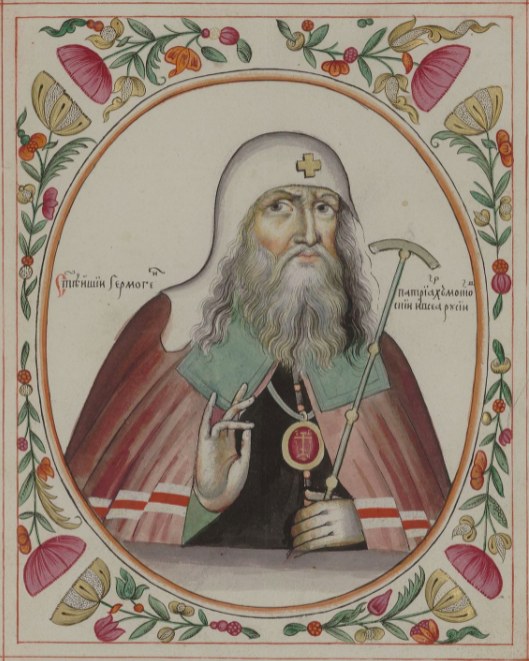
Iconography
Hermogenes is depicted as a patriarch in full hierarchical vesture — the sakkos, omophorion, and the white patriarchal koukoulion (cowl) with its cherubim and cross — bearing the Gospel or a scroll, with a grey beard, in the type of the Moscow patriarchs. Because his cult was formally established only at his glorification in 1913, his images are of the twentieth and twenty-first centuries; some show him in the cellar of the Chudov Monastery, or with the Kazan Icon whose finding he recorded, or with a scroll bearing his summons to the defence of Moscow. The stored image is the 1672–1673 portrait of the patriarch from the Tsarsky Titulyarnik tradition.