
Hermogenes of Tobolsk
The Holy New Hieromartyr Hermogenes (Dolganev), Bishop of Tobolsk and Siberia, and those martyred with him
New Martyr · Hieromartyr · Bishop · b. 25 April 1858, in the Kherson province, baptised Georgy — d. 16 June 1918, drowned in the river Tura
Hermogenes (Georgy Yefremovich Dolganev, born 1858) was a lawyer's student turned monk who became rector of the seminary of Tiflis, bishop of Saratov, and — after five years of disgrace for his public war on Rasputin — bishop of Tobolsk in the year of the revolution, while the deposed imperial family was held in that city. Fearless, combative and wholly unwilling to be silent, he denounced the Bolshevik persecution of the Church from his cathedral, was arrested in the spring of 1918, and on the night of 16 June 1918 was drowned in the river Tura with a stone tied about him, near the village of Pokrovskoye. Four men who had gone to plead for him or shared his imprisonment died in the same days: the priests Ephrem Dolganev, Michael Makarov and Peter Korelin, and the layman Constantine Minyatov. All five were glorified by the Russian Church in 2000.

Origins and formation
He was born on 25 April 1858 in the Kherson province, in the family of a priest, and received the name Georgy. He read law at the Novorossiysk University in Odessa, completing the course in 1889 — an unusual formation for a Russian bishop of his generation — and only then entered the St Petersburg Theological Academy. He was tonsured Hermogenes in 1890, ordained hierodeacon in the same year and hieromonk in 1892.
Tiflis and Saratov
In 1893 he was appointed inspector, and in 1896 rector, of the theological seminary of Tiflis, the great seminary of the Caucasus, where he organised missionary brotherhoods and work among the poor of the city. It was under his rectorship, in 1899, that a seminarian named Joseph Dzhugashvili — afterwards Stalin — was struck off the rolls for failing to appear at his examinations; the fact is reported in the Russian accounts of the bishop's life and is much repeated, and is recorded here with the note that the seminary's own documents give the failure to sit examinations, not political activity, as the formal ground.
Consecrated bishop of Volsk in 1901, he was given the see of Saratov in 1903 and held it thirteen years. He was a formidable diocesan: he preached and wrote against the sects and against the new atheism, founded churches and monasteries, reformed the diocesan schools, and — with an energy that alarmed the authorities as much as it alarmed the sectaries — took the side of workers against employers. In 1908 he was involved in an attempt to reform the workings of the Holy Synod.
Rasputin, and the years of disgrace
In 1911–1912 Hermogenes broke publicly with Grigory Rasputin, whom he had at first received, and joined in a direct and physical confrontation with him in the capital, demanding that he leave the court. The denunciation cost him everything: he was removed from the Synod, deprived of his see, and confined to a monastery — first Zhitomir in Volhynia — where he remained until the fall of the monarchy.
Tobolsk, 1917–1918
In 1917, after the February revolution, he was restored to active ministry and appointed to the see of Tobolsk and Siberia. In August of that year the deposed imperial family was brought to Tobolsk under guard, and the bishop's care for them — services, and the pastoral attention his position allowed — is part of the record of his last year. When the Bolsheviks took the city he refused to be quiet: he preached against the seizure of church property, the closing of the schools, and the terror.
On Palm Sunday 1918 he led a cross-procession through Tobolsk, having sought and received permission for it, and was arrested within days. He was taken to Yekaterinburg and held, then moved to Tyumen. A party from Tobolsk — the priests Ephrem Dolganev (a kinsman of the bishop) and Michael Makarov and the layman Constantine Minyatov — went to Yekaterinburg with money to obtain his release; they were themselves seized and shot. The priest Peter Korelin was taken with them.
On the night of 16 June 1918 (Old Style; June 29 by the civil reckoning of the New Calendar), on the river Tura near the village of Pokrovskoye — Rasputin's own village, by one of the bitter coincidences of that year — the bishop was thrown into the water with a heavy stone bound to him. His body was found on the bank some weeks later and was afterwards buried in the cathedral of Tobolsk, in the crypt of the church of St John Chrysostom; his relics were uncovered in 2005.
Glorification
Hermogenes and the four who died with him were canonised by the Jubilee Council of the Russian Orthodox Church in August 2000, among the New Martyrs and Confessors of Russia. They are commemorated on June 16 and with the whole company of the New Martyrs on their synaxis.
Feast and commemoration
June 16 (church date; Old Calendar civil June 29). Russian usage (Moscow Patriarchate) and the OCA; not in the Greek or Antiochian menaia. He is commemorated again with the Synaxis of the New Martyrs and Confessors of Russia (the Sunday nearest January 25) and in the synaxis of the saints of Siberia. The Russian calendar also enters him on the dates connected with the discovery and translation of his relics.
Hymns
Apolytikion — Tone 4 (common of a hieromartyr)
As a sharer in the ways and a successor to the thrones of the Apostles, O God-inspired one, thou didst find in contemplation the ascent to divine heights; rightly dividing the word of truth, thou didst contend for the faith even unto blood, O hieromartyr Hermogenes: intercede with Christ God that our souls may be saved.
Iconography
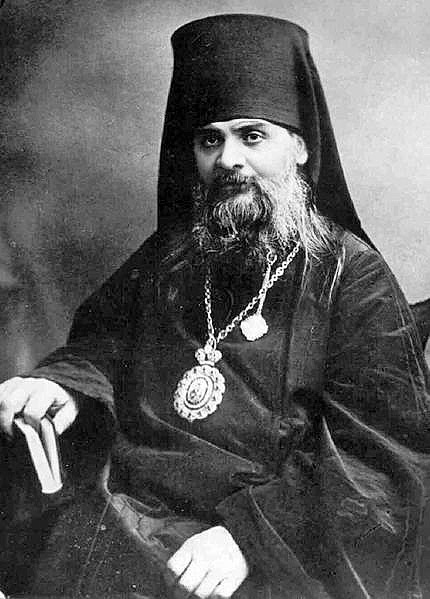
The new martyrs of the Russian persecution are painted from their photographs, and Hermogenes is immediately recognisable in the icons: a bishop of middle age with a full dark beard, in the mantle and klobuk of a monastic hierarch or in full episcopal vesting with the omophorion, blessing with one hand and holding the Gospel or a martyr's cross in the other. His proper attribute is the stone and the water — the millstone or weight bound to him, and the river below — which appears in the narrative scenes on the borders of his icon and in the composite icons of the New Martyrs and Confessors of Russia, where he stands among the hierarchs of the first rank. In the icons of the saints of Siberia he is placed with the Tobolsk hierarchs, beside St John of Tobolsk.
No pre-1900 image of him exists — he died in 1918 and was glorified in 2000 — and all painted icons of him are modern and in copyright. The image stored here is therefore not an icon but a Russian studio photograph of the bishop taken before 1918, long out of copyright: the seated figure in klobuk and mantle with the panagia and engolpion, holding a book. Identity rests on the description carried with the print rather than on any inscription, and a second photograph of the same sitter from the same years, independently published, agrees with it.
Disputed questions
- Not Hermogenes, Patriarch of Moscow. The bishop of Tobolsk is constantly confused with Hermogenes, Patriarch of Moscow (†1612), the patriarch who was starved to death by the Poles in the Time of Troubles and whose feast is February 17 (with the uncovering of his relics on May 12). They share a name and the fate of dying in the hands of an occupying power, and nothing else: three centuries and two entirely different offices separate them.
- Bishop, not metropolitan. Some accounts style him metropolitan of Tobolsk. He was bishop of Tobolsk and Siberia; the see was not metropolitan in his time.
- The Stalin story. That the future Stalin was expelled from the Tiflis seminary while Hermogenes was rector is well attested as to date and office; the causal versions that circulate — that the rector personally expelled him for revolutionary activity, or that Stalin bore him a grudge that determined his death in 1918 — go beyond the evidence and are not asserted here.
- The companions. The four martyred with him are commemorated on this day as a company and do not each have an independent cultus; the exact sequence and manner of their deaths in June 1918 is variously reported in the accounts consulted, which agree that the three who travelled to Yekaterinburg were shot and that all four died in the same fortnight as the bishop.