
Hermolaus, Hermippus and Hermocrates
The Holy Hieromartyrs Hermolaus, Hermippus and Hermocrates, Priests of Nicomedia
Hieromartyr · Priest · d. c. 305, at Nicomedia
Commemorated 26 July — Beheading of the three priests of Nicomedia, the day before the feast of their disciple Panteleimon
Three priests of Nicomedia who survived the great burning of the Christians of that city in the persecution of Diocletian and Maximian, lived on in hiding, and continued to serve and to teach. The eldest of them, Hermolaus, met in the street a promising young physician-in-training named Pantoleon, drew him into his lodging, unpicked for him the emptiness of the gods, and at last baptised him — so making the great-martyr and unmercenary Panteleimon, whose feast the Church keeps on the very next day. When Panteleimon was denounced, his teacher was sought out with him; Hermolaus, together with Hermippus and Hermocrates, was arrested, refused to sacrifice, and was beheaded at Nicomedia about the year 305. Their commemoration on July 26 stands immediately before their disciple's on July 27, and the two feasts are read together.

Nicomedia after the burning
The three belong to the cycle of the Nicomedian martyrs, the largest and most terrible single body of sufferers in the Diocletianic persecution. Nicomedia in Bithynia was then an imperial capital: Diocletian resided there, the edict of February 303 was published there, and the cathedral of the city — visible from the palace windows — was among the first buildings razed. The Greek tradition relates that at the winter feast a great multitude of Christians was shut into the church of the city and burned alive; the synaxaria give the famous round figure of twenty thousand, and keep them on December 28. Whatever the true number, the effect was to decapitate the Christian community of the capital at a stroke.
Hermolaus, Hermippus and Hermocrates were presbyters of that church who were not inside it on that day, or who escaped. They did not leave the city. They lived, the account says, "in a small house," concealed, gathering what remained of the faithful and continuing the services in secret — a picture the persecution literature knows well, and one that requires no embellishment to be credible.
Hermolaus and the young Pantoleon
The one act for which Hermolaus is universally remembered is the making of a saint. A youth named Pantoleon — son of the pagan senator Eustorgius and of the Christian Eubula, and apprenticed to Euphrosynus, the most celebrated physician of Nicomedia — passed daily along the street where the old priest lodged. Hermolaus, watching him, judged the boy's character from his bearing and called him in.
The catechesis went slowly and by conversation. Hermolaus asked him what he was learning, and what the gods he served could do; he set the multitude and mutual quarrelling of the Greek deities against the one God who is not made, and the physician's art, which fails, against the Physician who does not. Pantoleon came back day after day. What settled the matter was an event outside the house: the young man came on a child dead of a viper's bite, prayed as Hermolaus had taught him — in the name of Christ — and the child rose and the serpent burst. He went straight to Hermolaus and was baptised, taking the name Panteleimon, "all-merciful."
The relation of teacher and disciple is the hinge of both feasts. Panteleimon afterwards healed a blind man and converted his own father; his fellow physicians, seeing their trade ruined, denounced him to Maximian.
Arrest, the earthquake, and the beheading
Under examination Panteleimon did not deny who had taught him. Soldiers were sent for Hermolaus, and with him were taken his two fellow priests, Hermippus and Hermocrates — the tradition treats the three as a settled company, and some retellings make Hermippus and Hermocrates brothers.
The passion preserves a night vision: the Lord appeared to Hermolaus and told him that on the morrow he would suffer for His name. He told his companions, and the three went to the tribunal already knowing the outcome. Before the emperor they confessed Christ and refused the sacrifice. Threatened with the instruments, they answered — the recurring retort of the Nicomedian passions — that the gods of the empire were no gods; and at that moment, the account says, an earthquake shook the city and the idols in the temples fell and were broken. When this was reported to Maximian he took it as proof of the danger the three represented rather than of the truth of what they said, and ordered them tortured and then beheaded. Their execution is placed about 305; Panteleimon suffered shortly after, and is commemorated on July 27.
Veneration
The three priests never acquired an independent cultus of the scale of their disciple's; they are venerated precisely as the men who stand behind Panteleimon, and their day is fixed the day before his so that the Church reads the two accounts in sequence. Hermolaus alone is sometimes commemorated by name in Greek usage, and his name is carried by churches and chapels in Asia Minor and the islands. In the Slavonic books the three appear as Ермолай, Ермипп и Ермократ, "priests of Nicomedia," on 26 July.
Feast and commemoration
July 26 (church date; New Calendar civil July 26, Old Calendar civil August 8). The rank is that of an ordinary commemoration with six stichera. The day is chosen for its position: it is the eve of the great-martyr Panteleimon (July 27), one of the most widely kept saints' days of the Byzantine year, and the Menaion intends the pair to be read together — the teacher on the eve, the disciple on the feast. In Greek parishes dedicated to St Panteleimon the vigil of the 26th therefore commemorates Hermolaus by name.
Where the church is dedicated to the Nicomedian martyrs generally, the three are gathered with the December 28 company. The Antiochian Archdiocese keeps July 26 on the civil day; Old Calendar Churches keep it on civil August 8.
Hymns
Apolytikion — Tone 4
Sharers in the ways of the Apostles and successors upon their thrones, ye found in the practice of virtue the ascent to contemplation, O inspired of God; wherefore, rightly dividing the word of truth, ye contended for the faith even unto blood, O hieromartyrs Hermolaus, Hermippus and Hermocrates: intercede with Christ our God that our souls may be saved.
Kontakion — Tone 2
Priests of the Most High and teachers of the truth, ye hid yourselves from the fury of the tyrant but not from the light of Christ; and having brought the physician Panteleimon to the healing waters of baptism, ye were beheaded with him for the faith. Wherefore we cry to you: cease not to intercede for us all.
Original translation from the Greek
Iconography
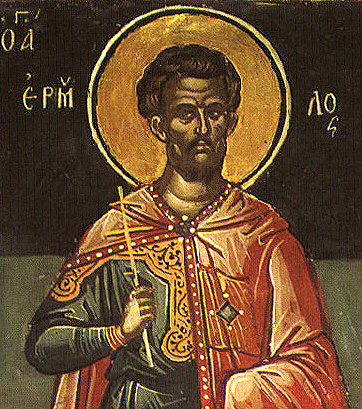
Hermolaus is painted as the calendars describe him: a priest, in the phelonion and epitrachelion, dark or grizzled of beard, holding the martyr's cross in his right hand — the two signs, priesthood and martyrdom, that his titles combine. Where the three are shown together they stand in a row of equal height, all three in priestly vesture with crosses, distinguished only by their inscriptions. In the menologion cycles for July the scene is the beheading: three figures kneeling before an executioner, and often, at the side, the fallen idols of the earthquake.
By far his most frequent appearance is not alone but beside Panteleimon — in the vita-icons of the great-martyr, where the small scenes around the border show Hermolaus teaching the youth, and Hermolaus baptising him. Anyone reading such a border is reading this feast.
The stored image is a Greek panel of the fourteenth to fifteenth century inscribed Ο ΑΓ(ΙΟС) ΕΡΜ[Ο]ΛΑΟС, bust-length against a dark ground: the saint in a red mantle over an ornamented under-garment, holding the slender cross of the martyrs, with a gold halo.
Disputed questions
- Date and reign. The synaxaria place the martyrdom under Maximian (Galerius Maximianus, who governed the East and drove the persecution hardest) about 305; the burning of the Nicomedian church is dated 303. Some Greek texts telescope the two events and date the priests to 303 as well. The 305 date is the more usual, and is followed here.
- Were all three priests? The Slavonic and Greek menaia style all three ἱερεῖς / иереи, priests, and hence hieromartyrs. A minority of retellings make only Hermolaus a presbyter and the other two laymen of his household. The calendars' own classification is followed here (the project's constitution, TAXONOMY rule 3).
- The twenty thousand. The figure is a synaxarion round number, not an archival count. The historical record (Lactantius, Eusebius) attests savage repression at Nicomedia and the destruction of the church, but no such total. The entry reports the tradition as tradition.
- Hermolaus and the "Ten Thousand Martyrs." Western art of the fifteenth and sixteenth centuries knows a Martyrdom of the Ten Thousand in which a Hermolaus figures; that cycle belongs to a quite different legend (the martyrs of Mount Ararat) and the identity of names is coincidental.