
Panteleimon the Healer
The Holy Great Martyr and Healer Panteleimon, the Unmercenary
Great Martyr · Unmercenary · Wonderworker · b. c. 275 — d. c. 305
Commemorated 27 July — Beheading at the olive tree in Nicomedia
Panteleimon of Nicomedia (c. 275 – c. 305) is the physician-martyr of the Great Persecution and, with Cosmas and Damian, the chief of the Unmercenary Healers of the Orthodox Church. Son of the pagan senator Eustorgius and of the Christian Eubula, trained in medicine at Nicomedia under the celebrated Euphrosynus, and marked out to be physician to the emperor Maximian, he was converted and baptised by the hidden priest Hermolaus, gave away his inheritance, healed the sick without fee in the name of Christ, and was denounced by the envy of his fellow-physicians. Preserved through a long cycle of tortures, he was beheaded beside an olive tree which, at the moment of his death, broke into fruit. His name — Panteleēmōn, "all-merciful" — is invoked in the Mystery of Holy Unction, at the Blessing of Waters and in every Orthodox prayer for the sick, and his cult is one of the most universal in the Church: his skull is kept at the Russian monastery on Mount Athos that bears his name.

Origins and early life: Nicomedia, the two households
Panteleimon was born about the year 275 at Nicomedia in Bithynia — the eastern capital of the empire under Diocletian, and therefore the very theatre of the Great Persecution. His father Eustorgius was a man of rank and of the old religion, whose house was full of idols; his mother Eubula was a Christian, and the tradition holds her memory on March 30. The boy was given the name Pantoleon, "in all things a lion" — a warrior's name, a father's ambition.
Eubula began to teach her son the faith; she died while he was still a child, and the Christian thread in the household was cut. Eustorgius, left in charge, sent the boy to the pagan schools and then apprenticed him to Euphrosynus, the most famous physician of Nicomedia. Pantoleon was gifted, and quickly outstripped his fellows. Euphrosynus presented him at court; the emperor Maximian, who kept his household at Nicomedia, was taken with him and marked him out for the post of imperial physician when his training should be finished.
Two educations were therefore laid on him, and the Passion is careful to name both: the mother's, buried but not dead, and the master's, which gave him the skill that would become the instrument of the other. The kathisma of his office puts it exactly — he loved his mother's piety, and set right, by piety, the impiety of his father.
Hermolaus, the dead child and the snake
At that time three priests were living in hiding in Nicomedia — Hermolaus, Hermippus and Hermocrates, survivors of the burning of the church and the massacre of the Christians of the city (the Twenty Thousand Martyrs of Nicomedia, kept on December 28). Their refuge stood on the road that Pantoleon walked between the physician's house and his own; Hermolaus, watching the young man pass day after day, called him in and spoke to him about Christ. The talk became a habit, and the habit a catechesis: Pantoleon came to the old priest daily, and Hermolaus taught him that the physician's art, which Pantoleon knew, was a shadow of a greater healing, and that the Physician of souls and bodies is one.
The decision was made by a sign in the street. Walking home, Pantoleon came upon the body of a child lying dead of the bite of a great snake, the serpent still coiled beside it. He stopped, and made a bargain with the God he had not yet confessed: if the Lord Jesus Christ would raise the child and kill the serpent, he would believe and be baptised. He prayed; the child rose alive, and the snake lay dead. He went to Hermolaus and was baptised, and received the name by which the Church knows him — Panteleimon, the all-merciful, in place of the lion's name his father had given him. The Church has never let the two names go: the hymns play on them constantly, and the tradition observes that a man who is a lion in everything and merciful to all is the exact description of a martyr who is also a physician.
The blind man, and the conversion of Eustorgius
He set out to win his father. Eustorgius was not persuaded by argument; he was persuaded by sight. A blind man, who had spent his substance on physicians and been made worse by them, came to Panteleimon; the saint refused the fee, laid his hand on the man's eyes and called on the name of Jesus Christ, and the man saw. Eustorgius, who was present, believed on the spot, and was baptised by Hermolaus together with the man whose sight had been restored. The blind man is himself numbered among the saints of this day: he confessed Christ publicly under interrogation, refused to say that the cure had come from the pagan gods, and was beheaded — the first-fruits of Panteleimon's healing and the first of the converts his martyrdom would make. The later Greek and Slavonic lists give him the name Celidonius, taken over from the Western tradition of the man born blind in the ninth chapter of St John; the older synaxarion leaves him unnamed.
Eustorgius died soon after, a Christian. Panteleimon inherited a great house and a great fortune, freed the slaves of the household, and gave the whole of it away. From that day he practised medicine without fee — this is the technical sense of the Greek anargyros, "silverless" — attending the poor, the crippled and the abandoned, and going into the prisons to dress the wounds of the confessors held there. What is peculiar to his dossier, and what the hymns insist on, is that he kept the science: he did not abandon medicine for prayer, but practised the one within the other, so that the Church could hold him up as the model of the Christian physician. Nicomedia noticed. Patients deserted the other doctors of the city and went to the young man who took nothing.
Denunciation, trial, and the paralytic
Envy did the rest. His fellow-physicians laid an information before Maximian: Panteleimon was a Christian, and was healing the imprisoned confessors. The emperor, who had meant to make him his own doctor, sent for him and offered him the easy way out — a sacrifice, a grain of incense, and the charge would be dropped.
Panteleimon confessed himself a Christian and proposed instead a trial by result. Let a sick man be brought whom no physician could help; let the pagan priests call on their gods over him, and let Panteleimon call on Christ. A man paralysed for many years was carried in. The priests of the idols, who were skilled in medicine as well as in sacrifice, invoked their gods over him at length and nothing happened; Panteleimon named the name of Jesus Christ and took him by the hand, and the man stood up and walked. It was a demonstration in the emperor's own presence, and it settled nothing, because Maximian had the healed man executed on the spot and handed Panteleimon over to the torturers.
The cycle of tortures
The Passion runs him through the whole repertory of the Nicomedian tribunal, and at every stage the Lord appears to him — in the form of the priest Hermolaus, the account says — and he is preserved:
- hung on a tree and torn with iron hooks, and burned in the wounds with torches;
- stretched on the wheel, which broke;
- cast into a cauldron of molten lead, which cooled;
- thrown into the sea with a stone about his neck, and brought back to the shore;
- exposed in the circus to wild beasts, which came up and licked his feet, so that the crowd began to shout "Great is the God of the Christians!" — and Maximian ordered the soldiers to cut down whoever shouted it.
At this point Hermolaus, Hermippus and Hermocrates were arrested and beheaded; their memory is kept on the day before his own (July 26), so that in the Menaion the teacher goes to his death one day ahead of the disciple, and the two feasts read as a single account divided in two.
The olive tree
Maximian gave up and ordered the beheading. They led Panteleimon out of the city and bound him to an olive tree. He prayed; a soldier struck him, and the blade went soft as wax against his neck and left no wound. The soldiers threw down their swords, fell at his feet and refused to go on. Panteleimon told them to obey the order — that if they did not, they would have no part with him in the age to come. They kissed him, weeping, and did it; and a Voice was heard from heaven calling him by his new name and summoning him to the Kingdom.
At the stroke, the tradition says, milk flowed from the wound instead of blood, and the dry olive tree to which he was bound broke into leaf and bore fruit in that hour. Many of those standing by believed. His body was thrown on a fire and was not consumed; Christians took it up and buried it. Three of his servants — Laurence, Bassus and Probus — had followed him to the place, heard the Voice, and wrote down what they had seen: the Passion of Panteleimon claims them as its eyewitnesses, and this is the ordinary claim of the genre rather than a verifiable one. The year is given as 305, at the end of Maximian's reign.
Relics and shrines
The head of the great martyr is the most famous of his relics: it is kept at the Monastery of St Panteleimon on Mount Athos — the Russian house, the Rossikon, which takes its name from him and whose brotherhood has carried his cult through the Slavic world. Blood and myrrh from his shrines have been reported for centuries, and portions of the relics were dispersed very widely and very early; his name is attached to churches, hospitals and healing springs across the whole Orthodox oikoumene, and beyond it, for the Latin West keeps the same saint on the same day as St Pantaleon, one of its Fourteen Holy Helpers, and the city of Ravello in Campania keeps a phial of his blood which is reported to liquefy on his feast.
Veneration
The veneration is not local and never was. In the East he is one of the three or four saints whose name every Orthodox Christian knows without being taught it, because it is read aloud over them when they are ill: Panteleimon is named in the Mystery of Holy Unction, in the Great Blessing of the Waters and in the prayers for the sick, alongside the Unmercenaries Cosmas and Damian and Cyrus and John. In Russia the cult is attested from the twelfth century — Prince Izyaslav Mstislavich, Panteleimon in baptism, carried the saint's image on his helmet and ascribed his survival at the battle of 1151 to him — and two naval victories over the Swedes, in 1714 and 1720, fell on his feast and fixed him in the Russian imperial calendar as a protector of soldiers.
That double patronage — soldiers and the sick — is not an accident of history but the working out of his two names. Pantoleon, the lion, gives the soldier; Panteleimon, the all-merciful, gives the physician; and the tradition observes drily that the two go together, since it is soldiers above all who need doctors. Modern Greek and Slavic usage adds to this the patronage of physicians and of hospitals as such.
Feast and commemoration
July 27 (church date; New Calendar civil July 27, Old Calendar civil August 9). His is the office of the day everywhere, with vespers stichera to Ὁ ἐξ ὑψίστου κληθεὶς, a proper apolytikion in Tone 3, and the kontakion with its oikos in Tone 5; in Greek and Slavonic practice the feast is kept with a vigil in churches dedicated to him and on the Holy Mountain. The Antiochian, Greek, Slavonic, Romanian and Georgian calendars are unanimous, and the day carries no competing office of comparable rank. His mother Eubula is kept on March 30, and his teacher Hermolaus with Hermippus and Hermocrates on July 26, immediately before him.
In Russian usage the day is doubly loaded, since it also carries the glorification of Herman of Alaska (1970), which was celebrated on this church date, and the memory of Nicholas Kochanov of Novgorod, whose relics lie under a church dedicated to Panteleimon.
The appointed readings for the great martyr in Slavonic use are 2 Timothy 2:1–10 and John 15:17–16:2.
Hymns
Apolytikion — Tone 3
O holy prize-winner and healer Panteleimon, make intercession with the merciful God, that He may grant unto our souls the forgiveness of our sins.
Kontakion — Tone 5
O imitator of the Merciful One, who from Him hast received the grace of healings, prize-winner and martyr of Christ our God: by thy prayers heal thou the sicknesses of our souls, driving away for ever the stumbling-blocks of the adversary from those who cry without ceasing: Save us, O Lord.
Original translation from the Greek
Magnification
We magnify thee, O holy passion-bearer, great-martyr and healer Panteleimon, and we honour thy precious sufferings, which thou didst endure for Christ.
Original translation
Appointed readings
Epistle — 2 Timothy 2:1–10
1Thou therefore, my son, be strong in the grace that is in Christ Jesus. 2And the things that thou hast heard of me among many witnesses, the same commit thou to faithful men, who shall be able to teach others also. 3Thou therefore endure hardness, as a good soldier of Jesus Christ. 4No man that warreth entangleth himself with the affairs of this life; that he may please him who hath chosen him to be a soldier. 5And if a man also strive for masteries, yet is he not crowned, except he strive lawfully. 6The husbandman that laboureth must be first partaker of the fruits. 7Consider what I say; and the Lord give thee understanding in all things. 8Remember that Jesus Christ of the seed of David was raised from the dead according to my gospel: 9Wherein I suffer trouble, as an evil doer, even unto bonds; but the word of God is not bound. 10Therefore I endure all things for the elect’s sakes, that they may also obtain the salvation which is in Christ Jesus with eternal glory.
Gospel — John 15:17–16:2
17These things I command you, that ye love one another. 18If the world hate you, ye know that it hated me before it hated you. 19If ye were of the world, the world would love his own: but because ye are not of the world, but I have chosen you out of the world, therefore the world hateth you. 20Remember the word that I said unto you, The servant is not greater than his lord. If they have persecuted me, they will also persecute you; if they have kept my saying, they will keep yours also. 21But all these things will they do unto you for my name’s sake, because they know not him that sent me. 22If I had not come and spoken unto them, they had not had sin: but now they have no cloke for their sin. 23He that hateth me hateth my Father also. 24If I had not done among them the works which none other man did, they had not had sin: but now have they both seen and hated both me and my Father. 25But this cometh to pass, that the word might be fulfilled that is written in their law, They hated me without a cause. 26But when the Comforter is come, whom I will send unto you from the Father, even the Spirit of truth, which proceedeth from the Father, he shall testify of me: 27And ye also shall bear witness, because ye have been with me from the beginning. 1These things have I spoken unto you, that ye should not be offended. 2They shall put you out of the synagogues: yea, the time cometh, that whosoever killeth you will think that he doeth God service.
Iconography
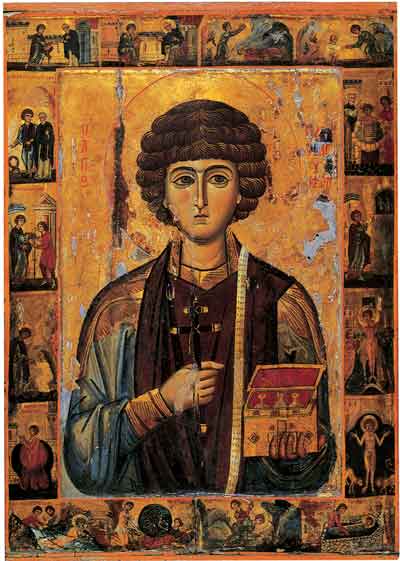
Panteleimon is one of the most immediately recognisable figures in the Byzantine repertory, and the type is remarkably stable from the tenth century to the nineteenth. He is always young and beardless, with a full head of thick dark curls — the mark of the youth-martyr, which he shares with George and Demetrius — and he wears the red cloak of martyrdom over a tunic. What identifies him absolutely is what he carries: in the right hand a slender lancet or probe held upright between finger and thumb, and in the left a small rectangular medicine box (the narthēkion or chrismarion), often jewelled, sometimes shown open with its phials. No other saint carries that pair. The inscription is Ο ΑΓΙΟΣ ΠΑΝΤΕΛΕΗΜΩΝ.
He is very often paired with Hermolaus, his teacher, who stands beside him as a white-bearded priest, and he appears in the standing rank of the Unmercenaries with Cosmas and Damian and Cyrus and John. Narrative cycles, where they occur, take the miracles rather than the tortures as their subject: the raising of the child bitten by the snake, the healing of the blind man, the paralytic before the emperor, and the beheading at the olive tree.
Two images are stored here. The primary is the thirteenth-century vita icon from the Monastery of St Catherine at Sinai — the only surviving Byzantine vita icon of this saint — which shows him half-length in the centre with the lancet and the jewelled medicine box, surrounded by sixteen scenes of his life and passion.
The second is a tenth-century glazed ceramic tile in the Walters Art Museum, Baltimore, one of a set of three identical busts of saints from a Byzantine polychrome frieze, inscribed Ο ΑΓΙΟΣ ΠΑΝΤΕΛΕΗΜΩΝ down either side of the head. It is among the earliest securely dated images of him, and shows the medicine box already in place, together with the lancet in his right hand.
Disputed questions
- Historicity and the Passion. No contemporary document survives. The Passion is a developed hagiographic composition of the fifth or sixth century, of the type that supplies a full cycle of miraculous deliverances before the final sword, and its eyewitness colophon (Laurence, Bassus and Probus) belongs to the conventions of the form. What is early and independent of it is the cult: churches of St Panteleimon at Constantinople and in Bithynia are attested from the fifth century, and the Nicomedian localisation is constant. The historical core — a young Christian physician of Nicomedia put to death in the persecution — is not seriously contested; the detail is hagiography.
- The two names. Older Western books and some Greek manuscripts call him Pantaleon throughout and treat Panteleimon as a later, pious refinement of the name; the Eastern tradition uniformly treats the change as made at his baptism and reads it theologically. The Roman calendar keeps him as Pantaleon on the same day.
- The relics. More than one house claims the head. The Athonite Rossikon's claim is the strongest and the best attested; other Greek and Italian claims exist and are not reconcilable with it.
- Not to be confused with the Nicomedian companies of martyrs kept on other days — the 20,000 Martyrs of Nicomedia (December 28), among whom his teacher Hermolaus was a survivor, and the 3,628 Martyrs of Nicomedia (September 2) — nor with the many later saints named Panteleimon, including the new-martyr priest Panteleimon Bogoyavlensky, shot in 1918, whose memory the Russian Church keeps on this same day.