
Hezekiah
The Holy and Righteous Hezekiah, King of Judah
Righteous · King · b. c. 741 BC — d. c. 687 BC, at Jerusalem
Commemorated 28 August — Commemoration of the righteous king of Judah
Hezekiah, thirteenth king of Judah and the son of the idolatrous Ahaz, is commemorated among the righteous of the Old Covenant as the king who cleansed the Temple, broke the high places, and kept a Passover such as had not been kept since Solomon. In the fourteenth year of his reign Sennacherib of Assyria overran Judah and demanded Jerusalem; Hezekiah spread the letter of the Assyrian before the Lord in the Temple and prayed, and the angel of the Lord went out in the night and the siege was broken. Sick to death soon after, he turned his face to the wall and wept, and the prophet Isaiah, who had just told him he would die, was sent back with the word that fifteen years were added to his life and the shadow on the sun-dial went backward as the sign. He is remembered in the Church less for his reign than for those two prayers — the prayer against the invader and the prayer against death — and for the hymn he wrote when he recovered, which the Church still sings as the fifth ode of every canon.

The son of Ahaz
Hezekiah came to the throne of Judah as a young man, about the year 715, after the reign of his father Ahaz, who had shut the doors of the Temple, set up altars in every corner of Jerusalem, made his own son pass through the fire, and bought Assyrian protection with the treasures of the house of God. The Books of Kings and Chronicles state the contrast in the first sentence they give him: he did that which was right in the sight of the Lord, according to all that David his father had done. Of all the kings of Judah only he and Josiah receive that verdict without qualification.
The reform
He began, according to the Chronicler, in the first month of his first year. He opened the doors of the house of the Lord and repaired them; he called in the priests and Levites and had the Temple cleansed of everything his father had put in it; he restored the offerings and the courses of the singers. He broke the images and cut down the groves, and removed the high places — the local shrines which even good kings before him had left standing, so that this is the particular note of his reform. He also broke in pieces the bronze serpent that Moses had made in the wilderness, because Israel had begun to burn incense to it, and called it Nehushtan, "a piece of bronze." It is a striking act for a conservative reformer: the relic was genuine, and its authenticity was exactly the danger.
Then he sent letters through all Judah and northward into what was left of Israel, summoning the people to keep the Passover at Jerusalem. The feast was kept in the second month, because the priests had not sanctified themselves in time and the people could not gather; many came unpurified from the northern tribes and Hezekiah prayed for them, that the Lord would pardon everyone who prepared his heart to seek God though he were not cleansed according to the purification of the sanctuary — and the prayer was heard. The Chronicler says there had been nothing like it in Jerusalem since Solomon. It is the first great instance in Scripture of mercy overriding rubric, and the Fathers cite it as such.
Sennacherib
In the fourteenth year of his reign Sennacherib, king of Assyria, came up against all the fenced cities of Judah and took them. Hezekiah first tried to buy him off, stripping even the gold from the doors of the Temple; the tribute was taken and the army came on. The Assyrian sent his Rabshakeh to stand before the wall of Jerusalem and shout to the people on it in Hebrew, telling them that no god of any nation had delivered his land, and that the Lord could not deliver theirs.
Hezekiah rent his clothes, went into the house of the Lord, and sent to Isaiah. When the second and more insolent letter came he did the thing for which he is chiefly remembered: he took the letter, went up into the Temple, and spread it out before the Lord — and prayed, not for his own honour but that all the kingdoms of the earth might know that the Lord alone is God. Isaiah answered with the great oracle against Sennacherib, that he should not come into this city nor shoot an arrow there; and that night the angel of the Lord went out and smote in the camp of the Assyrians a hundred fourscore and five thousand. Sennacherib broke camp, returned to Nineveh, and was murdered by his own sons in the temple of his god.
To the same emergency belongs Hezekiah's other well-attested work: he stopped the springs outside the city and cut a conduit through the rock to bring the water of Gihon inside the walls. The tunnel is still there under Jerusalem, and the inscription its diggers left where the two teams met is one of the oldest Hebrew inscriptions known — a rare case where the archaeology and the sacred text touch at the same point.
The sickness and the fifteen years
In those days was Hezekiah sick unto death. Isaiah came to him with the plain word: set thine house in order, for thou shalt die and not live. The king turned his face to the wall and prayed, and wept sore, asking the Lord to remember how he had walked before him. Isaiah had not left the middle court before he was sent back: the prayer had been heard, the tears seen, and fifteen years were added to his life, and the city would be defended. He was healed by a lump of figs laid on the boil; and for a sign the shadow on the dial of Ahaz went back ten degrees.
Out of that recovery came the Writing of Hezekiah, the psalm preserved in Isaiah 38 — I said in the cutting off of my days, I shall go to the gates of the grave… the living, the living, he shall praise thee, as I do this day. The Church took it into her daily prayer: it is the scriptural basis of the fifth ode of the canon, sung at matins the year round, so that Hezekiah's thanksgiving for fifteen more years is on Orthodox lips more often than the words of almost any other king.
The Babylonian envoys, and the end
The last episode is a warning rather than a triumph. Envoys came from Merodach- baladan of Babylon with letters and a present, and Hezekiah, flattered, showed them everything — the silver, the gold, the spices, the armoury, all the house of his treasures. Isaiah asked him what he had shown them, and told him that all of it, and his own sons, would one day be carried to Babylon. Hezekiah answered, Good is the word of the Lord which thou hast spoken — and added, in the text's unsparing way, for there shall be peace and truth in my days. Scripture records both the submission and the complacency.
He reigned twenty-nine years and died about 687, and was buried, the Chronicler says, in the chief of the sepulchres of the sons of David, and all Judah and Jerusalem did him honour at his death. He was succeeded by his son Manasseh, who undid everything.
Feast and commemoration
August 28 (church date; New Calendar civil August 28; Old Calendar civil September 10), on which the Greek synaxaria list Δίκαιος Ἐζεκίας ὁ Βασιλιάς — the Righteous Hezekiah the King — and the Slavic books the Righteous Hezekiah, king of Judah. No proper office is appointed; where the commemoration is kept liturgically it is sung under the common of the righteous. He shares the day with Moses the Ethiopian, and the Slavic calendar adds a further commemoration of him among the righteous of the Old Covenant on the Saturday of Cheesefare. Like all the kings and forefathers of Israel he is comprehended in the Sunday of the Holy Forefathers and the Sunday before the Nativity, when the whole ancestry of Christ after the flesh is commemorated together.
His prayer is nevertheless in constant liturgical use: Isaiah 38:10–20, the Writing of Hezekiah, is the scriptural ode behind the fifth ode of every canon in the Octoechos and the Menaion.
Hymns
Troparion — Tone 2
Reigning in righteousness over the people of God, thou didst cleanse the temple of the abominations of thy father, and spreading before the Lord the letter of the boaster thou wast heard in the night; wherefore, O righteous king Hezekiah, intercede with Christ God that our souls may be saved.
Original translation from the Greek
Kontakion — Tone 2
Turning thy face to the wall thou didst weep, and thy tears were seen, and years were added to thy life and a sign given thee in the going back of the shadow; and the song thou didst then sing the Church still singeth. Wherefore we cry to thee: pray that our days also be turned to repentance, O Hezekiah, king and righteous one.
Original translation from the Greek
Iconography
Hezekiah is rarely painted alone. Where he appears he is a beardless or short-bearded young king in the Byzantine royal manner — the loros, the closed crown, and the sceptre — of the type used for the kings of Judah generally, and is identified by his inscription rather than by an attribute. His usual place is in the genealogy of Christ and in the Tree of Jesse, the great composition that runs the royal ancestry up the wall or the iconostasis from the sleeping Jesse to the Theotokos, in which the kings of Judah are ranged in medallions and Hezekiah takes his place among them; and in illustrated Psalters and Books of Kings, where the narrative scenes belong to him — the Assyrian host struck in the night, the letter spread before the altar, the king in his bed with Isaiah at the door, and the sun-dial with the shadow reversed. The last of these is his most distinctive image and appears in Byzantine manuscript illumination of the sickness of Hezekiah.
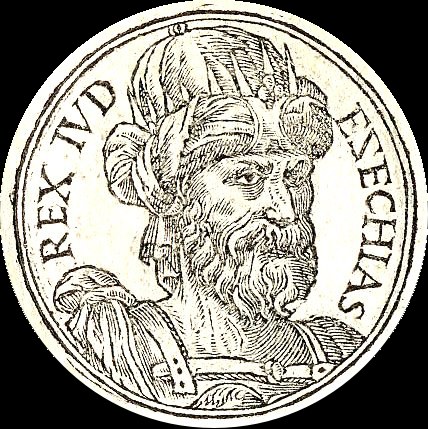
The stored image is a Western work per §34: the woodcut medallion Ezechias Rex Iud. from Guillaume Rouillé's Promptuarii iconum (Lyon, 1553) — an imagined portrait, as all the Promptuarium's ancient likenesses are, the crowned and bearded king in profile, stored as a labelled period image rather than a likeness. A Byzantine image of the king — from the prophet rows or the illumination of his sickness — remains the true want and is listed among the upgrade-wanted icons.
Disputed questions
Chronology. The synchronisms of Kings, the Assyrian annals of Sennacherib, and the fourteenth-year dating of the invasion cannot all be reconciled without strain, and the accession is variously placed between about 727 and 715, with a co-regency often proposed. Sennacherib's campaign of 701 is firmly dated from his own inscriptions, which describe shutting Hezekiah up "like a bird in a cage" in Jerusalem — and, tellingly, do not claim to have taken the city.
Whether he is a saint properly so called. The righteous of the Old Covenant are honoured by the Church as forerunners of Christ rather than as saints of the New Israel, and Hezekiah's separate day is a comparatively thin commemoration kept in the Greek and Slavic synaxaria without a proper office. He is more commonly met in the general commemoration of the holy forefathers and ancestors, and in the reading of his prayer.
The added years. The Fathers dispute whether the fifteen years were a mercy or a concession: Manasseh, the worst king Judah had, was born within them. The tradition draws from this the lesson that God grants what is asked, and that what is asked is not always what should have been asked.