
Moses the Ethiopian
Our Venerable Father Moses the Ethiopian, of Scetis
Venerable · Priest · b. c. 330, in Africa (of black African, traditionally Ethiopian, birth) — d. c. 400, at Scetis (Wadi al-Natrun), slain by raiders
Commemorated 28 August — Repose at Scetis under the swords of the raiders
Moses the Ethiopian — called in Greek ho Aithiops and in Slavonic Murin, "the Black" — is the desert's great sign that no life is beyond mending. Born in Africa about the year 330 and sold as a slave into an Egyptian household, he was thrown out for theft and murder, gathered a band of brigands in the Nile valley and led them by sheer size and ferocity until his name was a terror in the country. Then, hiding among the monks of Scetis, he was overtaken by repentance, received the habit, and gave himself to a penitential struggle of legendary severity under Abba Isidore. He became one of the most quoted of the desert fathers — the author of the saying about the leaking basket of sand, and of the rule that a monk "must die to his neighbour and never judge him at all" — was ordained deacon and then priest, and gathered some seventy-five disciples about him. About the year 400, in his seventy-fifth year, foreseeing a raid on Scetis, he sent his monks away, refused to lift a hand, and was cut down with seven who stayed; a brother hidden in the palm-leaves is said to have seen seven crowns come down upon them. He is honoured throughout the Orthodox and Coptic worlds as the pattern of repentance and of the refusal to judge.

Origins, slavery, and the years of robbery
The record of Moses is unusually good for a desert father. Beside the sayings transmitted under his name in the Apophthegmata Patrum there stands the independent testimony of Palladius, who wrote of him in the Lausiac History about 420 from what was still living memory at Nitria and Scetis, and of the historian Sozomen, writing at Constantinople a generation later. All agree in the outline, and the outline is startling.
He was a black African — the Greek calls him Aithiops, the Slavonic Murin, words that in late antiquity covered the peoples south of Egypt generally and did not yet carry the modern national sense of "Ethiopian." He was a slave in the house of a man of some standing, perhaps a government official; the household dismissed him, Palladius says, for theft, and the tradition adds the suspicion of murder. Cast out and beyond the reach of the law, he went to the brigands of the Nile, and among them rose to be chief — the sources are frank that he owed this to his enormous strength and his savage temper together. Of the robber years the tradition preserved one episode with the vividness of a thing actually remembered: baulked of a raid by a shepherd who had set his dogs on him, Moses crossed the Nile by night with his sword between his teeth, killed the man's best rams, ate what he wanted, and swam back with the carcasses over his shoulders. He was, says the account, feared through the whole district, so that men trembled at his name.
The turning
How the turn came the sources do not agree in detail, and the tradition has never pretended otherwise. In one telling, hunted and needing to disappear, he took refuge among the monks at Scetis and was undone by what he saw there — the silence, the poverty, the courtesy of men who owned nothing and feared no one. In another, a great and sudden compunction fell upon him in the middle of his crimes. What all the accounts hold in common is that the change was total and immediate: he came to a monastery of the desert and asked for the habit, and when the fathers doubted him — as they had every reason to — he would not be sent away, but stood at the gate and wept.
They took him in, and the tears did not stop. The elders remarked on it: that he who had made others weep now wept without ceasing for what he had made them suffer. He gave himself to a flat, unarguing obedience — to the superior and to the brethren alike, taking the last place and disputing nothing.
The tradition set beside his tonsure an episode that has become inseparable from his name. Four robbers of his old kind broke into his cell to rob him. Moses, who could still have killed any two of them with his hands, seized them one after another, tied them together, hoisted the bundle on his back like a sack of grain and carried them into the church, saying that since he was forbidden to hurt anyone he did not know what to do with them, and would the fathers say? The elders ordered them released. The four, who had come to plunder a monk and had been carried into a church by the most feared man in Egypt without a blow struck, were so broken by the thing that they asked for the habit themselves; and in time, says the account, the whole of his old band followed them into the desert.
The ascetic struggle
His conversion did not end the war; it moved it inside. The Apophthegmata are unembarrassed about this: for years Moses was fought by the passions of his old life, and above all by fornication, until he was in danger of despair. He went to Abba Isidore the priest of Scetis, and Isidore set him to a rule of fasting and of standing vigil through the night, and told him to eat only bread and salt and to stop nowhere.
Two of Isidore's answers to him have shaped Orthodox ascetic teaching ever since. When Moses, worn out with the fight and ashamed of himself, came saying he could bear it no longer, Isidore took him up to the roof of the cell before dawn, made him look west, and showed him the demons stirring and scattering as the light came; and then made him look east at the sun coming up slowly, and said that so, little by little, the light rises on a soul — the fight is not lost because it is long. And when Moses came ready to give up altogether, Isidore refused him permission to despair: he was to go back and sit still.
To the struggle Moses added labours of his own. For years he rose at night and went round the cells of the aged fathers, collecting their water-jars and carrying them the long distance to the well and back, so that the old men woke to find their water drawn and never knew by whom. It was in the middle of this, the account says, that the demons fell on him bodily and left him lame and broken for a year — and that when at last Isidore told him the passions had gone out of him, he was given authority over the demons that had tormented him, so that they fled at his word.
Abba Moses of the sayings
By his middle life he was one of the great old men of Scetis, and the sayings gathered under his name are among the most-copied in the whole desert corpus. Four have passed into the common speech of the Church.
The leaking basket. A brother at Scetis fell into a sin, and a council was called to judge him; they sent for Moses, and he would not come. They sent again, and he rose, filled an old basket with sand, slung it on his back where he could not see it, and walked to the assembly with the sand pouring out behind him all the way. They asked what it meant. "My own sins are running out behind me, and I do not see them — and today I have come to judge the sins of another." The brother was forgiven and the council broke up.
"Sit in your cell." Asked by a brother for a word, he said: Go, sit in your cell, and your cell will teach you everything. It is perhaps the single most quoted sentence of the desert.
Dying to one's neighbour. The monk must die to his neighbour and never judge him at all — that is, he must be as incapable of condemning as a corpse is of speaking. In Moses' mouth this is not a piece of moral advice but the whole programme of a man who knew exactly what he himself would look like under judgement.
"Get out, Ethiopian." The most painful and most characteristic of the stories. Archbishop Theophilus of Alexandria, wanting to test him, told the clergy that when Moses came into the sanctuary they should drive him out with insults and then follow to hear what he said. They did: they thrust him from the altar calling him a blackamoor and telling him to get out. He went away muttering to himself — and the clergy, listening, heard him say that they had done rightly, for his skin was as black as ashes, and he was no man, so why should he be let in among men. The tradition records the racial insult without softening it and records what he did with it; that is the point of preserving it.
Ordination
He was ordained deacon, and served in that order for many years — fifteen, in one account — before he was made priest. Of the ordination the desert kept a single exchange. When they had put the white vestment on him, the archbishop said, looking at him, "See, Abba Moses is all white now." And Moses answered: "The outside, lord and father; would that the inside were so too."
As priest he was the father of a community. Palladius gives him seventy-five disciples, gathered in the cells about him at Scetis, and later books make the number larger. Cassian, who was at Scetis in these years, sets the first two of his Conferences — on the aim and end of the monastic life, and on the virtue of discretion — in the mouth of an Abba Moses, whom the tradition and most modern scholars identify with this Moses; if that is right, the great Latin exposition of discretio, the mother of the virtues, comes to the West from the mouth of the converted robber of the Nile.
Repose
He was about seventy-five when word came that a band of raiders — the Mazices, the Berber tribesmen whose incursions would presently devastate Scetis — was moving on the settlement. Moses told his monks to go, and would not go himself. When they urged him he answered that he had waited many years for the word of the Lord to be fulfilled in him: all they that take the sword shall perish with the sword (Matt. 26:52). He would not lift a hand and he would not run. Seven of the brethren stayed with him, and the raiders killed them all. An eighth had hidden himself under a pile of palm-leaves; and it was he, the account says, who saw seven crowns come down out of heaven upon the seven — and understood, when he had counted them, that the eighth crown was waiting for him if he would come out. He came out, and was killed with them.
The traditional year is c. 400; some books give 405, others carry it to the first great sack of Scetis in 407.
Relics and veneration
The Copts, who keep him with particular love as Abba Moses the Black, honour his relics at the Monastery of the Romans (Deir al-Baramus) in the Wadi al-Natrun, one of the four surviving houses of the Scetiote desert, where his body is said to lie with that of his disciple Abba Isidore. His veneration in the Byzantine world is ancient and universal: he stands in the Greek and Slavonic synaxaria for August 28, in the Lausiac History and the Apophthegmata which every monastery copied, and in the canon of Cheesefare Saturday among the ascetic fathers whom the Church names before Lent. Modern devotion in the English-speaking world — where he is usually called Moses the Black — has fastened on him as the patron of those whom the world has written off, and of the reconciliation of peoples; but this is an application, not an invention, of what the sources always said about him.
Feast and commemoration
August 28 (church date; New Calendar civil August 28; Old Calendar civil September 10), kept universally in the Byzantine rite and on the same day in Antiochian, Greek, and Slavic usage. The day falls in the closing days of the church year and on the eve of the strict fast of the Beheading of the Forerunner (August 29), so that in practice the office of Moses is often abbreviated by the forefeast material of the Beheading; the Greek Menaion nevertheless appoints him a full office with proper apolytikion, kontakion, and canon. He is commemorated a second time, with the whole choir of the ascetic fathers and mothers, on the Saturday of Cheesefare, the movable commemoration that opens Great Lent by setting the desert before the Church as its model.
He shares the day in the Slavic calendar with the uncovering of the relics of Job of Pochaev and the Synaxis of the Fathers of the Kiev Far Caves, and in the Greek with the martyrs Diomedes and Laurence and the Thirty-three Martyrs of Heraclea.
Not to be confused with Moses the God-seer the prophet (September 4), Moses the Anchorite (June 28), Moses the Hungarian (July 26), or Moses the Wonderworker of the Kiev Caves (July 28).
Hymns
Apolytikion — Tone 5
Leaving behind the Egypt of the passions, O Father, thou didst climb the mountain of the virtues with burning faith, taking upon thy shoulders the Cross of Christ; and being gloriously glorified, thou wast shown forth a pattern unto monastics, O Moses, summit of the Fathers: with whom cease not to entreat that mercy be shown to our souls.
Kontakion — Tone 4
Having beaten back the faces of the noetic Ethiopians, thou didst shine forth like a radiant sun, giving light to the souls of us who honour thee, O all-blessed Moses.
Original translation from the Greek
Iconography
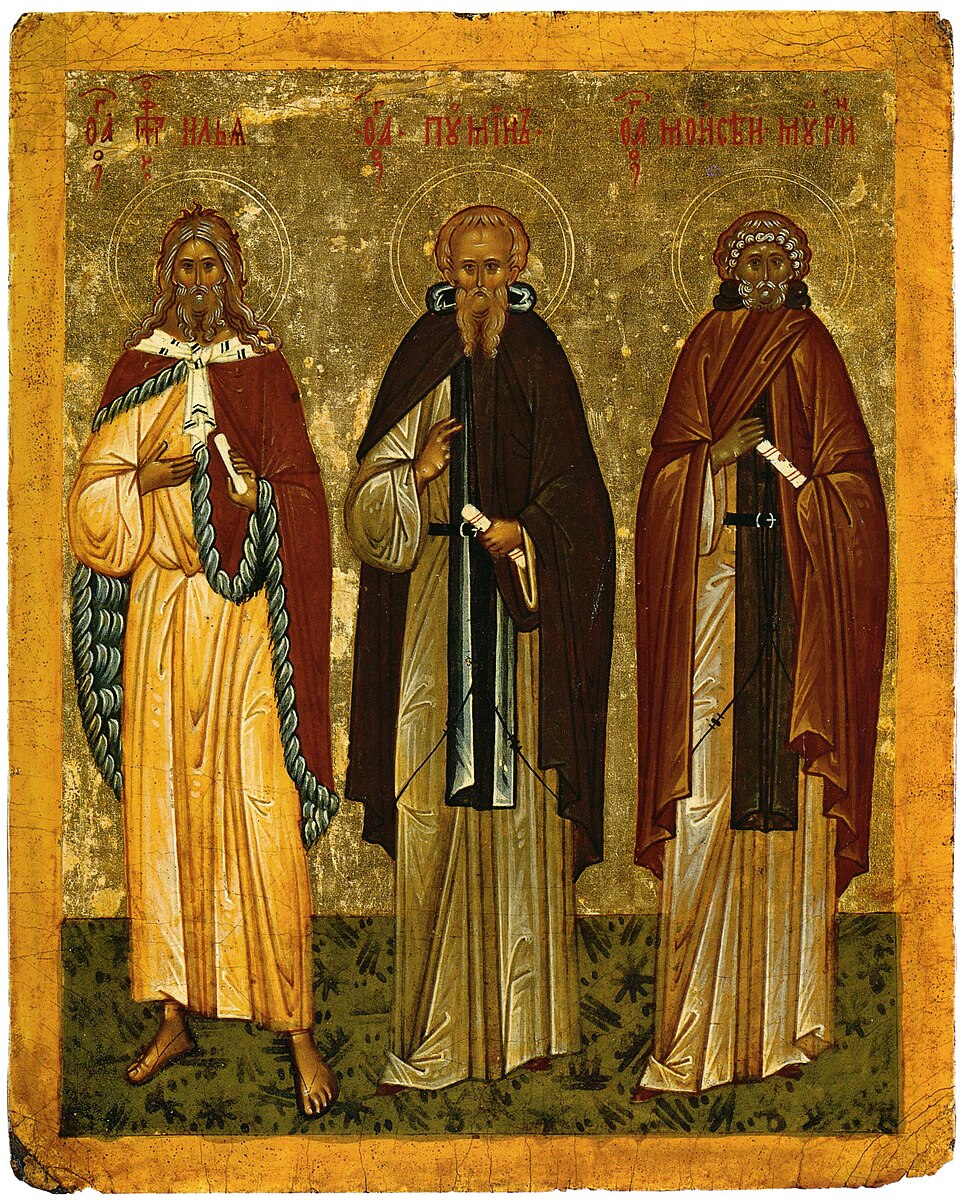
Moses is painted as an old monk of dark complexion — the one clearly and deliberately black face in the ordinary Byzantine and Russian menologion — with close-curled black hair and a full black beard, in the monastic mandyas over the rason, holding a scroll or a cross, and often with the great schema. His height and bulk are frequently indicated: he is drawn a head taller and heavier than the fathers beside him, which is the icon's way of remembering the robber's strength turned to God. He usually appears among the ascetic fathers rather than alone — beside Pimen, Isidore, Arsenius, or Macarius — and in the illustrated menologia under August 28. Later Russian icons sometimes show his death: the raiders with drawn swords, the seven monks, and the crowns descending. In modern devotional practice, especially in North America, he is given a fresh iconographic prominence as the black saint of the desert, but the type itself is old and settled.
The stored image is a fifteenth-century Novgorod panel from the Cathedral of St Sophia (now in the Novgorod Museum), showing three saints side by side; the figure on the right is inscribed СТЫ МОИСЕИ МУРИ — "Holy Moses the Black" — dark-skinned, black-bearded, in the brown mantle over the white rason, holding a scroll and a staff, beside the venerable Pimen in the centre and the Prophet Elijah at the left. It is one of the earliest and clearest surviving witnesses to the settled type (source, public domain, pd-old-work).
Disputed questions
Ethiopian, Nubian, or simply African? The Greek Aithiops and the Slavonic Murin were used broadly of dark-skinned Africans and do not by themselves locate him in the kingdom of Aksum. He may have come from Nubia, from the Ethiopian highlands, or from further west; the sources do not say, and the Ethiopian Church naturally claims him. Nothing in the tradition turns on the answer.
Was he a martyr? The Byzantine books rank him hosios, a venerable father, not a martyr, and this entry follows them; but he was killed for refusing to defend himself, and the seven crowns of the story are martyrs' crowns. Several calendars and much popular usage accordingly call him a martyr, and the Coptic tradition is firmer still on the point. The difference is one of classification and not of fact.
The Abba Moses of Cassian. The identification of this Moses with the Abba Moses of Conferences I–II is traditional and widely accepted, and the chronology and setting fit; it is not, however, formally proved, and a second Moses of Scetis cannot be excluded.
The demons "of the Ethiopians." The Egyptian monastic literature habitually represented the demon of temptation as a black Ethiopian — a convention of the period that the modern reader meets with a jolt, and which appears in Moses' own kontakion, where he "beats back the faces of the noetic Ethiopians." The Church that framed that image also glorified this man and put him in its calendar, and its hymnographers turned the figure deliberately: the black man is the saint, and the blackness that matters is the one he washed off inside.