
Hierotheus of Athens
Our Father among the Saints Hierotheus, Bishop of Athens
Bishop · d. 1st century
Commemorated 4 October
Hierotheus (1st century) is venerated as a member of the Athenian Areopagus converted by the apostle Paul, bishop of Athens, and the teacher of Dionysius the Areopagite, whose feast precedes his on October 3. Everything the tradition tells of him comes through the writings that bear Dionysius's name: that he was an initiate of divine things second only to Paul, author of Elements of Theology and Hymns of Love, and that at the Dormition of the Theotokos he was "wholly transported out of himself," surpassing all the other sacred singers. The Greek books commemorate a peaceful repose; the Slavic tradition styles him a hieromartyr. His feast is October 4.
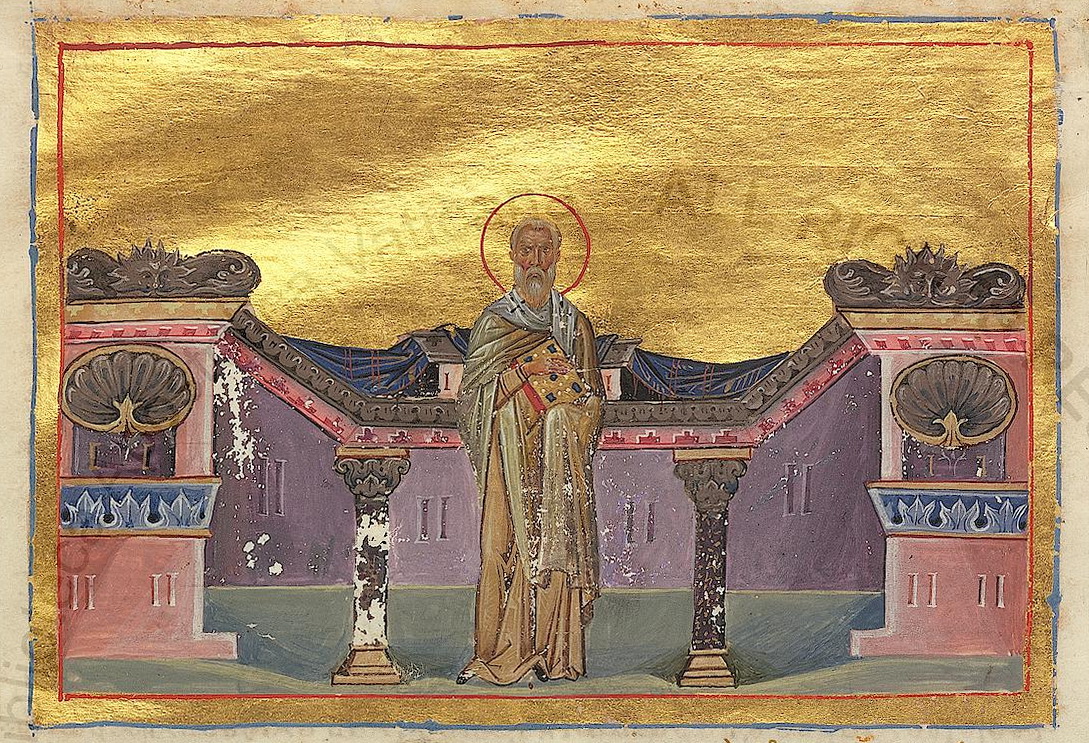
.jpg)
The witness of the tradition
The synaxaria relate that Hierotheus was one of the nine judges of the Areopagus, the venerable high council of Athens, when Paul preached there the sermon on the Unknown God recorded in Acts 17. Converted — the accounts vary as to whether before or together with his fellow councillor Dionysius the Areopagite — he was instructed in the faith by the apostle himself and consecrated by Paul as bishop of Athens. The tradition then makes him in turn the catechist and initiator of Dionysius, so that the two Areopagites stand in a chain of transmission running from Paul: the apostle taught Hierotheus, and Hierotheus "perfected" Dionysius in the deeper mysteries.
Nearly everything ascribed to him beyond this outline derives from the corpus of writings transmitted under Dionysius's name (see Disputed questions). There Hierotheus appears as the author's "famous teacher" (κλεινὸς καθηγεμών), whose instruction came partly from the sacred writers, partly from long scientific inquiry into the Scriptures, and partly from "a certain more divine inspiration, not only learning but suffering divine things" (οὐ μόνον μαθὼν ἀλλὰ καὶ παθὼν τὰ θεῖα) — a phrase that became a permanent axiom of Orthodox mystical theology. The corpus cites two lost works under his name — the Elements of Theology (Θεολογικαὶ στοιχειώσεις), from which it quotes at length on the divine Eros, and Hymns of Love (Ἐρωτικοὶ ὕμνοι) — and presents its own treatises as expansions, for beginners, of teachings Hierotheus had set down with a concentration too dense for common use.
At the Dormition of the Theotokos
The most celebrated notice of Hierotheus in the corpus, and the scene by which the liturgical tradition chiefly remembers him, is the account in On the Divine Names (3.2) of the gathering of "ourselves and many of our holy brethren for the vision of the life-originating and God-receiving body" — understood by the whole later tradition as the funeral of the Theotokos, at which the apostles were gathered miraculously from the ends of the earth, together with James the Brother of God and Peter. After the vision, all the hierarchs present hymned the infinite goodness of the divine weakness; Hierotheus, the text says, "was wholly transported out of himself, wholly in ecstasy towards the things hymned, and was judged by all who heard and saw him, whether they knew him or not, to be inspired of God and a divine hymnographer" — second only to the apostles themselves. The exapostilarion of his feast sets this scene directly into the service of October 4.
Repose
Of his end the early record says nothing beyond the fact of his death. The verses of the Synaxarion of Constantinople for October 4 speak only of his having "departed" and been joined to the Word, and of the earth covering him — the language of a peaceful repose, and the Greek books accordingly style him "our Father among the saints." The Russian tradition, followed by the OCA, styles him a hieromartyr and states that he died a martyr's death in the first century; no account of a martyrdom survives, and the discrepancy is treated below.
Veneration and later cultus
Hierotheus's cultus is inseparable from that of the Areopagitic corpus: as the writings attributed to Dionysius rose to immense authority from the sixth century onward, the teacher named in them entered the calendars beside his disciple. The Byzantine service of October 4, with a full canon and proper stichera, praises precisely what the corpus records — his writings, his initiation by Paul, and his rapture at the Dormition — and in Dormition iconography he is regularly depicted among the hierarchs attending the bier with Dionysius and Timothy.
In Greece his memory remains vivid: the women's monastery of Saint Hierotheos near Megara bears his name, and he is honoured as the first bishop and a heavenly patron of Athens. A curious western extension of his cultus arose in Spain, where seventeenth-century tradition, resting on the fabricated chronicle ascribed to Flavius Dexter, claimed Hierotheus as the first bishop of Segovia; a chapel of "San Geroteo" in Segovia cathedral maintains the devotion to this day. The claim has no ancient basis but witnesses to the breadth of his fame.
Feast and commemoration
October 4 (church date; Old Calendar civil October 17), the day after the feast of his disciple Dionysius the Areopagite — a deliberate pairing that the hymnography of both days exploits, each saint's service invoking the other. The feast is kept universally in the Byzantine rite. The Greek books commemorate him as a hierarch ("our Father among the saints"); the Slavic books as a hieromartyr — the one substantive difference in his commemoration between the traditions. In the Roman Martyrology he appears on the same day, October 4.
Hymns
Troparion — Tone 4
Having learned goodness and being sober in all things, clothed with a good conscience as befits a priest, thou didst draw out from the Vessel of Election things ineffable; and having kept the faith, thou hast finished the like course, O Hieromartyr Hierotheus. Intercede with Christ God, that our souls may be saved.
Original translation from the Greek
Kontakion — Tone 8
We acclaim thee, the hierarch of Athens, for through thee we were initiated into strange and ineffable mysteries; for thou wast shown forth a hymnographer seized by God. But intercede, all-blessed Hierotheus, that we be delivered from calamities of every kind, so that we may cry: Rejoice, O Father wise in the things of God.
Original translation from the Greek
Kontakion
Like an unshakeable pillar, O Hierotheus, thou wast not affrighted at the threats of the enemies, but didst overthrow the stronghold of deception, rolling like a precious stone, O father; wherefore the Master crowneth thee, who hast striven bravely, with His life-originating and divine right hand. Him do thou entreat for us all.
Original translation from the Greek
Iconography
Hierotheus is depicted as an elderly hierarch with a tapering grey beard, in phelonion and omophorion, holding the book of the Gospels; he is distinguishable from his disciple Dionysius chiefly by inscription and by his plainer, non-polystavrion vesture in older monuments. Beyond his single portrait he appears constantly in icons of the Dormition of the Theotokos, standing at the bier among the hierarchs with Dionysius and Timothy. Notable early images include the mosaic at Hosios Loukas (11th century), the fresco by Michael and Eutychios in the Peribleptos church at Ohrid (c. 1295), and the miniature in the Menologion of Basil II (c. 985), which is the image stored here.
Disputed questions
- Historicity. Hierotheus is known to history solely through the Areopagitic corpus and the synaxaria dependent on it. Since the corpus itself is now generally dated by scholars to around the year 500 and regarded as pseudonymous, Hierotheus's own existence as a first-century Athenian cannot be independently verified: he may be a literary creation of the corpus's author, or — as some scholars have suggested — a veiled honouring of the author's real (fifth-century) teacher. The Byzantine tradition received him without question as a historical companion of Paul, and the Church's calendars commemorate him as such; this entry records the tradition and the problem side by side. (A later Syrian legend even produced a "Book of Hierotheus," in fact a work of the Syrian mystic Stephen bar Sudhaili, further illustrating how the name attracted attribution.)
- Martyrdom. The Greek synaxarion and Menaion know nothing of a violent death, and their verses imply a peaceful repose; the Slavic menologia and the OCA style him "hieromartyr," and the troparion common to him and Dionysius addresses him as such. As with Cornelius the Centurion (September 13), the martyric styling of some calendars is recorded here without being converted into a biographical fact: no account of a martyrdom of Hierotheus is transmitted.
- First bishop of Athens. The synaxaria call Hierotheus bishop of Athens ordained by Paul, and the Greek tradition commonly styles him the city's first bishop; but Eusebius, quoting Dionysius of Corinth (2nd century), makes Dionysius the Areopagite the first bishop of Athens. The two claims are variously harmonised — Hierotheus first, succeeded by Dionysius; or Dionysius first while Hierotheus taught — and no early evidence settles the sequence.
- The epithet "Thesmothete." Later Greek usage calls him ὁ Θεσμοθέτης, "the lawgiver" — properly the title of six of the nine Athenian archons — reflecting the tradition that he sat among the judges of the Areopagus.