
Dionysius the Areopagite
The Holy Hieromartyr Dionysius the Areopagite, Bishop of Athens, and with him the Martyrs Rusticus the Presbyter and Eleutherius the Deacon
Hieromartyr · Bishop · d. c. 96
Commemorated 4 January — Synaxis of the Seventy Apostles (he is counted among the Seventy in the traditional lists), 3 October — Martyrdom, with Rusticus and Eleutherius
Dionysius the Areopagite (†c. 96) was the judge of the Athenian high court who believed at the Apostle Paul's sermon on the Areopagus (Acts 17:34) and became, by the earliest tradition, the first bishop of Athens. The Church commemorates him on October 3 as a hieromartyr, together with the presbyter Rusticus and the deacon Eleutherius who suffered with him. Around his name has gathered one of the great questions of Christian history: the Corpus Areopagiticum, the profound mystical-theological writings transmitted under his name but composed some four centuries after him, and the medieval conflation of the Areopagite with Denis, the martyred third-century bishop of Paris.

Conversion at the Areopagus
Everything certainly known of Dionysius stands in a single verse of Scripture. When Paul came to Athens on his second missionary journey (c. 50–52), provoked by the city full of idols, he was brought to speak before the Areopagus — at once a hill west of the Acropolis and the name of the venerable council that had anciently met there, the highest court of the city, whose members, the Areopagites, were drawn from former archons and were men of standing, learning and proven character. There Paul delivered the address preserved in Acts 17, taking as his text the Athenian altar "to an Unknown God" and proclaiming the God who made the world, who "is not far from each one of us," and who had appointed a day of judgment by a Man raised from the dead. Most of the hearers mocked or deferred; "but certain men clave unto him, and believed: among the which was Dionysius the Areopagite, and a woman named Damaris, and others with them" (Acts 17:34).
That a member of the Areopagus court accepted the apostolic preaching was remembered by the Church as a first-fruit of learned Greece — the day's hymnography calls him the offering by which "the glorious metropolis of Athens" was presented to Christ. On Damaris, converted in the same hour and commemorated on the same day, see her own entry.
Bishop of Athens
The earliest post-biblical witness is Dionysius, bishop of Corinth (c. 170), quoted by Eusebius of Caesarea: writing to the Athenians, the Corinthian records that Dionysius the Areopagite, converted by Paul according to the account in Acts, "was the first to be entrusted with the bishopric of the diocese of Athens" (Eusebius, Church History 3.4.10; cf. 4.23.3). This tradition, barely a century removed from the events, is early and credible in itself, and the Church has always received it: the Areopagite governed and built up the infant Athenian church, of which Quadratus the Apologist and Publius were later heads. The later hagiographic tradition adds that he was ordained for Athens by Paul himself; the tradition that he was also numbered among the Seventy Apostles appears in the traditional lists of the Seventy ascribed to Dorotheus and Hippolytus, and the Slavic calendars accordingly include him in the Synaxis of the Seventy on January 4.
The later traditions
The received Byzantine Life — drawn together in the encomium ascribed to Michael the Syncellus (9th century), in Symeon Metaphrastes, and in the synaxaria — clothes the bare record in a fuller biography, most of it derived, directly or at a remove, from the writings transmitted under Dionysius's own name (see Disputed questions):
- Education and the darkness at the Crucifixion. Born of eminent Athenian parents, Dionysius was trained in the full curriculum of Greek philosophy and travelled to Egypt to study astronomy. At Heliopolis, with his companion Apollophanes, he observed the unnatural darkening of the sun at the hour of the Crucifixion — an eclipse impossible by natural reckoning, the moon then being full — and is said to have exclaimed that "either God suffers, or the world is ending." The source of this celebrated episode is the seventh letter of the Corpus Areopagiticum, addressed to Polycarp, where the author "recalls" the observation in the first person; the hagiographers received it as biography.
- Presence at the Dormition. The tradition that Dionysius stood with the apostles at the falling-asleep of the Theotokos likewise rests on the Corpus: in On the Divine Names (3.2) the author describes being gathered with James the brother of God and Peter to gaze upon "the life-giving and God-receiving body," a passage the Church's tradition has always read of the Dormition, and which placed Dionysius (with his teacher Hierotheus) among the hierarchs depicted in Dormition icons.
- Mission and martyrdom in the West. The synaxaria relate that after long labours at Athens Dionysius journeyed to Rome, was sent by Clement of Rome to preach in Gaul, and evangelized at Lutetia (Paris) with the presbyter Rusticus and the deacon Eleutherius, until all three were beheaded under the persecution of Domitian, about the year 96, the bishop being then some ninety years old. The famous cephalophore legend — that the martyr's body rose, took up its severed head, and walked to the place where he willed to be buried — is of Western origin, from the Parisian passions of St. Denis, but it entered the Byzantine tradition whole: the epigram of the Synaxarion of Constantinople for October 3 plays upon it ("Thou art beheaded — and what a marvel follows: taking up thy head, O Dionysius, thou runnest").
Rusticus and Eleutherius
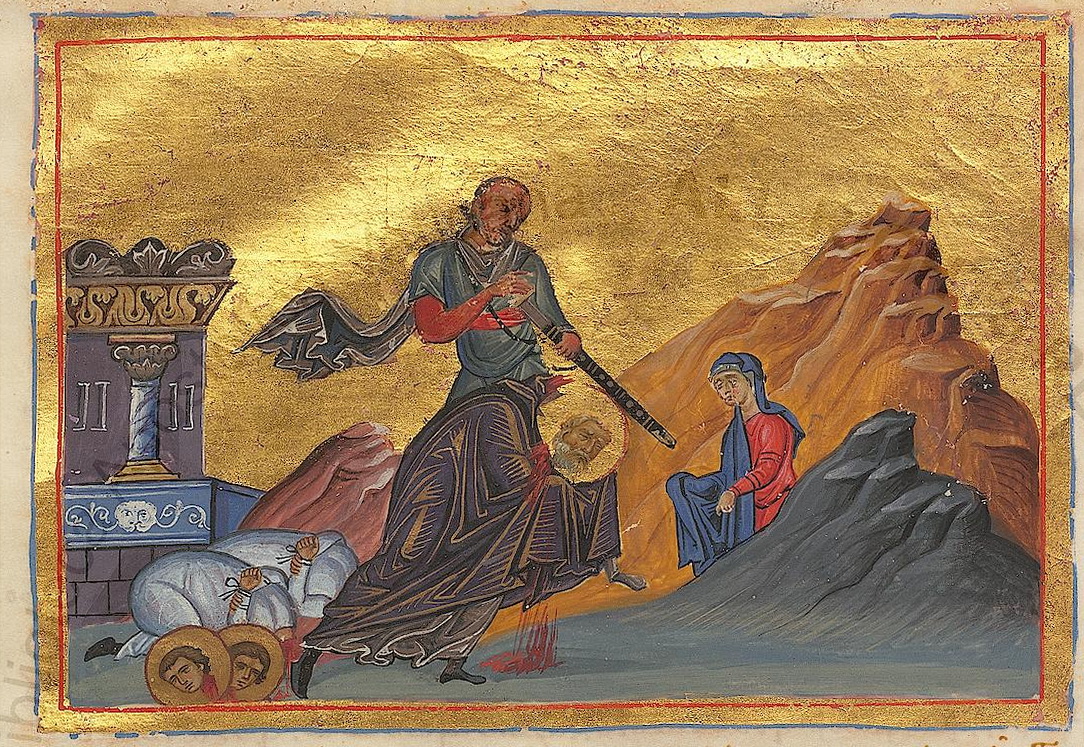
The presbyter Rusticus and the deacon Eleutherius are known only from the Parisian martyrdom account, in which they are the fellow-labourers and fellow-martyrs of the bishop, beheaded with him and buried with him. The Byzantine synaxaria give them a separate notice with its own epigram on October 3 but no independent cultus: they are commemorated with Dionysius, share his service, and are shown with him in the Menologion of Basil II miniature of the triple martyrdom. They therefore share this entry. Their Latin names sit more naturally in third-century Gaul than in the first century — one of the observations that first unpicked the conflation discussed below. The deacon Eleutherius of this company is not to be confused with the hieromartyr Eleutherius, bishop of Illyricum (December 15), a distinct saint with his own feast.
Relics and the abbey of Saint-Denis
The Western tradition held that the three martyrs were buried where the abbey of Saint-Denis later rose, north of Paris; the abbey — royal necropolis of France — claimed the relics of "Dionysius the Areopagite" throughout the Middle Ages, and its prestige powered the identification of the Parisian martyr with the Athenian convert. Portions of relics attributed to the Areopagite are also claimed in the East. No head or body relic tradition in the Byzantine world rivals the Parisian claim, which stands or falls with the identification itself.
Veneration and later cultus
Dionysius is the patron saint of the city of Athens, where October 3 is kept as a civic feast, and is honoured in Greece as patron of the judiciary — a patronage flowing directly from his seat on the Areopagus court, whose name the modern Supreme Court of Greece (the Areios Pagos) still bears. Byzantine hymnography celebrates him above all as the initiate and expounder of the heavenly mysteries: the stichera of his feast praise him for having "set down in sacred books the supramundane good order of the hierarchy," and the doxastikon of Vespers pairs him with Cyprian of the previous day's feast as the two hierarchs won from pagan philosophy and magic. The Menologion of Basil II (c. 985) devotes to the three martyrs one of its finest miniatures.
Feast and commemoration
The primary feast, October 3 (church date; Old Calendar civil October 16), commemorates the martyrdom and is kept universally in the Byzantine rite, with the martyrs Rusticus and Eleutherius named in the second place of the synaxarion. The service in the Menaion is a full proper service of the hieromartyr. In the Slavic usage Dionysius is also commemorated in the Synaxis of the Seventy Apostles on January 4, being counted among the Seventy in the traditional lists. In Athens the feast is patronal and civic. The Roman rite keeps the conflated Western feast of Denis, Rusticus and Eleutherius on October 9; since the twentieth century the Roman books identify that Denis as the bishop of Paris, not the Areopagite.
Hymns
Troparion — Tone 4
Having learned goodness and being sober in all things, clothed with a good conscience as befits a priest, thou didst draw out of the vessel of election things ineffable; and having kept the faith, thou didst finish an equal course, O hieromartyr Dionysius. Intercede with Christ God, that our souls may be saved.
Original translation from the Greek
Kontakion — Tone 8
Having passed through the gates of heaven in spirit, taught as a disciple by the Apostle who reached beyond the third heaven, O Dionysius, thou wast enriched with all knowledge of things unutterable, and thou didst enlighten those who before lay sleeping in the darkness of ignorance. Wherefore we cry: Rejoice, Father of all the world.
Original translation from the Greek
Appointed readings
Epistle — Acts 17:16–34
16Now while Paul waited for them at Athens, his spirit was stirred in him, when he saw the city wholly given to idolatry. 17Therefore disputed he in the synagogue with the Jews, and with the devout persons, and in the market daily with them that met with him. 18Then certain philosophers of the Epicureans, and of the Stoicks, encountered him. And some said, What will this babbler say? other some, He seemeth to be a setter forth of strange gods: because he preached unto them Jesus, and the resurrection. 19And they took him, and brought him unto Areopagus, saying, May we know what this new doctrine, whereof thou speakest, is? 20For thou bringest certain strange things to our ears: we would know therefore what these things mean. 21(For all the Athenians and strangers which were there spent their time in nothing else, but either to tell, or to hear some new thing.) 22Then Paul stood in the midst of Mars’ hill, and said, Ye men of Athens, I perceive that in all things ye are too superstitious. 23For as I passed by, and beheld your devotions, I found an altar with this inscription, TO THE UNKNOWN GOD. Whom therefore ye ignorantly worship, him declare I unto you. 24God that made the world and all things therein, seeing that he is Lord of heaven and earth, dwelleth not in temples made with hands; 25Neither is worshipped with men’s hands, as though he needed any thing, seeing he giveth to all life, and breath, and all things; 26And hath made of one blood all nations of men for to dwell on all the face of the earth, and hath determined the times before appointed, and the bounds of their habitation; 27That they should seek the Lord, if haply they might feel after him, and find him, though he be not far from every one of us: 28For in him we live, and move, and have our being; as certain also of your own poets have said, For we are also his offspring. 29Forasmuch then as we are the offspring of God, we ought not to think that the Godhead is like unto gold, or silver, or stone, graven by art and man’s device. 30And the times of this ignorance God winked at; but now commandeth all men every where to repent: 31Because he hath appointed a day, in the which he will judge the world in righteousness by that man whom he hath ordained; whereof he hath given assurance unto all men, in that he hath raised him from the dead. 32And when they heard of the resurrection of the dead, some mocked: and others said, We will hear thee again of this matter. 33So Paul departed from among them. 34Howbeit certain men clave unto him, and believed: among the which was Dionysius the Areopagite, and a woman named Damaris, and others with them.
Gospel — Matthew 13:44–54
44Again, the kingdom of heaven is like unto treasure hid in a field; the which when a man hath found, he hideth, and for joy thereof goeth and selleth all that he hath, and buyeth that field. 45Again, the kingdom of heaven is like unto a merchant man, seeking goodly pearls: 46Who, when he had found one pearl of great price, went and sold all that he had, and bought it. 47Again, the kingdom of heaven is like unto a net, that was cast into the sea, and gathered of every kind: 48Which, when it was full, they drew to shore, and sat down, and gathered the good into vessels, but cast the bad away. 49So shall it be at the end of the world: the angels shall come forth, and sever the wicked from among the just, 50And shall cast them into the furnace of fire: there shall be wailing and gnashing of teeth. 51Jesus saith unto them, Have ye understood all these things? They say unto him, Yea, Lord. 52Then said he unto them, Therefore every scribe which is instructed unto the kingdom of heaven is like unto a man that is an householder, which bringeth forth out of his treasure things new and old. 53And it came to pass, that when Jesus had finished these parables, he departed thence. 54And when he was come into his own country, he taught them in their synagogue, insomuch that they were astonished, and said, Whence hath this man this wisdom, and these mighty works?
Iconography
Dionysius is depicted as an aged hierarch with a long, tapering grey or white beard, in cross-adorned phelonion and omophorion, holding the Gospel book; his physiognomy is fixed and recognisable across the Byzantine world. He appears not only in single icons and menologion cycles but, from the middle Byzantine period onward, among the hierarchs (with Hierotheus and Timothy) standing beside the apostles in icons of the Dormition — a direct iconographic echo of Divine Names 3.2. Western art gave the conflated St. Denis the cephalophore type, mitred and carrying his own head; that type is foreign to Orthodox iconography, though the synaxarion epigram knows the legend.
The stored primary image is the miniature of the Menologion of Basil II (c. 985, Vat. gr. 1613, p. 82), showing the beheading of the three martyrs — Dionysius in episcopal vesture, Rusticus and Eleutherius beside him. The variant is a portrait icon by Emmanuel Tzanes (17th century, Cretan school; National Museum of Art, Architecture and Design, Oslo), showing the saint enthroned in hierarchical vestments.
Disputed questions
The Corpus Areopagiticum
Under the name "Dionysius the Areopagite" antiquity transmitted a body of writings of immense depth and influence: On the Celestial Hierarchy, On the Ecclesiastical Hierarchy, On the Divine Names, the brief On Mystical Theology, and ten letters (the author refers also to further treatises — a Symbolic Theology, Theological Outlines — which no one has ever seen and which are generally judged a literary fiction). The question of their authorship is one of the great critical problems of Christian literature.
The case against apostolic-age authorship. No writer of the first five centuries — not Eusebius, who catalogued Christian literature; not Jerome — knows these works. They surface abruptly in the early sixth century in Syrian monophysite circles: Severus of Antioch cites them (before 518), and at the colloquy between Chalcedonians and Severans held at Constantinople in 532/533 the Severan party appealed to them, whereupon Hypatius of Ephesus, spokesman of the Orthodox side, rejected the citations on the ground that if such works of the Areopagite existed, the ancients could not have been ignorant of them — the first recorded doubt, and still the heart of the matter. The internal evidence is decisive: the author quotes the fifth-century Neoplatonist Proclus (†485) — the dependence demonstrated in detail by Hugo Koch and Josef Stiglmayr in 1895, which settled the question critically — presupposes the developed liturgy, monasticism, and creedal usage of the late fifth century, and writes a Greek saturated in late Neoplatonic vocabulary. The corpus is therefore dated between about 485 and 528, and its author, conventionally "Pseudo-Dionysius," is generally sought in Syrian theological circles. Candidates proposed — Peter the Iberian (Honigmann), Sergius of Reshaina, John of Scythopolis himself, among others — have each found advocates and none general acceptance; the author's self-veiling has succeeded to this day.
Why the pseudonym. The choice of the Areopagite was not idle: the author presents his mystical theology as the hidden wisdom the convert of Acts 17 received from Paul — the philosopher-judge won on the very hill of Greek wisdom becomes the ideal mouthpiece for a theology in which the best of Hellenic thought is baptized and surpassed. Pseudonymous attribution to an apostolic figure was an established convention of the age, however much it complicated later reception.
Reception and influence. Once received, the corpus's authority was immense and its influence on Christian theology, East and West, second only to Scripture and the greatest fathers. John of Scythopolis annotated and defended it (c. 540); Maximus the Confessor built upon it and the scholia travelled under his name, sealing its orthodox reception; it was cited at the Lateran Synod of 649 and by John of Damascus; its angelology — the nine orders in three triads (Seraphim, Cherubim, Thrones; Dominions, Powers, Authorities; Principalities, Archangels, Angels) — became the Church's standard, shaping hymnography and iconography alike; its apophatic theology — that God, beyond every name and concept, is known in the "divine darkness" beyond knowing — passed into the bloodstream of Orthodox theology, through Maximus to Gregory Palamas and the hesychasts. In the West, translated by Hilduin and then masterfully by Eriugena (c. 862), the corpus formed medieval mysticism and scholasticism — Aquinas cites "Dionysius" well over a thousand times. Renaissance criticism (Lorenzo Valla, 1457; Erasmus after him) reopened Hypatius's doubt; Koch and Stiglmayr closed the case.
The Orthodox reception of the question. The Orthodox Church has never made the critical question a matter of doctrine. She continues to venerate the hieromartyr Dionysius the Areopagite, convert of Paul and bishop of Athens, whose historicity stands on Acts and the second-century witness and is untouched by the authorship problem; and she continues to read, cite and revere the Corpus as a patristic monument of the first rank, whose orthodoxy was secured by the interpretive labour of John of Scythopolis and Maximus, whatever the author's name. The Menaion's hymns for October 3, composed when no one doubted, praise the martyr precisely as author of the books on the hierarchies; the modern reader of the service sings them as the Church's reception of the corpus into the saint's cultus. Modern Orthodox scholarship (Florovsky, Meyendorff, Louth, Golitzin) overwhelmingly accepts the pseudonymity while defending the corpus's theological worth; a minority of traditionalist voices still argues for authenticity. This entry keeps the two figures distinct: the first-century martyr commemorated today, and the anonymous early-sixth-century theologian who wrote in his name.
One saint or three: the Parisian conflation
Three originally distinct figures were welded into one "Saint Denis":
- Dionysius the Areopagite, the first-century Athenian of Acts;
- Dionysius (Denis), bishop of Paris, sent to Gaul in the mid-third century — Gregory of Tours (History of the Franks 1.30) counts him among the seven bishops sent under Decius (c. 250) — and martyred at Paris with the presbyter Rusticus and the deacon Eleutherius;
- The author of the Corpus, c. 500.
The decisive fusion of the first two was accomplished by Hilduin, abbot of Saint-Denis, whose Areopagitica (c. 835), written to glorify his abbey just after the corpus's arrival in Francia, gave the West a single composite saint: Areopagite, author, apostle of Gaul, and cephalophore martyr of Montmartre. The identification was doubted even in the Middle Ages — Abelard was expelled from Saint-Denis for observing that the abbey's patron might not be the Areopagite — and is universally abandoned: the Roman Martyrology now keeps Denis of Paris separately on October 9. The Byzantine synaxaria, receiving the Parisian passion material, absorbed the same conflation: the received Orthodox Life sends the Areopagite to Paris under Domitian and gives him Rusticus and Eleutherius as companions, whereas the historical kernel of the Paris martyrdom belongs to the third century. The Church's calendars commemorate the saints as received; the layered history is recorded here as the scholarship has established it.
Other Dionysii
The name was common, and confusion is easy. Distinct from today's saint are: Dionysius, bishop of Alexandria (†265, commemorated October 5, two days hence); Dionysius, bishop of Corinth (c. 170, our earliest witness to the Areopagite's episcopacy; commemorated November 29); the hieromartyr Dionysius with eight fellow-martyrs, listed by the Synaxarion of Constantinople on this same October 3 (see the day's pending entries); Dionysius the Recluse of the Kiev Caves (15th century, also October 3); and Dionysius of Zakynthos (December 17).