
Hilarion the Great
Our Venerable and God-bearing Father Hilarion the Great
Venerable · b. c. 291 — d. 371
Commemorated 21 October — Repose on Cyprus
Hilarion the Great (c. 291–371) was the founder of the monastic life in Palestine, as his master Anthony the Great was its founder in Egypt. Born of pagan parents near Gaza and converted while a student at Alexandria, he sought out Anthony in the Egyptian desert, then returned to withdraw into the barren coastland of Majuma, where for decades he lived in extreme austerity. His miracles drew such crowds that monasteries multiplied across the Palestinian desert around him, and to escape his own fame he fled in old age through Egypt, Sicily, Dalmatia, and finally Cyprus, where he died. His disciple Hesychius stole the body back to Palestine, and both islands and mainland claimed him. He is known above all from the celebrated Life written by Jerome.
.jpg)
The chief source for Hilarion is the Vita Hilarionis — the Life of Saint Hilarion — composed in Latin by Jerome (Hieronymus) around 390, some twenty years after the saint's death, as a deliberate counterpart to Athanasius's Life of Anthony. Jerome, who had lived as a hermit in the Syrian desert and later settled at Bethlehem, drew on the memoir of the saint's own disciple Epiphanius of Salamis and on the living memory of the Gaza region. An independent witness is the church historian Sozomen, himself a native of the Gaza district (Bethelia), whose family tradition held that his own grandfather had been converted to Christ through one of Hilarion's miracles; Sozomen devotes several chapters of his Ecclesiastical History to the saint. The two accounts agree in substance, and where later synaxaria abridge the story they follow Jerome.
Origins and early life
Hilarion was born about the year 291 in the village of Thabatha (Tabatha), some five miles south of Gaza on the Palestinian coast, of parents who worshipped the old gods — Jerome's memorable image is of "a rose springing from thorns." Sent while still a boy to Alexandria to be educated, he proved quick and eloquent in the schools of grammar and rhetoric; but there he also came to the Christian faith, was baptised, and found the churches and their assemblies dearer to him than the lecture halls and the theatre.
When word reached Alexandria of Anthony the Great, whose name by then filled Egypt, the boy — about fifteen years old — went out into the desert to find him. He remained with Anthony for a time (the accounts say about two months), watching the pattern of the great hermit's life: his unbroken prayer, his humility, his severity in fasting, his gentleness toward visitors and firmness toward the sick and the possessed who thronged him. But it was precisely the crowds around Anthony that Hilarion found unbearable, judging it unfitting to seek in the desert the fame he had left the city to escape. Resolving to begin where Anthony had begun, he returned to Palestine.
Ascetic struggle
He found his parents dead. Dividing his inheritance between his brothers and the poor and keeping nothing for himself — lest, in Jerome's phrase, he prove like Ananias and Sapphira, or, "having put his hand to the plough, look back" — he withdrew into the wilderness. The place he chose was the desolate strip of coast near Majuma, the port of Gaza, a haunt of brigands between the sea and a malarial marsh, where his friends warned him he would be killed. He was then about fifteen or sixteen.
His austerities became legendary and were graded with age. His clothing was a sackcloth shirt, a cloak of skins that Anthony had given him, and a coarse peasant's blanket; he never changed the sackcloth until it was worn out, holding it needless to look for cleanliness in a hair shirt, and cut his hair but once a year, at Pascha. From his fifteenth to his twentieth year his shelter was a tiny hut of reeds and sedge; afterwards he built himself a cell so low and narrow — four feet wide, five feet high, shorter than his own body — that it resembled a tomb more than a house. His diet, taken only after sunset, was for years fifteen figs a day; as he aged he added a little bread with salt and water, then herbs and a few vegetables, and in extreme old age a broth of meal and oil, always measured so as to keep the body weak enough to obey. When the assaults of the flesh troubled his youth he starved and beat the rebellious body, saying to it, "I will see to it, you little donkey, that you do not kick; I will feed you with straw, not with barley."
The demons, Jerome relates, assailed him with terrors — phantom noises in the night, the cries of infants, the bleating of flocks, the roar of beasts, once a gladiator's clash of arms, once a naked woman upon his poor bed — and he answered all with the sign of the Cross and the psalms, until the very ground he had chosen for a grave became the cradle of a new desert nation.
Founder of Palestinian monasticism
For some twenty-two years Hilarion lived unknown. His first public miracle, about the year 329, broke his obscurity: a noblewoman of Eleutheropolis named Aristaenete, childless for years, sought him out and was granted three sons. From that day the sick and the possessed came in a stream that never after ran dry. He healed a paralysed charioteer of Gaza; he broke the spells of a rival's magic in the hippodrome; he cast out a legion of demons from a frenzied camel led to him in chains; he cured fevers and blindness and barrenness, drew rain in drought for the parched fields around Gaza, and rebuked demons who confessed Christ against their will. He would take no payment and no gift, offering only a loaf of barley bread and refusing even a basket of fruit.
The crowds became a multitude. Monks and lay pilgrims settled about his cell, and out of them monasteries sprang up throughout the deserts of Palestine, for until Hilarion — as both Jerome and Sozomen insist — there had been no monks in that land at all. He made annual visitations of these houses, riding a donkey, attended by companies of ascetics, ordering their common life on the Egyptian model he had received from Anthony. He is therefore called the father and founder of monasticism in Palestine, the bridge by which the Egyptian anchoretic ideal crossed into the Holy Land. He is said to have received word of Anthony's death (356) while at prayer, and to have been visited in spirit by his master.
Flight from fame and wanderings
The very success he had dreaded at last drove him out. Numbering, Jerome says, some ten thousand who followed and pressed upon him, and grieving that he had found in the Palestinian desert the throng he had once fled in Egypt, Hilarion determined — now past sixty — to leave the country of his birth. Weeping, his disciples clung to him; he broke away, and with a company that soon dwindled to a few he began the long flight that fills the last third of his Life.
He went first back to Egypt: to Pelusium, to Bubastis, to the mountain and garden of Anthony, where the old man's two disciples Isaac and Pelusianus showed him the bed of reeds and the fruit trees the master had planted, and Hilarion kissed the place where Anthony had died. From the desert of Aphroditopolis and the oasis he took ship at Paraetonium for Sicily, resolving to be known only "among barbarians." He landed at Cape Pachynus and settled inland, gathering sticks for a hermit's living; but a demoniac dragged from Rome to Sicily cried out his name in the basilica of Peter, and the concealment failed.
Learning that his fame had spread even there, he crossed with his faithful disciple Hesychius to Epidaurus in Dalmatia. There, the tradition holds, he delivered the region from a monstrous serpent — a boa that devoured cattle and men — by commanding it onto a pyre; and when the great earthquake of 366 sent the sea rising in a wall against the town, the people carried the old hermit to the shore, where he traced three signs of the Cross upon the sand and stood against the flood until the waters, mounting like a mountain, sank back before him. Fame pursuing him still, he took ship again, and after a stormy passage — in which, Jerome notes, he refused the fare of pirates, having nothing, and converted the crew — he reached Cyprus.
Repose
On Cyprus Hilarion first settled among ruins near Paphos, then withdrew twelve miles inland to a hidden, all-but-inaccessible spot in the mountains, watered by a little spring and set among the vestiges of an old pagan shrine, where the local demons had long troubled the neighbourhood. There he spent his last five years in the quiet he had sought all his life, though even there the sick found him out and were healed. Hesychius, who had gone back to Palestine, returned to be with him at the end.
Hilarion died in that Cypriot retreat about the year 371, in his eightieth year. Feeling death near, he wrote in his own hand a short will leaving to Hesychius his only possessions — a Gospel book and his rough tunic, cloak, and hood — and, as his soul struggled to depart the body it had ruled so long, he spoke the words Jerome preserves: "Go forth, my soul; why dost thou fear? Go forth; why dost thou hesitate? Nearly seventy years hast thou served Christ, and dost thou fear death?" With that he reposed. The Christians of the district buried him where he lay.
Relics and translations
Hesychius, unwilling that so great a treasure should rest among strangers, kept vigil at the tomb for some ten months, feigning a wish to live at the holy place; then, secretly, he took up the body — found, the tradition says, entire and fragrant — and carried it by ship back to Palestine, to the old monastery at Majuma, where a great gathering of monks and townsfolk laid it to rest in the first cell of Hilarion's own founding. Both places thereafter claimed the saint and worked miracles at his grave: the Palestinians pointing to the body at Majuma, the Cypriots to the empty tomb and the spot of his repose, where a devout woman named Constantia (August 25) kept the vigil until her own death. The rivalry of the two shrines is itself an early witness to the strength of his cult.
Veneration and later cultus
Hilarion's memory spread quickly through both the Greek and Latin worlds, carried by Jerome's Life, which became one of the most widely read of all monastic biographies and a model for the genre. In the East he entered the Synaxarion under 21 October and was given a full liturgical office; in the West the Roman Martyrology keeps him on the same day. Monasteries and springs bore his name across the eastern Mediterranean, and the ruined coastal monastery of Tell Umm el-'Amr (Umm Amer) south of Gaza — one of the oldest in the Holy Land, uncovered by modern excavation — preserves the site traditionally connected with him. He is counted among the great fathers of the desert alongside Anthony, Paul of Thebes, and Macarius.
Miracles and traditions
The Life is unusually rich in wonders, and Jerome, writing for a sceptical educated audience, insists on their public and attested character: the barren made fruitful, the paralysed charioteer restored in the hippodrome, the counter-magic of Italicus's chariot-race broken, the possessed camel freed, the Dalmatian serpent destroyed, the tidal wave turned back at Epidaurus, rain given to Gaza in drought. Running through them is Hilarion's refusal of reward and his insistence that the power was Christ's and not his own; the hagiographer's point throughout is that the miracles served the preaching of the Gospel among still half-pagan populations.
Hymnographic and literary legacy
Jerome's Vita Hilarionis is not only the source but a monument in its own right — a polished piece of Latin hagiography that shaped the Western imagination of the desert saint and was translated and imitated for centuries. Sozomen's chapters give the parallel Greek tradition of the Gaza church. From these the Byzantine service for 21 October was composed: the Menaion appoints a full set of stichera, a canon, and the kontakion below, hymning Hilarion as "the foundation of ascetics" and "guide of the multitudes of monks."
Feast and commemoration
October 21 (church date; Old Calendar civil November 3), kept universally in the Byzantine rite and, on the same day, in the Roman Martyrology of the West. The Greek Menaion for the day is given over almost wholly to Hilarion. Several other, later saints named Hilarion are commemorated together with him on this date in the Slavic and Greek calendars (see Disputed questions), a coincidence of name rather than of person.
Hymns
Troparion — Tone 8
The multitudes of monks acclaim thee as their guide, O Hilarion our father; for through thee we have learned to walk the truly straight path. Blessed art thou, who didst labour for Christ and triumph over the might of the enemy, O companion of Angels and partaker with the venerable and the righteous. With them intercede unto the Lord, that our souls may find mercy.
Original translation from the Greek
Kontakion — Tone 3
As an unsetting star of the noetic Sun, gathered together this day we praise thee with hymns; for thou didst shine upon those who sat in the darkness of ignorance, raising them all to the divine heights, O Hilarion, as they cry aloud: Rejoice, O father, foundation of ascetics.
Original translation from the Greek
Appointed readings
Epistle — Galatians 5:22–6:2
22But the fruit of the Spirit is love, joy, peace, longsuffering, gentleness, goodness, faith, 23Meekness, temperance: against such there is no law. 24And they that are Christ’s have crucified the flesh with the affections and lusts. 25If we live in the Spirit, let us also walk in the Spirit. 26Let us not be desirous of vain glory, provoking one another, envying one another. 1Brethren, if a man be overtaken in a fault, ye which are spiritual, restore such an one in the spirit of meekness; considering thyself, lest thou also be tempted. 2Bear ye one another’s burdens, and so fulfil the law of Christ.
Gospel — Luke 6:17–23
17And he came down with them, and stood in the plain, and the company of his disciples, and a great multitude of people out of all Judæa and Jerusalem, and from the sea coast of Tyre and Sidon, which came to hear him, and to be healed of their diseases; 18And they that were vexed with unclean spirits: and they were healed. 19And the whole multitude sought to touch him: for there went virtue out of him, and healed them all. 20And he lifted up his eyes on his disciples, and said, Blessed be ye poor: for yours is the kingdom of God. 21Blessed are ye that hunger now: for ye shall be filled. Blessed are ye that weep now: for ye shall laugh. 22Blessed are ye, when men shall hate you, and when they shall separate you from their company, and shall reproach you, and cast out your name as evil, for the Son of man’s sake. 23Rejoice ye in that day, and leap for joy: for, behold, your reward is great in heaven: for in the like manner did their fathers unto the prophets.
Iconography
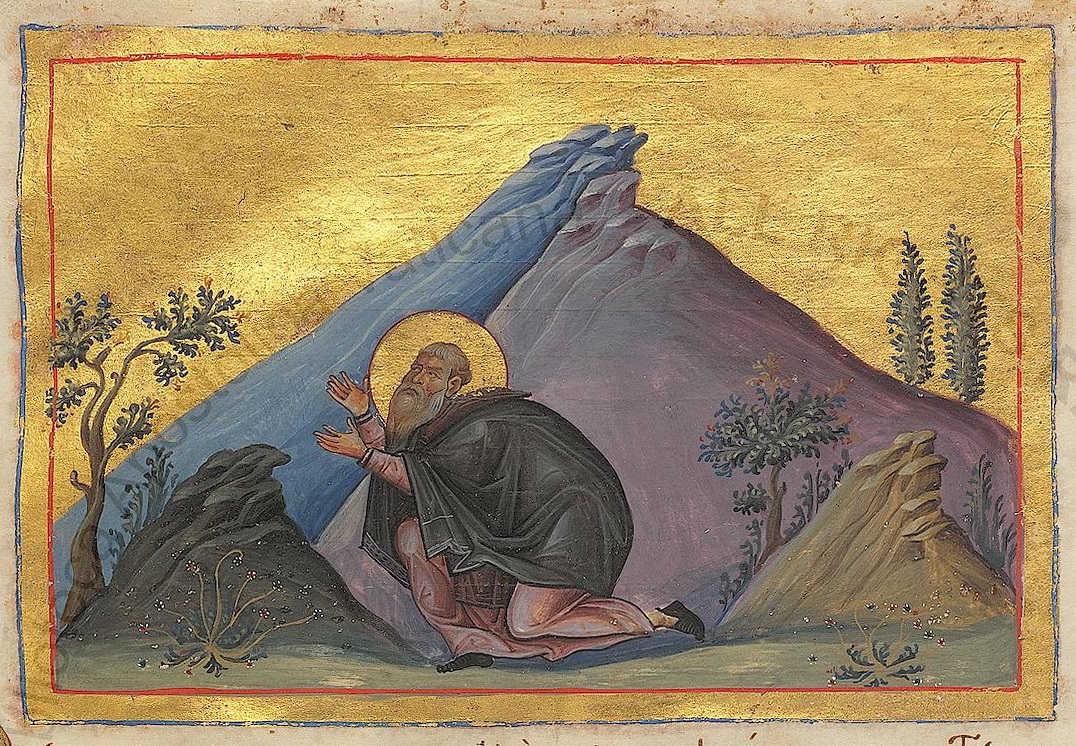
Hilarion is depicted as an aged monastic ascetic — grey-bearded, in the tunic and mantle of a desert father, often holding a scroll or blessing — his gaunt frame recalling the severity of his fasting. The stored image is the miniature from the Menologion of Basil II (Constantinople, c. 1000), which shows the saint standing frontally in monastic dress; the manuscript's calendar places him at 21 October.
Disputed questions
- Year of death. Jerome's chronology places the repose about 371; some reckonings give 372, the date also implied by the traditional age of eighty against a birth of 291. The difference is one of counting, not of substance.
- The relics. The double claim of Cyprus and Palestine was never resolved: the sources frankly record that Hesychius removed the body to Majuma while the Cypriots continued to venerate the place of burial, and each shrine reported its own miracles.
- Not to be confused with the several other saints named Hilarion commemorated on the same day — Hilarion, Bishop of Meglin (Bulgarian, †1164), Hilarion the Schemamonk of the Kiev Caves, and Hilarion, Metropolitan of Kiev — none of whom is this Hilarion, the fourth-century founder of Palestinian monasticism.
- Not to be confused, further, with the two abbots styled "Hilarion the New" precisely to distinguish them from this Hilarion, both of them iconodule confessors and both of them abbots of houses at or near Constantinople: Hilarion the New of Pelekete (March 28, †c. 754, under Constantine V) and Hilarion the New of Dalmatia (June 6, †845, under Leo V and Theophilos). The two "New" Hilarions are also constantly confused with each other; the day distinguishes them.
- Not to be confused with Hilary the Wonderworker (May 4), whose name is the distinct Greek Ἱλάριος and not Ἱλαρίων, though English and Slavic lists have often merged the two.