
Ilia Chavchavadze
The Holy and Righteous Ilia Chavchavadze, the Righteous of Georgia
Righteous · b. 27 October 1837, Qvareli in Kakheti — d. 30 August 1907, at Tsitsamuri near Mtskheta
Commemorated 20 July — Commemoration of Saint Ilia the Righteous
Ilia Chavchavadze (1837–1907) was the central figure of the Georgian national revival of the nineteenth century — poet, novelist, editor, historian, banker and public man — and the moving spirit behind the recovery of the Georgian language, the Georgian past, and the cause of the autocephaly of the Georgian Church, which had been abolished by the Russian Empire in 1811. He was assassinated on the road near Mtskheta on 30 August 1907, together with an attempt upon his wife Olga, by gunmen of the revolutionary left, and his widow asked that the killers be pardoned. The Georgian Orthodox Church glorified him in 1987 as Saint Ilia the Righteous (Ilia Martali), and keeps his memory on July 20, the feast of the Prophet Elijah, whose name he bore.

Kakheti, Tbilisi, Petersburg
Ilia was born on 27 October 1837 at Qvareli in Kakheti, of a family of the lesser nobility. His mother taught him his letters and his prayers, and from the age of eight he was schooled by a village archdeacon, Nikoloz Sepashvili; both his parents died while he was still a boy, and an aunt, Makrine, brought him up. He went on to a boarding school and then to the gymnasium at Tbilisi.
In 1857 he entered the faculty of law at the University of St Petersburg. What he did there was not chiefly law: he spent his time in the archives and libraries hunting Georgian manuscripts and reading Georgian history, in the conviction — which became the axis of his whole public life — that a people ignorant of its own past has no direction. Before completing the degree he left, in 1861, and went home.
The revival
The generation Chavchavadze led is known in Georgian history as the tergdaleulni, "those who drank the water of the Terek" — the students who had crossed the Caucasus to Russia and come back. Their programme was the reconstitution of a nation which the Empire's administration was steadily dissolving: the Georgian language, which was being displaced from the schools and the courts; Georgian letters, through the journals Sakartvelos Moambe and Iveria which he founded and edited; Georgian history and manuscripts, which he collected and had deposited in a repository; and the Georgian economy, through the Nobles' Land Bank, whose profits he directed to schooling and publication. He founded the Society for the Spreading of Literacy among Georgians, which built schools across the country. As a writer he produced the poems, the narrative verse and the prose fiction — The Hermit, Otaraant Widow, Is a Man a Human Being? — that every Georgian schoolchild since has read.
Two convictions of his are quoted to this day: that a nation which forgets its own history is like a beggar who does not know where he is going, and that a nation whose language is corrupted cannot long remain a nation.
The Church
The autocephaly of the Georgian Church, ancient and canonically established, had been suppressed in 1811, when the Church of Georgia was reduced to an exarchate of the Russian Synod with a Russian exarch, Slavonic gradually displacing Georgian in the services and Georgian antiquities being neglected or removed. Chavchavadze made the restoration of that autocephaly one of his central causes, and he pursued it as he pursued everything else — by documentation. He argued the case historically, publishing and defending the record of the Georgian Church's independence, and attacking the falsified and disparaging accounts of the Georgian past then in circulation. He did not live to see it: autocephaly was proclaimed in 1917, ten years after his death, and finally recognised by Moscow in 1943.
It is this that lies behind his glorification. He was not a churchman and made no claim to be an ascetic; he is honoured as a righteous layman whose public labour served the Church and the Christian people of Georgia, in the tradition by which the Orthodox Churches honour rulers, scholars and benefactors under that title.
Assassination and glorification
On 30 August 1907, travelling with his wife Olga from Tbilisi toward Saguramo, he was ambushed at Tsitsamuri near Mtskheta and shot dead; Olga was wounded. The killers belonged to the militant wing of the revolutionary movement, for whom Chavchavadze's national-liberal programme, his defence of property and his religion were all alike obstacles; the political responsibility has been argued over ever since. His funeral in Tbilisi was one of the great national gatherings of the age. Olga, who survived him, is remembered for having asked that the murderers be pardoned — an act her contemporaries read as the exact expression of her husband's own known readiness to forgive.
The Georgian Orthodox Church glorified him in 1987, under Patriarch-Catholicos Ilia II, as Saint Ilia the Righteous.
Feast and commemoration
July 20 (Old Calendar civil August 2), kept by the Georgian Orthodox Church and by the OCA on the feast of the Prophet Elijah. The commemoration is a modern one, dating from the glorification of 1987, and is observed with particular solemnity in Georgia, where Chavchavadze is a national as well as an ecclesiastical figure. He is named in the synaxis of the Georgian saints. The proper Georgian hymns are of recent composition and remain in copyright.
Hymns
Troparion — Tone 4
Thou didst love thy people with the love of Christ, and didst labour for their tongue, their memory and their Church as for thine own soul, O righteous Ilia; and when the bullets found thee on the road, thy blood cried not for vengeance but for pardon. Intercede with Christ God that our souls may be saved.
Original translation from the Georgian
Iconography
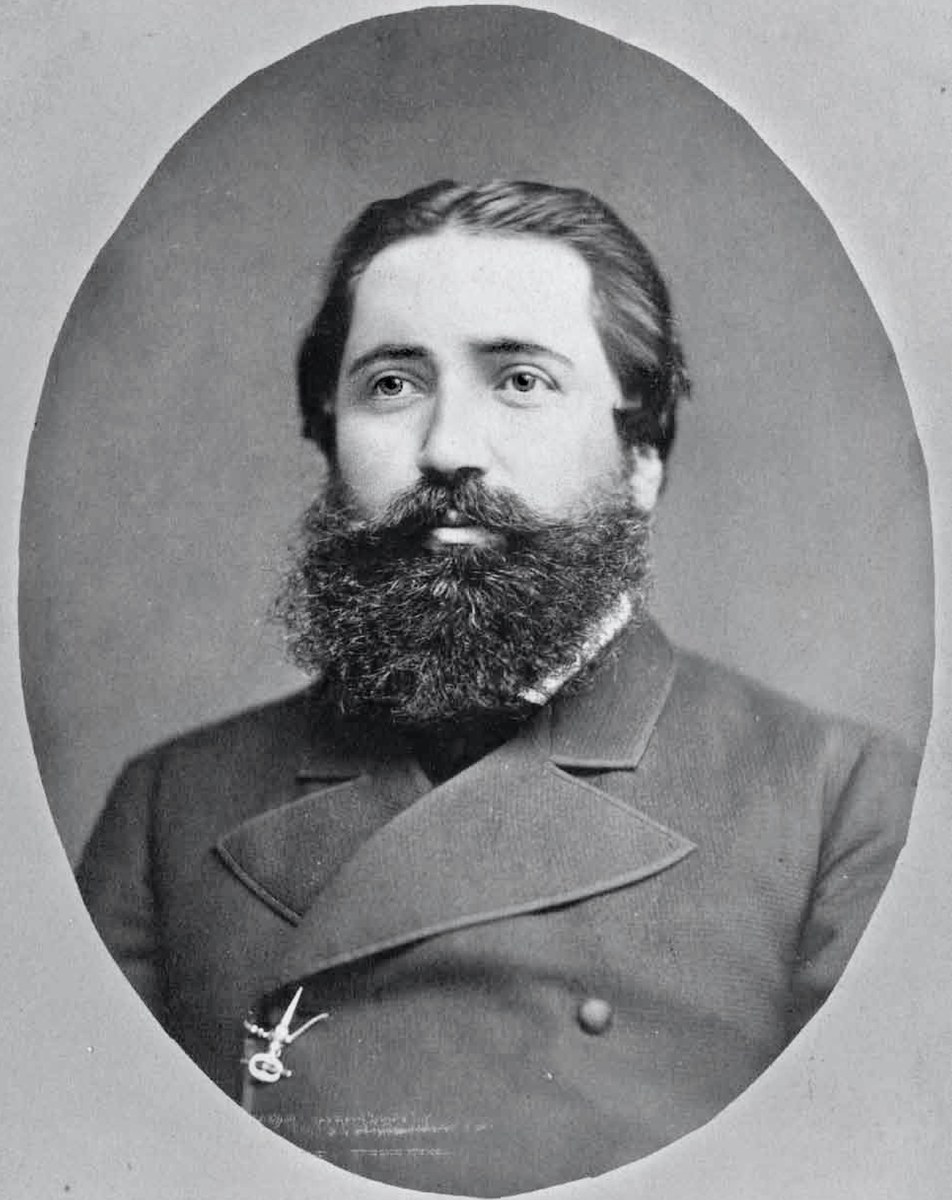
Ilia is painted in the modern Georgian manner as a layman-saint: bearded, in the dark frock coat and high collar of a nineteenth-century gentleman rather than in any ecclesiastical dress, holding in one hand a scroll or an open book — the sign of the writer and of the recovered Georgian letters — and often a cross in the other. Some icons place behind him the cathedral of Svetitskhoveli at Mtskheta, near the place of his death, or the Georgian alphabet worked into the border. He is regularly shown together with the other modern Georgian saints, and in the composite panels of the saints of Georgia. All such images are the work of living or recent iconographers; none may be reproduced, his glorification being of 1987 — but the §50 ruling admits his lifetime photograph, stored below as a labelled portrait.
The stored image is a late-19th-century photographic portrait, stored per the §50 ruling as a labelled portrait. A free-licensed painted icon remains the eventual want and is listed among the upgrade-wanted icons.
Disputed questions
- The date of the feast. He was killed on 30 August, but the Church keeps him on July 20. The most natural explanation is the Georgian custom of assigning a saint the day of his heavenly namesake: Ilia is Elijah, and July 20 is the Prophet's day. No source consulted states the reason explicitly, and it is given here as the probable one.
- "Martyr" or "righteous." The OCA calendar heads him "Martyr Ilia Chavchavadze of Georgia"; the Georgian Church's own title, and the one used here, is Ilia Martali, Ilia the Righteous. He was killed for political reasons rather than in odium of the faith, and the received Georgian title reflects that.
- The assassination. Responsibility has been attributed to Social-Democratic militants acting on their own, to a wider party decision, and — in some later Georgian argument — to the imperial security services. The question is historical and is not settled; this entry records that he was shot by gunmen of the revolutionary left and leaves the wider attribution open.