
Innocent of Irkutsk
Our Father among the Saints Innocent (Kulchitsky), first Bishop of Irkutsk, Wonderworker
Bishop · Wonderworker · b. c. 1680 — d. 1731
Commemorated 9 February — Uncovering of his relics; kept with the leavetaking of the Meeting, 26 November — Repose (1731); falls within the Nativity Fast
Innocent of Irkutsk (c. 1680–1731), in the world John Kulchitsky, was the first bishop of the Siberian see of Irkutsk and is honoured as a wonderworker and enlightener of Siberia. Educated at the Kiev Academy and appointed to lead the Russian ecclesiastical mission to Peking, he was refused entry by the Chinese and left to years of hardship and uncertainty on the Mongolian frontier; named bishop of Irkutsk in 1727, he governed his vast and impoverished diocese for barely four years, maintaining its schools and toiling amid extreme want until his early death. His incorrupt relics, discovered later in the century, made him the first canonised saint of Siberia; he is commemorated on November 26.

Origins and formation
The saint was born about 1680 into the noble family of Kulchitsky (Kolchitsky), of Polish descent, whose forebears had moved from Volhynia to the region of Chernigov in Little Russia. In baptism he was named John and was raised in piety. He studied at the Kiev Spiritual Academy, applying himself with particular diligence to eloquence in hope of one day preaching the word of God, and before completing his course was tonsured a monk with the name Innocent, in the cave of Saint Anthony near Kiev.
He was appointed a teacher at the Moscow Slavonic-Greek-Latin Academy, serving as prefect and professor of theology, and in 1719 was transferred to the Alexander Nevsky Lavra in Saint Petersburg, where he was made chief naval chaplain and, the following year, vicar of the Lavra.
The mission to China
On 14 February 1721 the hieromonk Innocent was consecrated bishop and appointed to head the Russian ecclesiastical mission to Peking. The Chinese government, however, refused to admit him: the Russian request had incautiously styled him "a great lord" (богдо), a title the Chinese reserved for the emperor alone, so that two such "great persons" could not, they said, be in the country at once. Compounded by the diplomatic blunders of the Russian envoy Raguzinsky and the intrigues of the Irkutsk archimandrite Anthony Platkovsky — who coveted the mission for himself — the affair dragged on for years. Innocent was left to wait, first at Selenginsk on the Chinese border and then at the Ascension Monastery near Irkutsk, in great deprivation: receiving no salary through an oversight of the Senate, he and his suite supported themselves by fishing and hired labour, and the bishop mended his own worn clothing.
Bishop of Irkutsk
By decree of the Holy Synod, Innocent was named in 1727 first bishop of the newly formed diocese of Irkutsk and Nerchinsk. His task was heavy: an immense and sparsely settled territory hard against the Chinese frontier, peopled by many nations — Buryats, Mongols and others — largely unenlightened by the Gospel, without roads and in poverty. Through the whole of it he received no proper funds and endured extreme want, yet he laboured tirelessly to order the diocese and strengthen its spiritual life. He maintained at the Ascension Monastery two schools, one for Mongol and one for Russian children, giving constant care to the choice of teachers and the provision of books and clothing for the pupils, and he governed his clergy and monasteries with firmness and paternal concern. Never robust in health, and often ill, he did not relax his ascetic labours, wearing a hair-shirt beneath his cassock and passing his nights in prayer in a cave outside the monastery wall.
Repose, relics and glorification
Worn out by hardship, Innocent reposed on 27 November 1731, having shepherded the flock of Irkutsk for little more than four years, and was buried in the Church of the Tikhvin Icon at the Ascension Monastery. When repairs decades later uncovered his body incorrupt, a stream of healings followed. After investigation, the Holy Synod, with the assent of the Emperor, glorified him on 1 December 1804, his sanctity confirmed by Alexander I on 28 October of that year; his memory was appointed for 26 November, the day of his repose, and he was proclaimed "Saint Innocent, first bishop of Irkutsk, wonderworker" — the first saint canonised of the whole Siberian land. The uncovering and enshrining of his relics is further commemorated on 9 February.
Feast and commemoration
November 26 (church date; Old Calendar civil December 9), the day appointed at his glorification for his repose, kept within the Nativity Fast by the Russian Church and the Orthodox Church in America. A second commemoration, of the uncovering of his relics, falls on February 9. On November 26 he is one of several Russian and Byzantine saints of the day, together with Alypius the Stylite and, in the Russian books, the dedication of the church of the Great-Martyr George at Kiev.
Hymns
Troparion — Tone 3
O most radiant lamp of the Church, who didst illumine this land with the rays of thy virtues, and by the many healings of those who come to thee in faith didst glorify God: we pray thee, O hierarch and father Innocent, guard this city by thy prayers from every evil and sorrow.
Original translation from the Slavonic
Kontakion — Tone 4
Let us the faithful praise with love the shepherd who bears the name of innocence, the preacher of the faith among the Mongol peoples, the glory and adornment of the flock of Irkutsk; for he is the guardian of the Siberian land and an intercessor for our souls.
Original translation from the Slavonic
Iconography
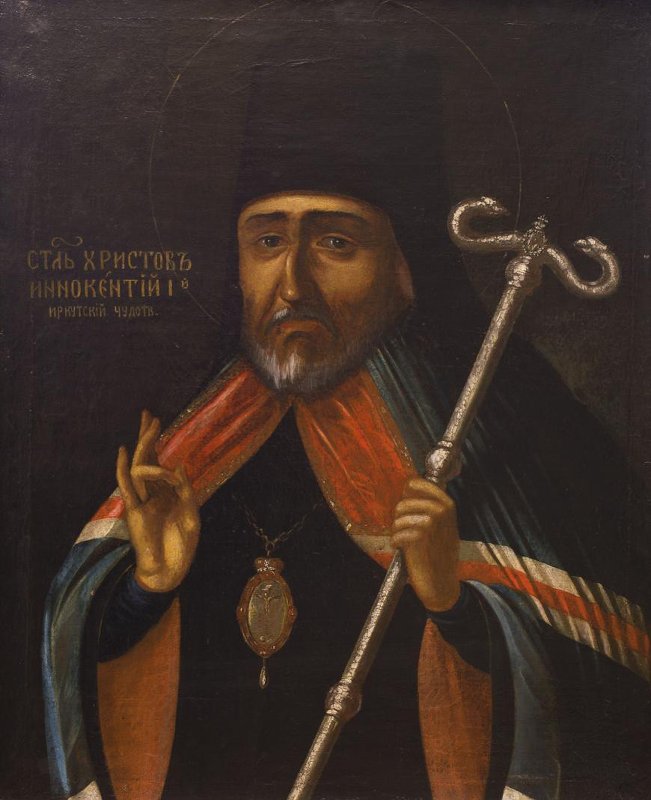
Innocent is depicted as a Russian hierarch of the eighteenth century, in episcopal vesture — omophorion and mitre — with a full greying beard, blessing with his right hand and holding the Gospel or a crozier; later icons often set him against the Ascension Monastery or the Siberian landscape. The stored image is an eighteenth-century portrait of the bishop, a work close to his own time.