
Innocent of Kherson
Our Father among the Saints Innocent (Borisov), Archbishop of Kherson and Taurida
Bishop · b. 15 December 1800, at Yelets in the province of Oryol — d. 25/26 May 1857, at Odessa
Commemorated 25 May — Repose at Odessa; kept in Russian and Ukrainian usage
Innocent (Borisov), Archbishop of Kherson and Taurida, was the most celebrated preacher of the Russian Church in the first half of the nineteenth century — often called the Russian Chrysostom — and the author of The Last Days of the Earthly Life of Our Lord Jesus Christ, a book that shaped Russian devotion to the Passion for a century. A priest's son from Yelets, he rose with startling speed through the theological academies of St Petersburg and Kiev, where as rector he reformed the teaching of theology and founded Воскресное чтение (Sunday Reading), the first popular religious weekly in Russia. As archbishop of the newest and most mixed diocese of the empire he set himself to restore the ancient Christian sites of the Crimea — Chersonesus, where St Vladimir was baptised, Inkerman, Bakhchisarai, Cape Fiolent — in a project he himself called a Russian Athos. During the Crimean War he stayed in his diocese, went into the bombarded lines at Sevastopol, and buried the dead; the exertions of the ruined post-war diocese finished him. He reposed at Odessa in May 1857, was canonised locally in 1997 and glorified for the whole Church in 2017, and his relics rest in the Transfiguration Cathedral at Odessa.

Yelets, Oryol and Kiev
Ivan Alekseyevich Borisov was born on 15 December 1800 at Yelets in the province of Oryol, the son of a priest of the town's cemetery church — the ordinary provincial clerical background from which the nineteenth-century Russian episcopate was almost wholly drawn. He passed through the district school at Voronezh and the Oryol Theological Seminary, from which he graduated in 1819, and then to the Kiev Theological Academy, where in 1823 he finished first in his course with the degree of Master of Theology.
He was tonsured a monk on 10 December 1823, made hierodeacon the same day, and ordained hieromonk on the 29th of that month — the whole monastic and priestly initiation compressed into three weeks, in the manner of the "learned monasticism" of the period, for which the habit was the gateway to an academic and hierarchical career rather than to the desert. He was at once sent to St Petersburg, as inspector and professor of the seminary and rector of the Alexander Nevsky school; by 1826 he was inspector and extraordinary professor of theology at the St Petersburg Theological Academy, and soon archimandrite. He was twenty-six.
Rector at Kiev: the reform of theological teaching
In 1830 he was appointed rector and professor of the Kiev Theological Academy, and it is here that his lasting influence on Russian church learning was exerted. Against the arid Latin scholasticism inherited from the eighteenth century — theology taught in Latin, by dictated theses, from Western handbooks — he lectured in Russian, in a vivid and rhetorical manner, and organised dogmatic theology around the history of salvation rather than around a chain of propositions. His method was contested in his own lifetime and he was more than once suspected of doctrinal looseness for it, but it carried the day. In 1837 he founded Воскресное чтение (Sunday Reading), a weekly of religious instruction for ordinary readers — the first of its kind in Russia and the model of a whole genre of periodical that followed.
Chigirin, Vologda, Kharkov
He was consecrated bishop of Chigirin, vicar of the Kiev metropolia, on 3 October 1836, while retaining the rectorship. In 1841 he was translated to Vologda and Ustyug, and at the end of the same year to Kharkov and Akhtyrka, where he remained until 1848 and was raised archbishop in 1845. The Kharkov years show the pattern of all his episcopates: the recovery of dilapidated or suppressed monasteries. He restored the Svyatogorsk (Holy Mountains) monastery on the Donets in 1844 — a great chalk-cliff monastery closed since Catherine's secularisations — and the houses at Akhtyrka and Totma, and opened a Bulgarian hospice at Odessa for the refugees of the Balkan wars.
Kherson and Taurida: the "Russian Athos" of the Crimea
On 24 February 1848 he became Archbishop of Kherson and Taurida, with his see at Odessa — a diocese barely two generations old, covering the newly annexed steppe and the Crimean peninsula, its population Russian, Ukrainian, Greek, Bulgarian, Armenian, Jewish and Tatar, and its Christian past almost entirely in ruins. Innocent's response was the most original work of his life. The Crimea, he argued, was holy ground for the Russian Church: the place of the exile and martyrdom of St Clement of Rome, of the Gothic and Greek bishoprics, of the cave monasteries of the Byzantine period, and above all of Chersonesus, where the Prince Vladimir was baptised. He set about reviving monastic life on the ancient sites — the Chersonesus monastery on the baptismal ground, the cave monastery of St Clement at Inkerman, the Dormition skete at Bakhchisarai, St George's at Cape Fiolent above Balaklava — and named the design a Russian Athos: a chain of sketes under a common rule, reoccupying the Christian topography of the peninsula. Several of the houses he founded or refounded survive.
The Crimean War
The Crimean War (1853–56) fell on his diocese with full force: Odessa bombarded by the allied fleet in 1854, the Crimea invaded, Sevastopol under siege for eleven months. Innocent did not leave. He is recorded travelling into the theatre of war repeatedly, entering the harbour and the lines at Sevastopol under fire, serving in the open air among the batteries, preaching to the soldiers, hearing confessions, and attending the wounded and the dying. His wartime sermons — plain, urgent and unrhetorical, quite unlike the polished academic preaching that had made his name — were among the most widely read things he wrote. He organised the reception of the wounded at Odessa and the care of the refugee population, and carried the Kasperov icon of the Mother of God in procession for the defence of the city, a devotion that has been kept at Odessa ever since.
Repose, relics and glorification
The war left the diocese wrecked, and the visitations by which he tried to repair it broke his health. He fell ill on the road and died at Odessa in the last days of May 1857, aged fifty-six, and was buried in the Transfiguration Cathedral at Odessa, the cathedral he had adorned. His collected works were published in six volumes in 1908 and were still being reprinted at the Revolution.
His cathedral was dynamited by the Soviet authorities in 1936 and rebuilt after 2000; in June 2007 his remains were translated to the lower church of the restored cathedral, where they are venerated. He was canonised as a locally venerated saint of the Odessa diocese in 1997, entered in the general calendar of the Russian Orthodox Church in December 2005, and glorified for veneration by the whole Church on 30 November 2017.
Writings
His name rests above all on Последние дни земной жизни Господа нашего Иисуса Христа (The Last Days of the Earthly Life of Our Lord Jesus Christ), a day-by-day narrative meditation on the Passion, harmonising the four Gospels and expounding them with a novelist's attention to place and motive; it went through edition after edition and is still read. Beside it stand a study On the Beginning of Christianity in Poland, a Dogmatic Collection, and a large body of sermons, including the Crimean war-time preaching. His descriptions of the Crimean holy places also belong to his literary work and were part of the propaganda of the "Russian Athos" scheme.
Feast and commemoration
May 25 (church date; New Calendar civil May 25; Old Calendar civil June 7), kept in the Russian and Ukrainian calendars on a day whose principal commemoration is the Third Finding of the Head of the Forerunner. Because Pascha falls between April 4 and May 8, the day always stands within the Pentecostarion. His memory is kept with particular solemnity at Odessa, where his relics lie in the Transfiguration Cathedral, and in the Crimean monasteries he refounded. A proper service was composed for his glorification; it exists only in modern texts under copyright and is not reproduced here.
Hymns
Troparion
A rule of faith and an image of meekness, a teacher of abstinence hath the truth of thy deeds shown thee to be unto thy flock: therefore hast thou gained the heights by humility, and riches by poverty. O father and hierarch Innocent, intercede with Christ God that our souls may be saved.
Original translation from the Slavonic
Iconography
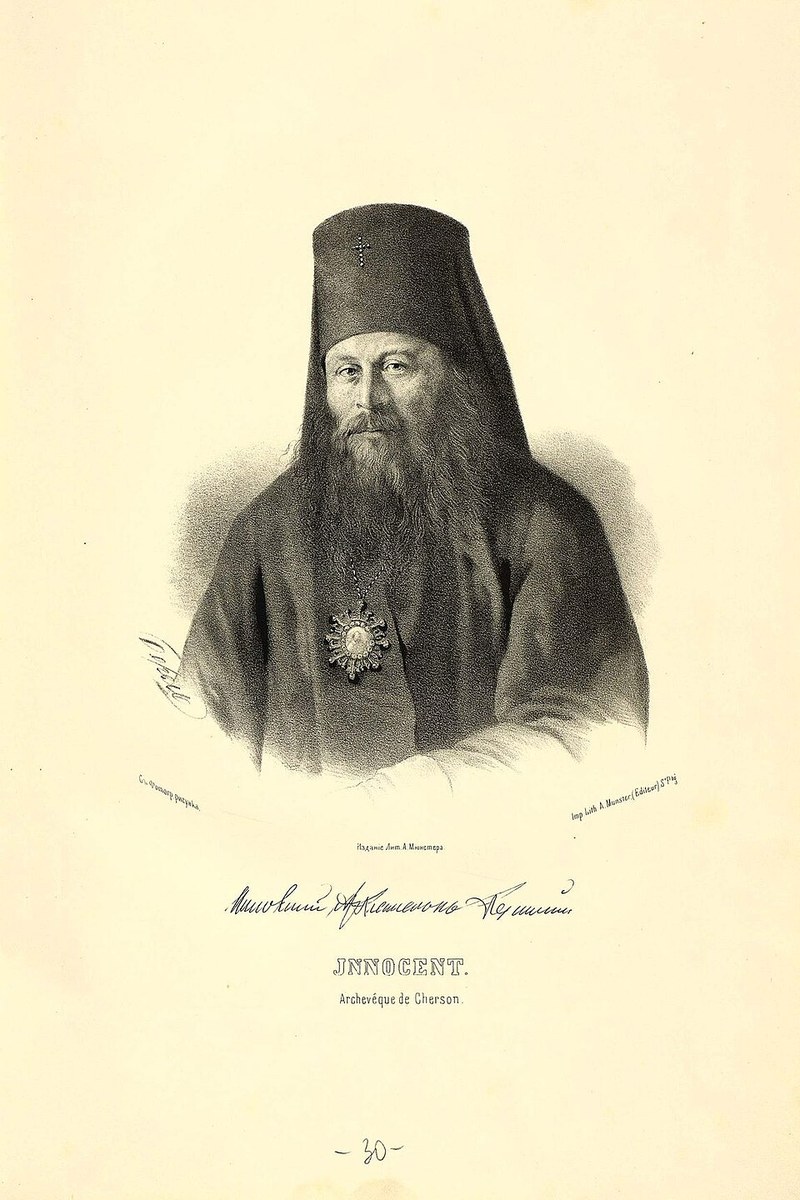
Innocent belongs to the class of modern Russian hierarch-saints whose iconography was created after their glorification and therefore, in his case, after 1997: he is painted in the standing or waist-length hierarch type, in the sakkos, omophorion and mitre or in the black klobuk of a monastic bishop, with the Gospel in his left hand and the right raised in blessing, his features taken from the nineteenth-century portraits — a long straight nose, a full dark beard, deep-set eyes. Icons of him are common at Odessa and in the Crimean monasteries, and often show the Transfiguration Cathedral or the Chersonesus basilica in the background, or a scroll with a line from his Passion-book. All of these are living artists' works and none may be reproduced here.
What can be stored is the pre-glorification portrait tradition. The image kept for this entry is a lithograph of 1864–69 by A. Münster of St Petersburg, plate 35 of the Portrait Gallery of Russian Celebrities (Портретная галерея русских деятелей), digitised from the Russian State Library copy: the archbishop half-length in the monastic klobuk and mantle with a jewelled panagia or star of an order at his breast, the plate captioned in Russian and French — Иннокентій Архіепископъ Херсонскій / INNOCENT. Archevêque de Cherson — with his autograph reproduced beneath. It is a portrait, taken from the life within living memory of the man, not an icon, and it is stored and labelled as such; it is also the source from which the modern icon-painters' likeness derives (source, public domain, pd-old-work).
Disputed questions
- The date of repose, and the calendar date. The Russian Church keeps his memory on 25 May (civil 7 June in the present offset), while most accounts of his life give his death as 26 May 1857, and some as the 25th. The discrepancy of a day between a dies natalis and a fixed calendar commemoration is common and is not resolved here; both dates are recorded above.
- "The Russian Chrysostom." The epithet is traditional and was applied to him in his lifetime and after, but it has been applied to other Russian preachers as well, and it should be read as a tribute to his reputation as an orator rather than as a fixed title.
- The theological suspicion. His break with the Latin scholastic method attracted accusations of unsoundness from conservative colleagues, and in the 1830s and 1840s these were pressed at Kiev and in St Petersburg. No censure followed, and his glorification more than a century and a half later settled the matter; but the episode is part of the record and is sometimes suppressed in hagiographical accounts.
- Extent of the veneration. Between 1997 and 2017 he was a locally venerated saint, and the sequence of acts (1997 local canonisation, 2005 entry in the calendar, 2017 general glorification) is given differently in different sources. The jurisdictions field here records Russian and Ukrainian usage; he is not carried in the Greek or Antiochian calendars, nor in the day-lists of the Orthodox Church in America.